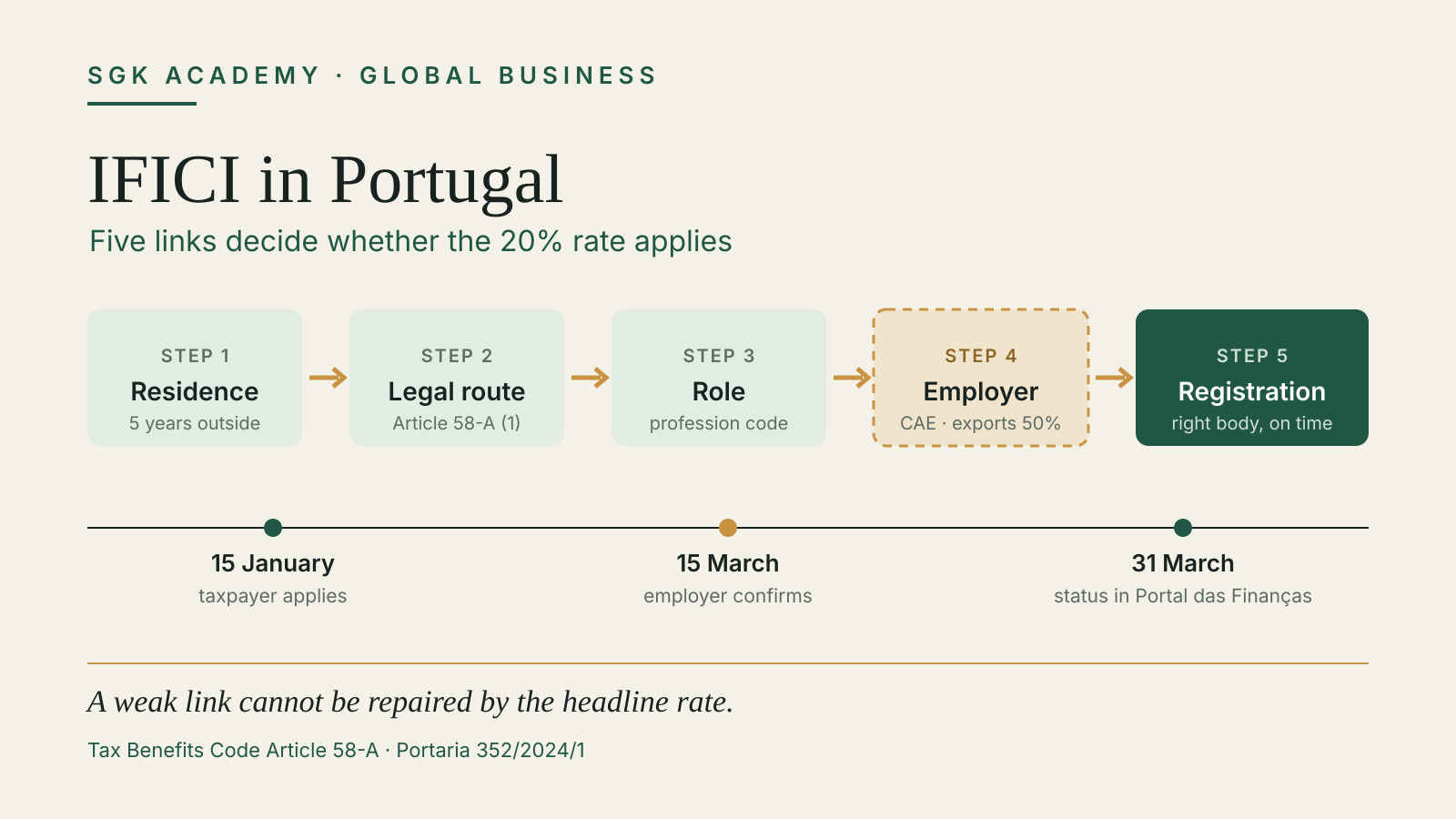
Portugal’s Incentive for Scientific Research and Innovation, usually shortened to IFICI, is a narrowly defined tax regime rather than a blanket replacement for the former non-habitual resident scheme. A person can satisfy the residence test and still miss IFICI because their role, employer or evidence does not fit one of the statutory routes.
This guide turns the current rules into a document-first check. It is educational information, not a personal tax opinion. The legislation and application procedure were checked against official Portuguese sources on 27 October 2026.
The benefit in one sentence
Under Article 58-A of the Tax Benefits Code, qualifying net employment income and self-employment income in categories A and B can be taxed at a special 20% IRS rate for up to 10 consecutive years, starting with the year in which the person registers as a Portuguese tax resident. A taxpayer may instead choose aggregation under the ordinary rules.
The 20% rate does not automatically apply to every source of income. The income must arise from a qualifying activity, and the taxpayer must keep satisfying the annual conditions. Other income, deductions and international tax questions need a separate analysis.
Start with the three personal tests
Before studying job titles or employer certificates, check three threshold questions.
- Will you be a Portuguese tax resident? IFICI is for people who become resident under the Portuguese IRS rules.
- Were you non-resident in Portugal throughout the previous five years? Article 58-A requires a five-year look-back.
- Are you excluded by a previous regime? The law excludes a taxpayer who benefits or previously benefited from the non-habitual resident regime, and someone who chose the return-to-Portugal rules in Article 12-A of the IRS Code. IFICI may be used only once.
This is why a move date matters. Keep tax-residence certificates, leases, travel records and foreign returns that support the five-year history. A registration form alone does not prove where you were resident.
When Portuguese residence starts
Article 58-A points to the residence rules in Article 16 of the IRS Code. A person is resident for a year if they spend more than 183 days in Portugal, consecutive or not, in any 12-month period that starts or ends in that year. A person who stays for less time is still resident if, on any day of that period, they have a home in Portugal in conditions that suggest they intend to keep and occupy it as their habitual residence. Any full or partial day that includes an overnight stay counts as a day of presence.
Article 16 also says that someone who meets either test becomes resident from the first day of their stay, unless they were resident on any day of the previous year. That first day fixes the year of residence, and the year of residence fixes both the 15 January application deadline and the start of the 10-year window.
Then identify the exact qualifying route
The law lists several routes. They are not interchangeable.
- teaching in higher education or scientific research in the specified national science and technology system;
- qualified jobs or corporate-office roles linked to contractual benefits for productive investment;
- listed highly qualified professions performed for certain investment-supported companies, or for listed industrial and service businesses that meet the export test;
- other qualified roles in entities recognised by AICEP or IAPMEI as relevant to the national economy;
- research and development roles whose personnel costs qualify under the business R&D incentive rules;
- jobs or corporate-office roles in entities certified as startups; and
- activities in the Azores or Madeira where regional legislation defines the route.
For the highly qualified profession route, Portaria 352/2024/1 lists professions such as certain senior managers, physical-science and engineering specialists, doctors, higher-education teachers and ICT specialists. The same regulation also sets minimum qualification evidence: level 8, or level 6 plus three years of documented professional experience, for the listed professional routes. Regulated professions still have to meet their separate licensing rules.
Annex I of the Portaria lists the qualifying professions by their code in the Portuguese classification of occupations:
| Code | Profession group |
|---|---|
| 112 | Managing directors and chief executives of companies |
| 12 | Administrative and commercial managers |
| 13 | Production and specialised services managers (except 1349) |
| 21 | Science, mathematics and engineering professionals (except 216) |
| 2163.1 | Industrial product or equipment designer |
| 221 | Medical doctors |
| 231 | University and higher-education teachers |
| 25 | Information and communication technology (ICT) professionals |
A familiar job title is not enough. The Portuguese occupation code, the work actually performed and the employer’s status all need to point to the same legal route.
Why the employer can decide the answer
One of the most commonly misunderstood routes combines three moving parts:
- a highly qualified profession from the official list;
- employment by a business whose main activity has an eligible Portuguese CAE code; and
- an export ratio of at least 50% in the year the person starts, or in either of the two preceding years.
The regulation’s CAE list includes extractive industries, manufacturing, information and communication activities, physical and natural science R&D, higher education and specified human-health activities. But an eligible CAE code alone does not satisfy the route. The export and profession conditions still matter.
For this branch, the employer must confirm through its reserved Tax Authority area that the requirements are met and that the employee performs the highly qualified profession. The company is also required to give the taxpayer a declaration supporting the applicable activity conditions.
If you are comparing job offers, ask the employer for its proposed IFICI route in writing. “We are a technology company” is not the same as confirmation of the CAE code, export test and your profession code.
The registration deadline
The normal application deadline is 15 January of the year after the year in which you become Portuguese resident. The application goes to the body responsible for your route:
- FCT for the specified higher-education and research activities;
- AICEP for specified productive-investment roles;
- the Tax Authority for the listed highly qualified profession branch;
- AICEP or IAPMEI for recognised activities relevant to the national economy;
- ANI for qualifying business R&D personnel; or
- Startup Portugal for jobs and corporate-office roles in certified startups.
The official body checks the activity requirements; the Tax Authority checks the other legal requirements. The Tax Authority is scheduled to make the registration status available in the taxpayer’s Portal das Finanças account by 31 March.
Late registration does not reset the 10-year clock. Article 58-A says that a late application takes effect from the year of registration and only for the remaining part of the original statutory period. Treat 15 January as a real planning deadline, not as optional administration.
The annual IFICI calendar
The Portaria sets a fixed sequence of dates for each year. For the highly qualified profession branch, the employer has its own deadline inside that sequence.
| By | What happens |
|---|---|
| 15 January | The taxpayer applies to the responsible body, or reports changes and loss of eligibility |
| 15 February | FCT, AICEP, IAPMEI, ANI and Startup Portugal send applications, changes and their activity checks to the Tax Authority |
| End of February | The Tax Authority makes the data for employer confirmation available |
| 15 March | The employer confirms the profession and company conditions in its Portal das Finanças area |
| 31 March | The Tax Authority shows the registration status, and the taxpayer can download proof |
As an illustration, a founder who becomes resident during 2026 applies by 15 January 2027 and checks the status by 31 March 2027. If the registration succeeds, the 20% rate can run for 2026 to 2035. The Portaria applies to people who became resident from 1 January 2024, and residents of that first year had a one-off later deadline of 15 March 2025.
Evidence to gather before applying
The regulation names several documents that may be required:
- an employment contract where the qualifying activity is a job;
- a current permanent commercial certificate for a member of a corporate body;
- a grant agreement for scientific research;
- evidence of the applicable academic qualifications;
- the employer’s declaration for relevant routes; and
- any further documents requested by the reviewing body.
Create one evidence folder for the move. Include the job description signed by the employer, the profession and CAE codes relied on, the employer certificate, proof of qualifications and experience, prior residence evidence, the submitted application and the final registration proof.
This file matters after approval too. The taxpayer must be able to show the qualifying activity, the related income and the other legal conditions whenever the Tax Authority asks.
What happens if the role changes
IFICI is checked year by year. The taxpayer must be Portuguese resident at some point in the year and continue earning qualifying income from an activity listed in the law. A new qualifying activity can start within six months after the previous one ends without breaking the statutory continuity rule.
A change of responsible body or of the company that must certify the conditions requires a new registration request. Other changes or the loss of eligibility must be reported to the responsible body by 15 January of the following year.
A gap does not always end the regime. Article 58-A allows a taxpayer who did not use IFICI in one or more years of the 10-year period to resume it in a later year of that same period, from the year in which they are resident again and earn qualifying income again. The lost years are not added back at the end.
One exclusion is easy to miss: the regime does not apply to income from jobs covered by Article 22, paragraph 2, subparagraph c of the Investment Tax Code. If the employer relies on investment-support benefits, ask which provision it uses.
Do not assume that a new employer inherits the old approval. Re-run the route, employer and evidence checks before signing or changing roles.
A practical pre-move checklist
Use this sequence before relying on IFICI in a salary or cash-flow forecast.
- Write down the planned Portuguese residence date and the five complete preceding years.
- Rule out the non-habitual resident and Article 12-A exclusions.
- Name one specific Article 58-A route; do not write only “tech worker” or “researcher”.
- Match the role to the official profession code where the route requires one.
- Get the employer’s CAE, investment, export, startup or recognition evidence relevant to that route.
- Identify the correct application body.
- Calendar the 15 January deadline and the employer’s separate confirmation steps.
- Keep the application receipt and check the status in Portal das Finanças.
- Model the 20% rate only on the net categories A and B income that arises from the qualifying activity.
- Ask a Portuguese tax adviser to review foreign income, social security, deductions, marital filing and treaty questions separately.
For broader move planning, pair this with SGK Academy’s company-jurisdiction decision framework and guide to permanent-establishment risk. Incorporating abroad does not, by itself, settle where a founder is resident or where work is taxed. If you also plan to set up a Portuguese company, the Portugal entry in our jurisdictions directory collects the formation and registry links.
The useful way to think about IFICI
IFICI is best treated as an evidence chain:
person → residence history → legal route → role → employer conditions → application body → annual qualifying income.
A weak link cannot be repaired by the headline 20% rate. Confirm the chain before committing to a move, and keep the supporting records for every year in which the regime is claimed.
Questions about IFICI Portugal
Is IFICI available to every new Portuguese tax resident?
No. The five-year non-residence test is only the starting point. The person’s activity and, for several routes, the employer’s status must also satisfy Article 58-A.
Does a technology job automatically qualify?
No. A role may need to match an official profession code, and the employer may need the right CAE activity, investment status or export record. The applicable route should be identified and documented.
What happens if the 15 January deadline is missed?
Late registration can still take effect from the year of registration, but only for the remainder of the original 10-year period. It does not start a fresh 10-year term.
Is the 20% rate applied to all income?
No. Article 58-A applies the special rate to qualifying net category A and B income from the eligible activity. Other income and filing questions require their own analysis.
Sources
- Portuguese Tax Authority: Tax Benefits Code, Article 58-A (Incentive for Scientific Research and Innovation), added by Law 82/2023 of 29 December; reviewed 27 October 2026.
- Portuguese Tax Authority: IRS Code, Article 16 (Residence), reviewed 27 October 2026.
- Diário da República: Portaria 352/2024/1 of 23 December, application procedure, profession codes and CAE list; reviewed 27 October 2026.