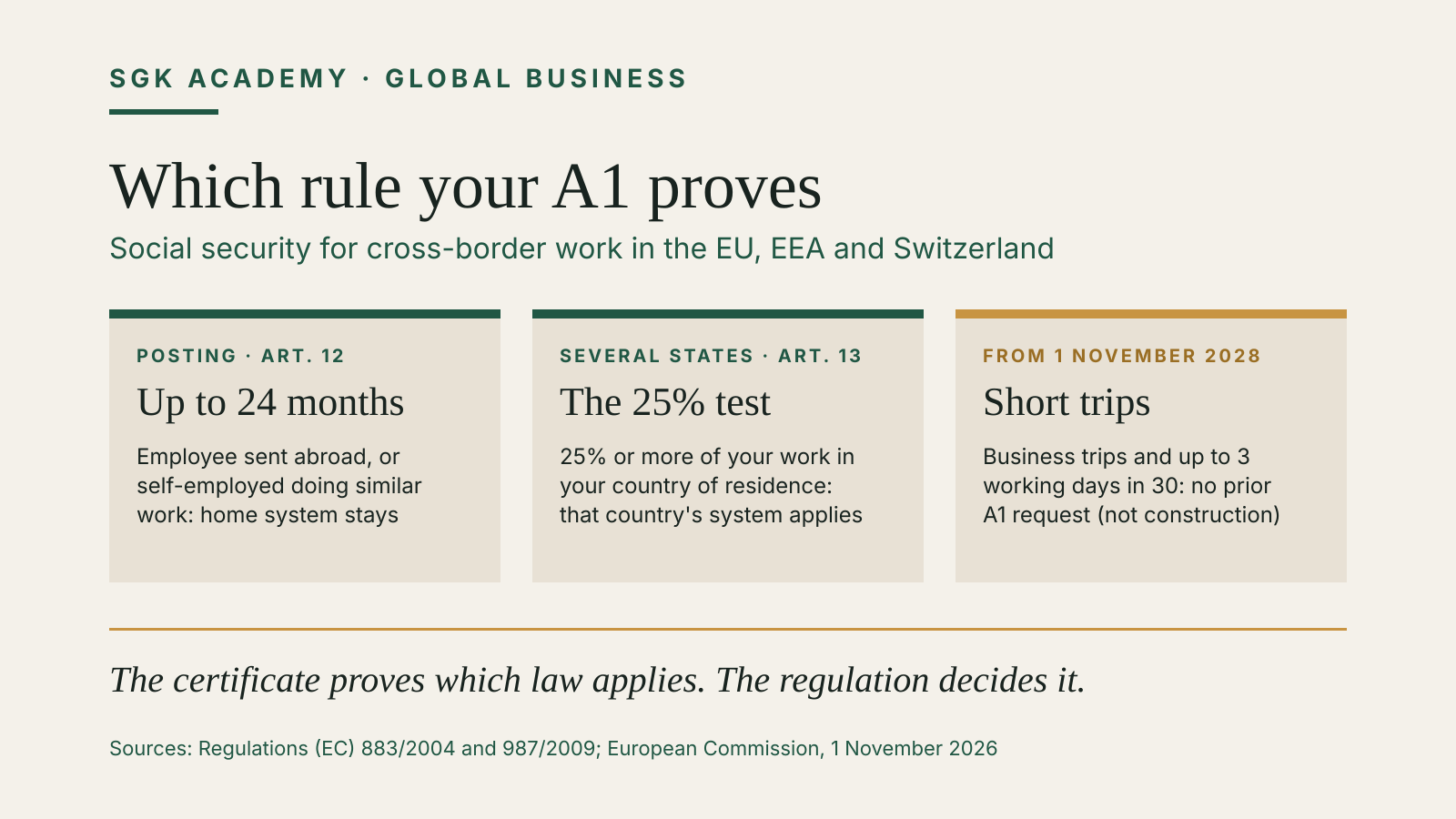
An A1 certificate (formally the Portable Document A1, or PD A1) proves which country’s social security system covers you while you work in another EU country, Iceland, Liechtenstein, Norway or Switzerland. You need one whenever your work crosses a border but your contributions should stay in one system: an employee sent abroad for up to 24 months, a self-employed person doing similar work abroad for up to 24 months, or anyone who normally works in two or more countries.
It is free, and it is issued by the social security institution of the country whose rules apply, not the country you travel to.
The certificate does not decide anything by itself. The rules in Regulation (EC) No 883/2004 decide which country’s legislation applies; the A1 is the evidence that a labour inspector, a client or a foreign social security office can check. A revision of those rules entered into force on 1 November 2026, and most of its changes to postings and A1 requests apply from 1 November 2028. Both sets of rules are covered below.
Checked against EUR-Lex, the European Commission, GOV.UK and national social security institutions on 6 November 2026. This explains the coordination rules; it is not advice on any individual case.
Find your situation first
Before you look for a form, find which rule covers you. The form, the issuing office and the time limit all follow from this.
| Your situation | Rule that decides | Which country’s system applies | Who applies for the A1 |
|---|---|---|---|
| Employee sent by an employer to work temporarily in another country | Article 12(1), Regulation 883/2004 | The sending country, if the anticipated duration is 24 months or less and you are not replacing another posted person | The employer, in the sending country |
| Self-employed person doing similar work temporarily in another country | Article 12(2) | The home country, if the anticipated duration is 24 months or less | You, in your home country |
| Employee who normally works in two or more countries, including working from home in one | Article 13(1) and Article 14(8), Regulation 987/2009 | The country of residence if you do a substantial part (25% or more) of your work there; otherwise the employer’s country | You or your employer, to the institution in your country of residence |
| Self-employed person who normally works in two or more countries | Article 13(2) | The country of residence if you do a substantial part of your activity there; otherwise the country where the centre of interest of your activities is | You, to the institution in your country of residence |
| Employed in one country and self-employed in another | Article 13(3) | The country where you are employed | You, to the institution in your country of residence |
| Moving to work in another country with no end date | Article 11(3)(a) | The country where you work; no A1, you register there | Nobody; you join the host system |
Two words in that table do most of the work. “Anticipated” means the expected length at the start, not how long the assignment eventually lasted. “Normally” separates a one-off assignment from a pattern: a designer who spends every Thursday at a client in another country is not on a series of postings, but working in two states.
Postings: the 24-month rule and what it requires
A posting keeps you in your home system while you work abroad, which saves a short assignment from starting and stopping contributions in a second country. Article 12 gives that result only on conditions, and the Commission’s practical guide on applicable legislation explains them:
- The employer must normally carry out its activities in the sending country. A letterbox company that only hires and posts staff does not qualify.
- A direct relationship must continue. The posted employee keeps working on behalf of the employer that sent them throughout the posting.
- No replacement chains. Under the current text, a posted worker may not be sent to replace another posted person.
- A pause between postings. The practical guide says a fresh posting of the same worker, by the same employer, to the same country cannot be authorised until at least two months after the previous one ended.
For the self-employed, the Your Europe page on social security cover abroad adds that the work abroad must be similar to the work at home, that you must already have worked as self-employed in the home country (it notes the required period varies and can be as little as two months), and that you must be able to resume the activity there when you return. In practice that means keeping your registration, your premises or equipment and your clients at home while you are away.
If the assignment is expected to run past 24 months, the A1 under Article 12 is not available. You either join the host country’s system or ask both countries for an exception under Article 16 of Regulation 883/2004, which needs the agreement of both authorities and must be in your interest.
Working in two or more countries: the 25% test
This is the rule that catches founders and remote employees, because it applies to a normal week, not a trip. Article 14(8) of Regulation 987/2009 says a “substantial part” of an activity is a quantitatively substantial part, not necessarily the major part. For an employee the indicators are working time and/or remuneration; for a self-employed person, turnover, working time, number of services and/or income. A share below 25% indicates that the substantial part is not in that country, and Article 14(10) says institutions assess the situation projected for the next 12 calendar months.
The Court of Justice tightened this for employees in a judgment of 4 September 2025 (ECLI:EU:C:2025:662). A worker who did 22% of his employed activity in his country of residence was not subject to that country’s legislation, and the Court held that other factors cannot make up for a share below 25% of working time and/or remuneration.
A worked example: one employer, three home-working patterns
The figures below are an illustration we built from the rules, not a ruling. The employee lives in Belgium and works for one company registered in the Netherlands, on a five-day week, with pay that does not vary by location. Both countries signed the cross-border telework framework agreement described below with effect from 1 July 2023, according to the list kept by Belgium’s Federal Public Service Social Security.
| Pattern over the next 12 months | Share of working time in Belgium | Substantial part in Belgium? | Default result under Article 13(1) | With a telework framework request |
|---|---|---|---|---|
| 1 day a week at home in Belgium | 1 ÷ 5 = 20% | No (below 25%) | Dutch legislation, as the employer’s country | Not needed; Dutch legislation already applies |
| 2 days a week at home | 2 ÷ 5 = 40% | Yes | Belgian legislation, as the country of residence | Employer and employee can jointly ask for Dutch legislation, because telework is under 50% |
| 3 days a week at home | 3 ÷ 5 = 60% | Yes | Belgian legislation | Not available; telework is 50% or more |
The middle row is where most hybrid workers sit, and where the outcome turns on a request rather than on the default rule. The framework agreement, signed under Article 16 of Regulation 883/2004, lets an employer and employee ask for the employer’s country’s legislation when cross-border telework in the country of residence is below 50% of total working time. Belgium’s page sets out three conditions: the employee lives in a different country from the employer’s registered office or place of business, telework in the residence country is less than 50%, and both employer and employee consent. The EURES summary adds that it does not cover the self-employed, that both countries must be signatories, and that an agreement under it runs for up to three years and can be renewed. The United Kingdom has indicated it will not sign.
Two practical points follow from the example. First, the 40% case does not resolve itself: without a request, the Belgian system applies, and the Dutch employer has Belgian obligations. Second, the test looks forward 12 months. A team that moves from one home day to two in the middle of the year should reassess when the pattern changes, not wait for the anniversary of the last certificate.
The same test for a self-employed founder
A freelance consultant resident in Portugal expects, over the next 12 months, to work 90 days at home for Portuguese clients and 130 days on site for clients in Spain and France, with 30% of turnover coming from the Portuguese clients. Working time in Portugal is 90 ÷ 220 = 41%, and turnover is 30%. Both indicators reach 25%, so under Article 13(2)(a) the Portuguese system would normally apply to all of the consultant’s self-employed activity. If both shares were below 25%, the institution would look instead for the centre of interest of the activities under Article 13(2)(b). Again, this is an illustration: the institution in the country of residence makes the determination, and for the self-employed Article 14(8) lets it weigh several indicators in an overall assessment.
The procedure for this case is in Article 16 of Regulation 987/2009: you tell the designated institution in your country of residence, it makes a provisional determination without delay and informs the other countries involved, and the determination becomes definitive if none of them disputes it within two months.
What changes from 1 November 2028
The revision adopted by the European Parliament on 7 July 2026 and by the Council on 28 September 2026 entered into force on 1 November 2026. The Commission says most of the changes to applicable legislation and prior notification apply from 1 November 2028, to give countries time to adapt their systems. Until then, the current text above applies.
| Point | Rule today | From 1 November 2028 |
|---|---|---|
| Telling the authorities before a posting | Employer or self-employed person informs the competent institution, “whenever possible in advance” (current Article 15(1), Regulation 987/2009) | Must inform and request the A1 before the activity starts; the institution issues the A1 or an automatic acknowledgement of receipt (Council text PE-CONS 29/26) |
| Business trips | No separate category | No prior notification or A1 request needed for a business trip |
| Very short activities | No exemption | No prior notification or A1 request for activities of no more than three consecutive working days within 30 consecutive days, except in construction |
| Cover before posting | A worker recruited to be posted must be subject to the sending country’s legislation immediately before starting (current Article 14(1), Regulation 987/2009); no minimum period is written in | At least three months under the sending country’s legislation for a worker recruited to be posted, and at least three months of prior activity for the self-employed (PE-CONS 29/26, new Article 14(1) and (3)) |
| Replacement | A posted worker may not replace another posted person | If a posted person does not complete the work and is replaced, the replacement stays in the home system as long as the combined duration of all persons in the host country does not exceed 24 months (PE-CONS 29/26) |
| Gap after a 24-month posting | Two months, under the practical guide | At least two months before Article 12 can apply again to the same person in the same country (PE-CONS 29/26, new Article 14(1a)) |
The new definition of a business trip in the Council text is narrow: a temporary activity, limited in time and related to the business interests of the employer or of the self-employed person, that excludes providing services or delivering goods but includes attending business meetings, cultural and scientific events, conferences and seminars, or receiving training. A consultant who flies to Munich to deliver a paid workshop is providing a service. The same consultant attending a trade fair to meet prospects is on a business trip.
Read the change carefully: the exemption removes the duty to notify in advance and request an A1. It does not change which country’s legislation applies. The same Council text also states that a failure to notify does not automatically change the applicable legislation, which is decided under Title II of Regulation 883/2004.
Where to apply: four countries compared
The application always goes to the country whose system will continue to apply. The routes below come from each institution’s own page; other countries have their own portals, which Your Europe links to.
| Your home system | Who issues the A1 | How you apply | What the institution says about timing |
|---|---|---|---|
| United Kingdom | HMRC | Employees: form CA3822, online, after the employer has confirmed eligibility once with form CA3821. Self-employed: form CA3837, online | Not more than 12 months in advance |
| Ireland | Department of Social Protection, International Postings | Welfare Partners platform, after registering for ROS and downloading a DSP sub-certificate | At least four weeks before the work abroad starts |
| Germany | Your statutory health insurer; Deutsche Rentenversicherung if you are not statutorily insured; the professional pension schemes’ association for their members; DVKA for multi-state cases | Electronically only since 1 January 2025, through certified payroll software or the SV-Meldeportal | Paper and fax applications are no longer accepted |
| Netherlands | Sociale Verzekeringsbank (SVB) | Online through My SVB with DigiD, or by paper form | Paper replies within 8 weeks; postings over 2 years need extra checks |
Some details are worth knowing before you start. The SVB says employees normally cannot apply for themselves unless they work in two or more countries, and that most countries’ inspectorates will also accept a copy of the application while the certificate is pending. HMRC asks self-employed applicants whether they will keep their UK business going while abroad, such as keeping the office, equipment, registration or advertising, because that is how the “similar activity” and “normally self-employed” conditions are checked. In Germany the issuing body depends on how you are insured, so a privately insured founder applies to the pension insurer, not to a health insurer.
The UK after Brexit
The UK still issues and accepts A1 certificates, now under the social security coordination protocol in the UK–EU Trade and Cooperation Agreement and the separate agreements with the EEA states and Switzerland. HMRC’s guidance for people going from the UK to work in the EU lists the same core cases: temporary work for up to 2 years for a UK employer, similar self-employed activity for up to 2 years, and working in the UK and one or more EU countries at the same time.
Two differences matter for a cross-border team. The 2028 revision amends the EU regulations, not the UK–EU protocol, so do not assume its business trip exemption covers work between the UK and the EU; follow HMRC’s guidance for those trips. And the UK has indicated to Belgium, the depositary, that it will not sign the telework framework agreement, so a UK–EU hybrid worker cannot use it.
HMRC also notes that the certificate is not a work permit. A UK citizen working in most EU countries needs separate permission to work, which an A1 does not give.
Questions people ask
Do I need an A1 certificate for a business trip?
Under the rules that apply today, the coordination regulations have no exemption based on the length or purpose of a trip: Article 12 covers any temporary work abroad for the sending employer. From 1 November 2028, the revised rules say you do not need to notify in advance or request an A1 for a business trip, or for any activity of up to three consecutive working days within 30 days outside construction. Until then, check the practice of the country you are visiting and apply when in doubt; the certificate is free.
Is the A1 the same as a European Health Insurance Card?
No. The A1 shows which country’s contributions apply. The European Health Insurance Card covers needed healthcare during a temporary stay. Your Europe advises posted workers to carry an EHIC, and to request a Portable Document S1 instead if they move their residence to the host country.
Can I get an A1 for working remotely from another country?
It depends on the pattern. Occasional remote work during a temporary stay can be a posting under Article 12. A regular pattern of working from home in your country of residence is work in two or more states under Article 13, where the 25% test and, between signatory countries, the telework framework agreement apply. A permanent move with all work done from the new country is not covered by an A1 at all.
What if the assignment runs longer than planned?
Your Europe says that an extension beyond 24 months is possible only by agreement between the authorities of both countries and only if it is in your interest, and that the request must reach the institution that issued the A1 before it expires. Otherwise, you switch to the host country’s system.
Does an A1 affect income tax or permanent establishment?
No. The A1 deals only with social security. Where income tax is due is set by domestic law and tax treaties, with different day-count and residence tests. Whether a founder’s work abroad creates a taxable presence for the company is a separate question, covered in our guide to permanent establishment and remote work. If you work as an autónomo in Spain, contributions there are explained in Spain’s autónomo contributions by income band.
Official sources
- Regulation (EC) No 883/2004 on the coordination of social security systems, EUR-Lex
- Regulation (EC) No 987/2009, implementing procedure, EUR-Lex
- Court of Justice judgment of 4 September 2025, ECLI:EU:C:2025:662
- European Commission: updated EU rules on social security coordination enter into force, 1 November 2026
- Council of the EU: PE-CONS 29/26, regulation amending Regulations 883/2004 and 987/2009
- European Commission: practical guide on the applicable legislation
- Your Europe: social security cover abroad
- Belgium FPS Social Security: cross-border telework framework agreement and signatories
- EURES: cross-border telework and social security
- GOV.UK: National Insurance if you go to work in the EU, Gibraltar, Iceland, Liechtenstein, Norway or Switzerland
- GOV.UK: form CA3822 for employees
- GOV.UK: form CA3837 for the self-employed
- gov.ie: A1 certificates, Department of Social Protection
- DVKA: electronic A1 application procedure
- SVB: apply for an A1 certificate
Rules checked against the sources above on 6 November 2026. This is a general guide, not personal tax or social security advice.