
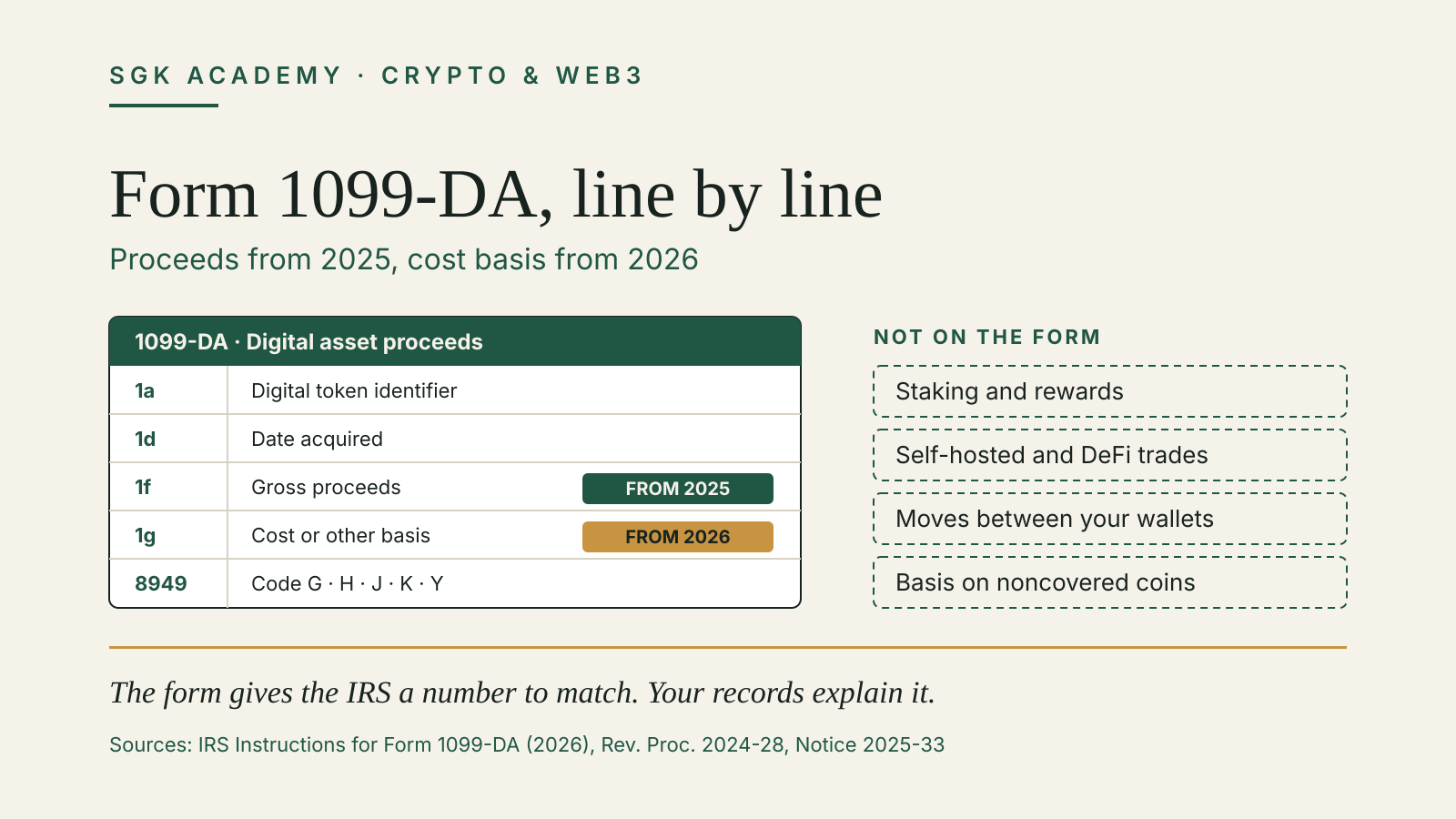
Form 1099-DA is the information return US custodial digital asset brokers use to report customers’ crypto sales to the IRS. Sales from 1 January 2025 show gross proceeds; for many assets bought on a platform from 2026, the broker also reports cost basis. The form does not calculate your tax. It gives the IRS a figure to match against your return, so your own records still have to explain every gain, loss and transfer.
This guide is for founders, freelancers and small-company owners who sell or receive crypto through an exchange or payment processor. It covers what the form shows, what it leaves out and how to reconcile it.
What the form reports, and who sends it
The IRS publishes a Form 1099-DA page and separate Instructions for Form 1099-DA. The instructions describe a broker as a person that, in the ordinary course of a trade or business, stands ready to effect sales of digital assets for others. In practice, that covers custodial trading platforms, certain payment processors and some kiosk operators. The IRS broker reporting FAQs confirm that digital asset kiosks can be brokers.
A custodian that only holds assets and does not effect sales has no reporting duty, according to the same FAQs. The IRS digital assets page also says the current rules do not apply to non-custodial (DeFi) brokers. A trade made directly from a self-hosted wallet through a decentralised protocol may therefore produce no form, while still being a taxable event for you.
Each form line identifies the asset with a Digital Token Identifier code in box 1a, its name in box 1b and the number of units in box 1c. Box 1d is the date acquired, box 1e the date sold, box 1f the gross proceeds and box 1g the cost or other basis.
The 2025 and 2026 split
The reporting rules arrived in two stages. The IRS digital assets page says brokers report gross proceeds for transactions on or after 1 January 2025, and basis on certain transactions from 1 January 2026. A separate set of real estate reporting rules for digital asset payments starts in 2026.
| Sale date | Gross proceeds (box 1f) | Cost basis (box 1g) |
|---|---|---|
| During 2025 | Reported | Not required on the form |
| After 2025, covered security | Reported | Required |
| After 2025, noncovered security | Reported | Optional for the broker |
The 2026 instructions define a covered security in this context as a digital asset acquired after 2025 in a customer’s account at a broker that provided custodial services, and held there until sale. Coins bought before 2026, or moved onto the platform from elsewhere, are generally noncovered. For those, the broker may leave basis blank, and you supply it on your return.
The IRS also eased the start-up period. Under Notice 2025-33 and the earlier Notice 2024-56, the digital assets page says brokers face no penalties for 2025 transactions if they make a good-faith effort, and backup withholding relief covers 2025 and 2026 transactions, with limited relief into 2027. That relief protects brokers. It does not change what a customer must report.
Read the Form 8949 code before the numbers
Box 1g only makes sense with the check-box code beside it. The instructions list codes that tell you how the line should flow to Form 8949 and Schedule D:
| Code | Holding period | Basis reported to the IRS? |
|---|---|---|
| G | Short-term | Yes |
| H | Short-term | No |
| J | Long-term | Yes |
| K | Long-term | No |
| Y | Holding period unknown | Broker cannot tell whether H or K applies |
A blank box 1g on an H or K line does not mean your basis is zero. The instructions tell brokers to enter -0- only where the asset actually had a basis of zero. If the box is blank, you enter the basis from your own records. Report a line with a missing basis as if it were all gain and you may pay tax on money you never made.
What you will not find on the form
Several common activities fall outside the form, or appear in a summarised way.
Rewards and staking. The instructions say rewards and staking payments are not reported on Form 1099-DA. Your income records have to capture them separately.
Excluded transaction types. Under Notice 2024-57, as summarised in the instructions, brokers do not file returns for wrapping and unwrapping, liquidity provider transactions, staking, transactions described as lending or short sales, and notional principal contracts. Again, this is a reporting exemption, not a tax exemption.
De minimis sales. A processor of digital asset payments need not report a customer’s payment-processor sales (PDAP sales) of $600 or less for the year. A broker using the optional method for qualifying stablecoins can skip designated stablecoin sales up to $10,000 a year in aggregate, and the optional method for specified NFTs carries a $600 threshold. Above those levels, the sales are reported.
Transfers between your own wallets. Moving coins from an exchange to a hardware wallet is not a sale. The IRS virtual currency FAQs (Q38) state that a transfer between wallets or accounts belonging to the same person is non-taxable, even if a platform issues an information return because of it. Keep the transaction hash and both addresses so you can show it was your own transfer.
Lot selection and basis by wallet
From 2025, basis is tracked wallet by wallet and account by account. Revenue Procedure 2024-28 explains that the regulations apply specific identification or first-in, first-out ordering within each wallet or account, and it gives a safe harbor for allocating unused basis to each wallet or account as of 1 January 2025. The allocation is irrevocable and has to be supported by records.
At the broker level, the instructions say that when a customer sells part of a position and gives no adequate and timely identification, the broker generally reports the sale of the earliest units purchased first. The average basis method is available only for tokenized securities, not for ordinary crypto holdings. If you want a different lot sold, use the platform’s specific identification tool before the trade. The virtual currency FAQs (Q39 and Q40) set out what specific identification requires.
The broker reporting FAQs add a detail that catches people out: acquisition information passed by a transferring broker can be used for lot ordering, but not for basis reporting. Your own records stay the evidence for basis on assets you moved in.
Owners, companies and non-US customers
Who receives a 1099-DA depends on how the account holder is documented.
A US individual or single-member LLC generally receives one if reportable sales occur. Self-employed people who are paid in crypto and then sell it face two events: the income when received and the gain or loss on sale. The sale may show on a 1099-DA; the income usually does not. Plan for both in your estimated tax payments.
A corporation can be an exempt recipient. The instructions let a broker treat a customer as exempt where, among other routes, it provides a properly completed Form W-9 showing it is not an S corporation, or a Form W-8 certifying it is a foreign corporation. A broker may still insist on the form and treat a customer that fails to provide it as non-exempt. If your company holds crypto, our guide to crypto in a limited company covers the accounting side.
A non-US person who is an exempt foreign person under Regulations section 1.6045-1(g)(4) is documented with a Form W-8 instead of a 1099-DA. Individuals use the form described in our W-8BEN guide for individuals; entities use the one in our W-8BEN-E guide. A wrong or expired form can lead to US reporting you did not expect. If a US entity is involved, the EIN without an SSN guide explains how to get the number the broker will ask for.
A business that takes crypto from customers has a related question about its own records. Our guide to accepting crypto payments covers invoicing and conversion on the way in.
Worked example: one platform, two years
This example is illustrative. A sole proprietor buys 2 ETH on a custodial US platform in March 2025 for $6,000, and 1 ETH in February 2026 for $2,500. All three units stay on the platform. In November 2026 she sells 1 ETH for $3,200 and gives no lot instruction.
| Step | What happens | Result |
|---|---|---|
| Lot ordering | No identification given, so the earliest units go first | One of the March 2025 units is sold |
| Covered status | Acquired before 2026 | Noncovered security |
| Form 1099-DA | Proceeds $3,200 in box 1f; basis may be left blank | Code K if basis is not reported (held over a year) |
| Her records | Basis is $3,000 per March 2025 unit | Long-term gain of $200 |
Had she identified the February 2026 unit before the sale, the lot would have been a covered security. The broker would then report the $2,500 basis with code G, and the short-term gain would be $700. A single instruction changes the holding period, the code and the gain, so decide on the lot before selling, not at year end.
A reconciliation routine for each year
Treat the 1099-DA as one input, not the answer.
- Collect every form from each platform and processor you used, plus full transaction exports.
- Match line by line to your ledger by date, units and asset code. Flag any line that is really a transfer between your own wallets.
- Fill missing basis on H, K and Y lines from your records, including any Rev. Proc. 2024-28 allocation.
- Add what is missing: self-hosted and DeFi trades, staking income and rewards, and sales under the de minimis thresholds.
- Keep the evidence: exports, wallet addresses, transaction hashes and the safe harbor allocation, for as long as the return can be examined.
If you rely on crypto sales to fund the business, run the sale proceeds through the cash runway calculator net of the tax you expect to owe, not the gross figure in box 1f.



