A founder can get an EIN without an SSN, but the route depends on where the business is principally located and whether the responsible party is eligible for a US taxpayer identification number. The online IRS application is not a universal shortcut: many international applicants must use Form SS-4 by phone, fax or mail.
This guide explains the current IRS process, the lines that cause most delays and what an EIN does—and does not—prove. It is based on the IRS EIN page and the December 2025 revision of the Form SS-4 instructions, reviewed on 16 October 2026.
First: what an EIN is
An Employer Identification Number is a nine-digit federal tax identifier assigned by the Internal Revenue Service. Corporations, partnerships and limited liability companies generally use one for tax filings and reporting. A business may also request an EIN for banking or state-tax purposes even when federal law does not otherwise require one.
The name can be misleading. A company may need an EIN even if it has no employees. Conversely, an EIN is not:
- permission to work in the United States;
- an immigration status;
- a state business licence;
- proof that a company is in good standing;
- a substitute for an individual SSN or ITIN; or
- a decision about how an LLC is taxed.
Form the legal entity first. The IRS asks applicants creating an LLC, partnership or corporation to complete the relevant state registration before requesting the EIN. If you are still deciding where to form, start with SGK Academy’s company formation directory rather than treating the EIN as the first step.
Can a non-US founder apply without an SSN?
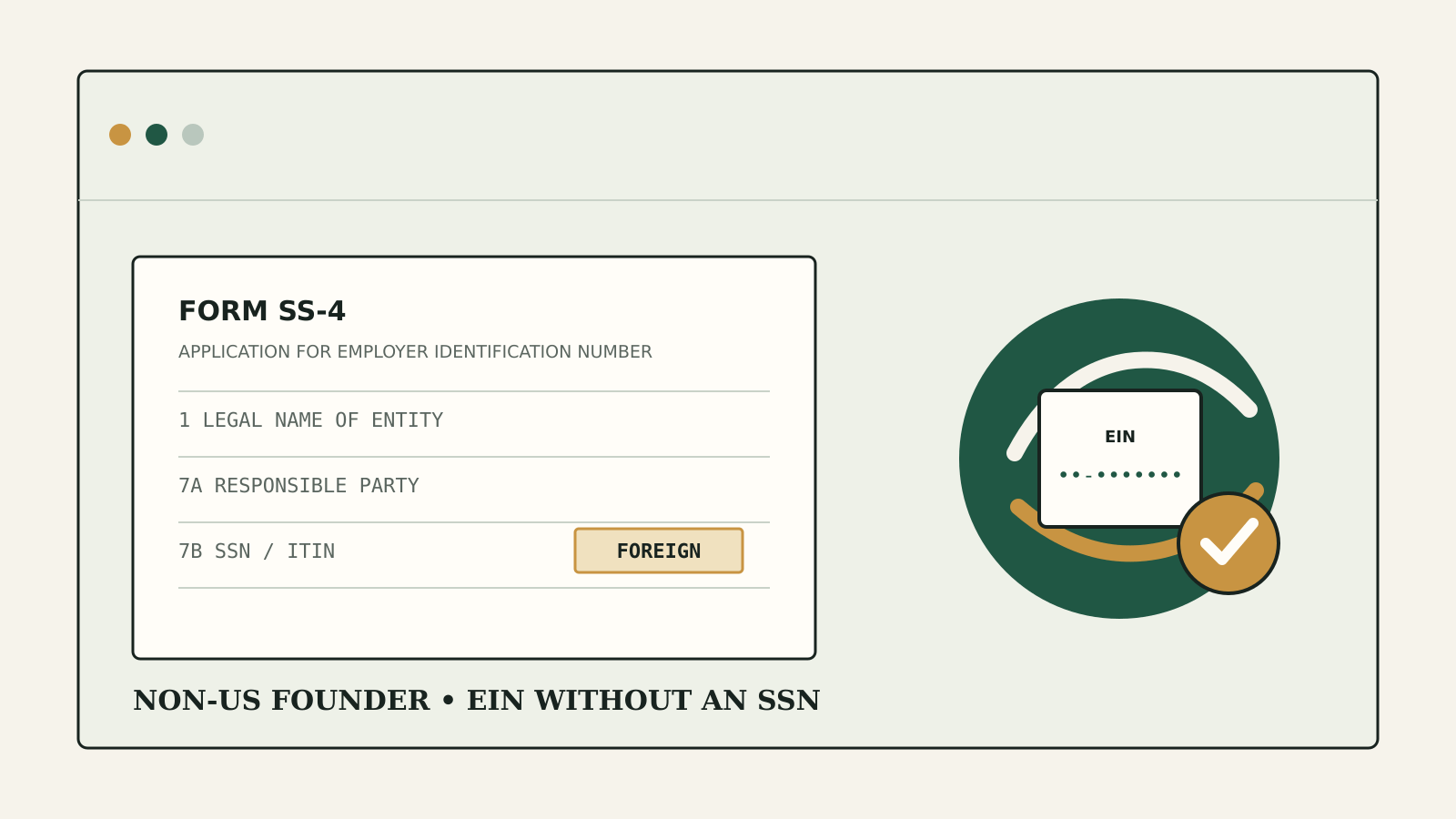
Yes, in a defined situation. The current Form SS-4 instructions say that line 7b may contain “foreign” or “N/A” when the responsible party does not have, and is ineligible to obtain, an SSN or ITIN. An entry is still required.
That wording matters. It is not a general invitation to omit a number that the responsible party already has, or to avoid applying for an ITIN when the person is eligible and another tax rule requires one. It is an instruction for a responsible party who lacks both numbers and is ineligible for them.
The IRS normally expects the responsible party to be an individual—the person who ultimately owns or controls the entity, or exercises effective control over its assets. A nominee is not the responsible party and is not authorised to apply merely because they helped form the company.
A quick route check
| Situation | Likely application route |
|---|---|
| Principal place of business in the US or a US territory, and the principal officer or owner has a valid TIN | Online application may be available |
| Principal place of business outside the US | International phone, fax or mail |
| Responsible party has no SSN or ITIN and is ineligible for both | Form SS-4 can show “foreign” or “N/A” on line 7b |
| A formation agent is only a nominee | The nominee should not be named as the responsible party |
| The entity already has an EIN | Do not request a second one merely because the name, address or responsible party changed |
“Principal place of business” is not necessarily the formation state printed on an LLC certificate. A Delaware LLC managed entirely from abroad can still be an international applicant for the EIN process. Use the applicant’s actual circumstances, not a registered-agent address, to choose the route.
Why the online application often fails for foreign founders
The online EIN service is available only when the applicant has a legal residence, principal place of business, or principal office or agency in the United States or a US territory. The person applying online must also provide a valid taxpayer identification number for the principal officer, general partner, owner, grantor or other responsible person.
If the business is principally outside the United States, the IRS directs it to the international methods instead. Repeatedly changing addresses or inserting a formation agent’s details to get through the online form can create a mismatched tax account. It is better to complete Form SS-4 accurately and use the proper channel.
The three international application methods
The IRS currently offers international applicants phone, fax and mail routes. Use one method for each entity. Sending the same application by fax and mail at the same time can create duplicate work or, worse, more than one EIN.
1. Apply by phone
An applicant with no legal residence, principal place of business, or principal office or agency in the United States or its territories may call the IRS international EIN line at 267-941-1099. It is not toll-free. The published hours are Monday to Friday, 6 a.m. to 11 p.m. Eastern time.
The caller must be authorised to receive the EIN and answer questions about Form SS-4. Complete the form before calling: the IRS representative uses its fields to create the account. The representative may ask for a signed copy by mail or fax within 24 hours.
This route is for international applicants. Domestic taxpayers no longer receive EINs by phone.
2. Apply by fax
Complete and sign Form SS-4, then use the fax number for an applicant without a legal residence, principal place of business or principal office in a US state or the District of Columbia:
- 855-215-1627 when faxing from within the United States; or
- 304-707-9471 when faxing from outside the United States.
Provide a return fax number. The Form SS-4 instructions say the IRS generally returns the EIN by fax within four business days, although the main EIN page warns that high inventory can cause delays.
3. Apply by mail
Mail the signed form to:
Internal Revenue Service
Attn: EIN International Operation
Cincinnati, OH 45999
United States
The instructions recommend mailing the application four to five weeks before the number is needed and say the EIN is generally received in about four weeks. International delivery time comes on top of IRS processing, so mail is usually the slowest option.
Phone and fax details can change. Recheck the IRS EIN page immediately before submitting rather than copying contact details from an old blog post.
How to complete the lines that matter
Form SS-4 is short, but several answers control how the IRS creates the account.
Lines 1 and 2: legal and trade names
Line 1 should match the legal formation document. Put a different trading or “doing business as” name on line 2. The IRS system accepts a limited set of characters, so follow its published name rules rather than improvising punctuation.
Lines 4 and 5: mailing and physical addresses
Line 4 is where the IRS sends correspondence. For a foreign address, include the city, province or state, postal code and country name; do not abbreviate the country. Line 5 is the physical address if it differs from the mailing address. Do not put a PO box on line 5.
Line 6: principal business location
Enter the entity’s primary physical location. This is not a prompt to repeat the US registered-agent address when the business is actually operated elsewhere.
Lines 7a and 7b: responsible party
Line 7a names the individual who ultimately owns or controls the entity or exercises effective control over its funds and assets. On line 7b:
- enter the person’s SSN or ITIN if they have one;
- enter “foreign” or “N/A” if they do not have, and are ineligible to obtain, either number;
- do not leave the line blank.
The December 2025 instructions tightened the wording around foreign responsible parties, so older articles that say an SSN or ITIN is always mandatory are out of date.
Lines 8 and 9: entity type
Answer the LLC questions using the entity’s legal structure and number of members. Federal tax classification is a separate issue. For example, a single-member domestic LLC is normally disregarded for federal income-tax purposes unless it elects another classification, while foreign eligible entities follow different default rules.
If classification is uncertain, do not guess from the company suffix. Review the Form SS-4 and Form 8832 instructions or obtain professional advice before submitting.
Line 10: reason for applying
Choose the actual reason: starting a new business, hiring employees, banking, withholding compliance or another listed purpose. A bank requesting an EIN does not automatically mean the entity has a US federal tax return obligation.
Lines 11–18 and signature
Complete every applicable field. Line 17 asks for a specific description of the principal activity. Line 18 asks whether the applicant entity previously received an EIN; this is one of the checks that helps prevent duplicates.
The form must be signed by an authorised person. Depending on the entity, that may be the individual applicant, a corporate officer, an authorised member or officer of an unincorporated organisation, or a fiduciary. A foreign applicant may use a duly authorised person, but a paid formation agent is not automatically authorised.
A practical submission checklist
Before calling, faxing or mailing, check the following:
- The legal entity exists and line 1 matches its formation record.
- The mailing and physical addresses are complete and use the unabbreviated country name.
- Line 7a identifies the real responsible party, not a nominee.
- Line 7b contains the responsible party’s TIN or the permitted “foreign” or “N/A” entry.
- The LLC membership and entity-type answers are internally consistent.
- The reason for applying matches the business’s real purpose.
- The principal activity is specific.
- Line 18 correctly states whether the entity previously received an EIN.
- An authorised person has signed and dated the form.
- You kept a copy and used only one submission method.
The IRS limits issuance to one EIN per responsible party per day, across online, phone, fax and mail requests. That limit is not a reason to submit duplicate forms on successive days. Each business entity should have only one EIN unless an ownership or structural change requires a new one.
After the EIN is issued
The EIN can generally be used immediately for opening a bank account, applying for business licences and filing a paper return. The IRS says to allow up to two weeks before expecting the number to work for electronic returns, electronic tax payments or the TIN Matching Program.
Store the assignment notice with the formation documents and tax records. If the responsible party or address later changes, Form 8822-B is the update route; a responsible-party change must be reported within 60 days. Do not request a new EIN simply to update those details.
An EIN also does not settle the company’s wider tax position. A foreign-owned US disregarded entity, for example, may have information-reporting duties even when it owes no US income tax. Company residence, permanent establishment, withholding and beneficial-ownership questions are separate. SGK Academy’s guides to company tax residence, permanent establishment risk and W-8BEN-E cover adjacent issues.
Questions founders ask
Do I need an ITIN before applying for an EIN?
Not always. The current instructions permit “foreign” or “N/A” on line 7b when the responsible party has no SSN or ITIN and is ineligible for both. A person who has a TIN should provide it. Whether an ITIN is required for some other tax filing is a separate question.
Can my registered agent be the responsible party?
Not merely because it is the registered agent. The responsible party is the person who ultimately owns or controls the entity or exercises effective control. The IRS says nominees are not authorised to apply.
Is the EIN application free?
Yes. The IRS issues EINs without a fee. A service provider may charge for preparing or submitting the form, but that fee is not an IRS charge.
Does an EIN make my company tax resident in the United States?
No. It is an identifier for federal tax administration. Tax residence and filing duties depend on formation, management, activities, ownership and applicable tax rules.
What if a tax return is due before the EIN arrives?
The IRS instructs filers to write “Applied For” and the application date in the EIN field. Payment instructions depend on the tax and filing location, so follow the relevant return’s current instructions.
Sources
- IRS: Employer identification number — reviewed 16 October 2026; page last reviewed or updated 17 July 2026.
- IRS: Instructions for Form SS-4 — December 2025 revision, reviewed 16 October 2026.
- IRS: Form SS-4 — December 2025 revision, reviewed 16 October 2026.
This guide explains the federal EIN application process. It is not tax, legal or immigration advice.