
Holding crypto in a limited company changes who pays the tax and under which rules. A UK company that buys bitcoin or other exchange tokens as an investment is normally taxed on a chargeable gain when it disposes of them, inside its Corporation Tax return. HMRC does not treat these tokens as money, so the foreign currency rules do not apply, and only unusual companies will be taxed on crypto as a trade or as an intangible fixed asset. The paperwork starts with the first purchase, not the first sale.
Source and version check: reviewed 22 October 2026 against the Corporation Tax chapters of HMRC’s Cryptoassets Manual (CRYPTO40000 to CRYPTO41650 and CRYPTO49000). The manual is HMRC’s published view of the law, not the law itself; HMRC says it considers each case on its own facts. Rates and filing dates are kept in SGK Academy’s data tools rather than repeated here.
This guide is about a company that buys and holds tokens with its own money. If your company is paid by customers in crypto, start with accepting crypto payments as a small business; if it wants to pay staff in tokens, see paying employees in crypto.
The short answer
| Question | HMRC’s position for a UK company |
|---|---|
| Are exchange tokens money or currency? | No. Rules that apply only to money or currency do not apply to them (CRYPTO41050) |
| Default tax treatment of a token held as an investment | Corporation Tax on chargeable gains when the company disposes of it (CRYPTO41200) |
| Is buying and selling likely to be a trade? | Only in exceptional circumstances (CRYPTO40150) |
| Do the loan relationship rules apply? | Generally not, because there is usually no money debt (CRYPTO41100) |
| Do the intangible fixed asset rules apply? | Only where the token is accounted for as an intangible asset and held for use on a continuing basis (CRYPTO41150) |
| How is cost tracked? | In a pool for each type of token, with same-day and ten-day matching exceptions (CRYPTO41350) |
| Which currency is used for the computation? | Pounds sterling at the time of each transaction, unless the company has a non-sterling functional currency (CRYPTO40100) |
Why a company is taxed differently from you
An individual who sells bitcoin at a profit usually deals with Capital Gains Tax. A company does not pay Capital Gains Tax. HMRC’s introduction to Corporation Tax on cryptoassets says companies are subject to Corporation Tax on their profits and gains, and must take into account all of their exchange token transactions, as they would for any other asset.
The same section makes a point that shapes everything else: HMRC does not consider any current type of cryptoasset to be money or currency. That rules out three sets of provisions a finance director might otherwise reach for:
- the foreign currency rules in section 328 of the Corporation Tax Act 2009;
- the Disregard Regulations on exchange gains and losses (SI 2004/3256);
- designated currency elections under section 9A of the Corporation Tax Act 2010.
So a stablecoin worth one dollar is not treated as a dollar balance for these purposes, and a token is not a foreign currency account. If the activity is not a trade and is not caught by the loan relationship or intangible rules, HMRC says the disposal is of a capital asset and any gain is typically charged as a chargeable gain.
The headline Corporation Tax rate that then applies to the company’s total taxable profits, including chargeable gains, is listed with its source in our United Kingdom jurisdiction profile.
Four possible tax routes, and which one usually applies
HMRC’s guidance sets out an order of questions. Working through them in this order avoids the common mistake of assuming the most familiar answer.
1. Is the company trading in tokens?
CRYPTO40150 says the question of whether buying and selling exchange tokens is a trade depends on factors including frequency, level of organisation and intention. It compares a trade in tokens to a trade in shares and securities, and points to the existing case law on financial traders.
HMRC’s expectation is plain: only in exceptional circumstances would it expect a business to buy and sell exchange tokens with such frequency, organisation and sophistication that the activity is a financial trade in itself. Calling transactions “trades” in a dashboard does not make them a trade for tax purposes. If the company does trade, the profits form part of its trading profits instead of being chargeable gains.
A separate case is a company whose existing trade simply involves tokens, for example one that accepts them from customers or uses them to pay suppliers. HMRC’s guidance on business income paid in cryptoassets says the tokens given or received are then accounted for within taxable trading profits.
2. Is there a loan relationship?
A company has a loan relationship when it has a money debt arising from a transaction for the lending of money. CRYPTO41100 says buying exchange tokens generally does not create one, because there is usually nobody standing behind the token and so no money debt.
Two practical edges matter for founders:
- Borrowing money against tokens. If tokens are pledged as collateral for an ordinary loan of money, a loan relationship exists and the loan relationship rules apply to that loan, whether the company is the borrower or the lender.
- Lending tokens. If the company lends tokens rather than money, HMRC says it is unlikely to be a loan relationship, because there is no money debt and no lending of money.
3. Do the intangible fixed asset rules apply?
The intangibles regime in Part 8 of the Corporation Tax Act 2009 takes priority over the chargeable gains rules. CRYPTO41150 says a token may fall into it only if it is both an intangible asset for accounting purposes and an intangible fixed asset, meaning created or acquired for use on a continuing basis.
The key sentence for most small companies is HMRC’s statement that exchange tokens which are simply held by the company, even when held in the course of its activities, will not meet that definition. Financial assets are also excluded. If the company does not prepare accounts that follow generally accepted accounting practice, HMRC applies the rules as if it had.
4. Otherwise: Corporation Tax on chargeable gains
For the typical founder’s company that has bought tokens as a treasury holding or a speculative investment, the answer is route four. CRYPTO41200 says a company that holds exchange tokens as an investment is liable to Corporation Tax on gains it realises when it disposes of them. Tokens count as chargeable assets because they can be owned and have a value that can be realised.
What counts as a disposal
A disposal is broader than a sale for pounds. HMRC’s list in CRYPTO41250 includes:
- selling tokens for money;
- exchanging tokens for a different type of token;
- using tokens to pay for goods or services;
- giving tokens away to another person.
Swapping one token for another is the trap. A company that moves from ether into a stablecoin has disposed of the ether, even though no pounds reached its bank account. If the company gives tokens to an individual, including a director, or to a company outside its group, it must use the market value of what it gave away to compute the gain.
Some movements are not disposals. HMRC says there is no disposal when the company keeps beneficial ownership throughout, for example when it moves tokens between public addresses it controls. Transfers between different blockchains are a separate question; HMRC’s view in CRYPTO41260 is that the answer depends on the facts of the transaction.
Working out the gain
Convert every transaction to sterling
The computation is in pounds sterling. Where a transaction has no sterling price, such as bitcoin exchanged for ether, CRYPTO40100 says an appropriate exchange rate must be established, using a consistent methodology, and the company must keep a record of that methodology. A company that has elected a non-sterling functional currency converts into that currency at the time of each transaction and completes the tax return in sterling at the end of the period.
Pool each type of token
Tokens of the same type are usually pooled. CRYPTO41350 explains that each type of token has its own pool with its own pooled allowable cost, which rises with each purchase and falls in proportion with each disposal.
Companies have two exceptions to the pool:
- Same day. A disposal is matched first with tokens of the same type acquired on the same day, even if the disposal came first.
- Ten days. If the company acquires tokens and disposes of the same type within ten days, the disposal is matched with the acquisition within the previous nine days, first in, first out, ahead of the pool.
HMRC notes that the pooling rules for individuals differ slightly, so a spreadsheet built for a personal tax return should not be reused for the company without checking the matching rules.
Deduct only allowable costs
CRYPTO41300 lists the costs HMRC accepts under section 38 of the Taxation of Chargeable Gains Act 1992. They include the sterling price paid, fees for having the transaction included on the ledger, professional costs of drawing up a contract for the acquisition or disposal, and the cost of making a valuation to compute the gain.
Exchange fees need sorting. A fee to buy tokens is a cost of acquiring them; a fee on selling them is an incidental cost of disposal. Fees for depositing or withdrawing sterling are not allowable, because sterling is not an asset for these purposes. On a token-for-token swap, HMRC accepts a 50/50 split of the fee between the token disposed of and the token acquired as just and reasonable, and a cost can be deducted only once.
A worked example
This is an illustrative calculation, not a filing. The figures are invented to show the mechanics described by HMRC.
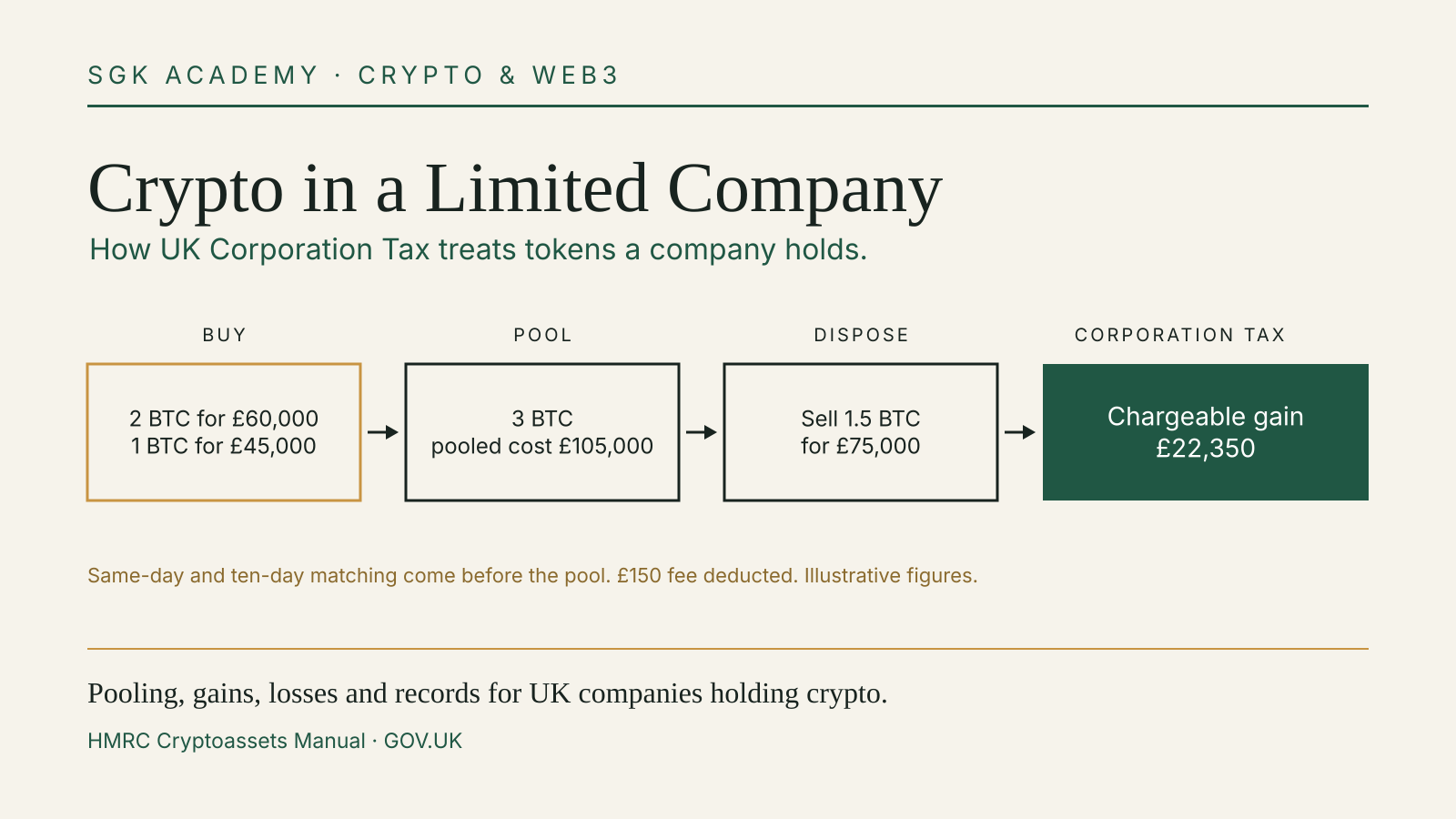
Northgate Studio Ltd, a UK design company, buys bitcoin as a small treasury position. It does not trade tokens, so route four applies.
| Date | Transaction | Bitcoin | Sterling |
|---|---|---|---|
| 10 January | Buys bitcoin, including the exchange’s purchase fee | 2.0 | £60,000 |
| 14 June | Buys more bitcoin, including the purchase fee | 1.0 | £45,000 |
| 20 November | Sells bitcoin; the exchange charges a £150 selling fee | 1.5 | £75,000 |
There is no purchase on the day of the sale or in the nine days before it, so the sale comes out of the pool.
- The pool before the sale holds 3.0 bitcoin with a pooled allowable cost of £105,000.
- The sale takes half the pool: £105,000 × 1.5 ÷ 3.0 = £52,500 of allowable cost.
- The selling fee is an incidental cost of disposal: £150.
- Chargeable gain: £75,000 − £52,500 − £150 = £22,350.
- The pool carries forward 1.5 bitcoin with a pooled cost of £52,500.
The £22,350 joins the company’s other taxable profits for the accounting period. Now change one fact: if the company had bought 0.5 bitcoin on 15 November, five days before the sale, the ten-day rule would match 0.5 of the 1.5 sold with that purchase first, using its cost, and only the remaining 1.0 bitcoin would come out of the pool.
When things go wrong
Losses are allowable only in the right circumstances, and the manual is specific about what does not count.
- Selling at a loss. A disposal for less than its allowable cost creates a loss. CRYPTO41400 says losses must be reported to HMRC before they can be used, and that special rules apply to disposals to a connected person.
- Tokens that become worthless. A company can make a negligible value claim for tokens it still owns. Because tokens are pooled, the claim covers the whole pool, not individual tokens, and must state the asset, the amount and the date of the deemed disposal (CRYPTO41450).
- A lost private key. Losing the key is not a disposal, because the key and the tokens still exist. If there is no prospect of recovering access, a negligible value claim may be possible (CRYPTO41500).
- Theft. HMRC does not treat theft as a disposal, because the owner keeps the right to recover the asset, so a theft victim cannot claim a loss on that basis. Paying for tokens that never arrive may also not produce a capital loss (CRYPTO41550).
The theft point is a strong argument for treating custody as a board decision rather than an afterthought. Our guide to crypto custody and insolvency explains what a company actually holds when an exchange keeps the keys.
Decisions to make before the first purchase
Write down why the company is buying. A board minute that records the purpose, the budget and who may approve transactions supports the investment analysis and shows the holding is not a disguised trade or a director’s personal position.
Keep company and personal wallets apart. Tokens bought with company money belong in accounts opened in the company’s name. Moving them to a director, even temporarily, is a disposal at market value for the company, and the director’s own tax position then needs separate advice. If money has passed between director and company, check how it sits in the director’s loan account.
Expect identity and ownership questions. Under the Cryptoasset Reporting Framework, UK reporting cryptoasset service providers must carry out customer due diligence from 1 January 2026. HMRC’s CRYPTO49000 says entity customers must also provide due diligence information about their controlling persons, and failing to provide it may lead to a penalty or a refusal of further service. Our DAC8 crypto reporting guide covers the EU equivalent.
Plan the year-end. Gains are reported in the company tax return for the accounting period in which the disposal happens. Use the company filing deadlines calculator to see when that return and the payment are due for your year-end.
Decide who keeps the ledger. Most exchanges export transaction histories, but those exports rarely contain sterling values for token-to-token swaps or the pool calculations. Someone has to own that reconciliation. The year-end accounts need their own figures too: accounting for cryptocurrency explains how the holding is measured under FRS 102, FRS 105 and IFRS, and why the accounts and the tax pool drift apart after a fall in price.
Records to keep
HMRC requires a record of the amount spent on each type of token and of each pool’s allowable cost, and a record of the valuation methodology. In practice, keep for every transaction:
- the date and time;
- the type of token and the number of units;
- the value in pounds sterling and how it was obtained;
- the counterparty, exchange or wallet used;
- fees, split between acquisition and disposal where relevant;
- the running pool for each token type;
- evidence of ownership of every wallet the company uses;
- board approvals and the custody arrangements.
Official sources
- HMRC Cryptoassets Manual: contents
- CRYPTO40100: Conversion to sterling and accountancy
- CRYPTO40150: Trading in exchange tokens
- CRYPTO41050: Corporation Tax, introduction
- CRYPTO41100: Loan relationships
- CRYPTO41150: Intangible fixed assets
- CRYPTO41250: What constitutes a disposal
- CRYPTO41300: Allowable costs
- CRYPTO41350: Pooling
- CRYPTO41450: Negligible value
- CRYPTO41550: Being defrauded
- CRYPTO49000: The Cryptoasset Reporting Framework



