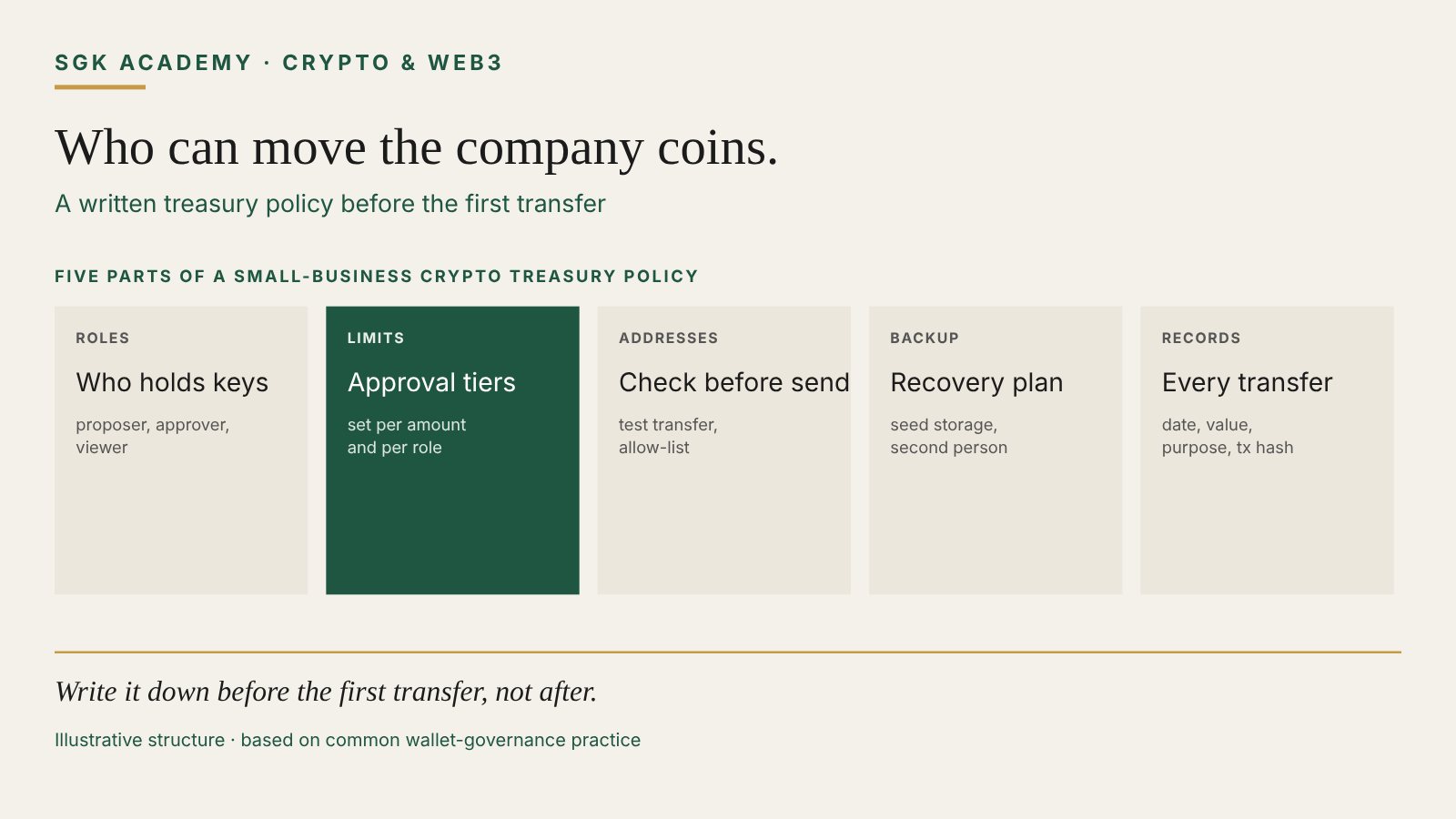
A crypto treasury policy for a small business should answer a practical question before any coin moves: who may propose a transaction, who may approve it, which wallet may sign it, and what evidence must be saved afterward?
The policy is more than a note telling staff to “use a hardware wallet.” A business needs an operating record that connects people, keys, addresses, limits, approvals, accounting and recovery. A secure wallet can still produce a bad payment if the destination is wrong, the amount is not authorized or nobody records the transaction.
This guide sets out a workable policy for a small company that receives, holds or pays with cryptoassets. It does not recommend a token, wallet vendor or custody model. Tax treatment and legal duties depend on the business, jurisdiction and transaction.
Documents checked: NIST SP 800-57 Part 1 Rev. 5; HMRC Cryptoassets Manual pages CRYPTO10400 and CRYPTO40050; Bitcoin.org wallet-security guidance; BIP 129. Checked 1 November 2026.
Start with a wallet register
Create one row for every wallet or custodial account the business uses. The register should tell a reviewer what the wallet is for and how control works without exposing a seed phrase or private key.
Record:
- an internal wallet name;
- the network and asset types it may hold;
- whether it is self-custodied or held by a custodian;
- the public receiving addresses or the method used to generate them;
- the owners of the business process, not the secret key itself;
- the signer or approval rule;
- the normal balance range and transaction limit;
- the backup and recovery procedure;
- the date access was last reviewed; and
- links to the accounting ledger and incident record.
Do not copy private keys, recovery phrases or authentication secrets into this register. NIST defines key management as the full lifecycle of key generation, storage, use, recovery and destruction. The business register should describe that lifecycle and point to controlled evidence, while the secrets stay in the system designed to protect them.
A wallet name such as “Treasury cold wallet” is too vague. “BTC long-term reserve, no customer receipts, 2-of-3 approval, quarterly recovery check” gives the next reviewer a usable boundary.
Separate proposing, approving and signing
A payment has at least three decisions:
- Proposal: someone records the purpose, recipient, asset, network, destination address, amount and supporting invoice.
- Approval: an authorized person confirms the commercial reason and checks that the transaction fits the policy.
- Signing: the wallet or custodian applies the cryptographic authorization.
Those roles do not have to be three different employees for every small payment. They do need to be explicit. A company with two directors might allow one director to propose a routine payment and require the other to approve it. A larger or unusual payment might require both directors plus an offline signer.
The crucial point is that a valid signature proves control of a signing key. It does not prove that the invoice was genuine, the destination belonged to the intended supplier or the payment was permitted by the company.
Set monetary limits in the reporting currency used by the business and state when the value is measured. “Director approval above £5,000 at the quoted exchange rate recorded with the proposal” is clearer than “large transfers need approval.”
Choose a custody model by failure mode
The policy should name the custody model and the failure it is meant to reduce.
| Model | What it can reduce | What still needs a control |
|---|---|---|
| Single self-custody key | Dependence on an exchange or custodian | Theft, loss, coercion and one-person control |
| Hardware wallet | Exposure of the signing key to a general-purpose computer | Address verification, backup, staff access and device replacement |
| Multisignature wallet | A single signer authorizing the transaction | Setup integrity, signer availability and recovery of the full wallet policy |
| Custodial account | Operational burden of managing private keys | Provider failure, account freeze, staff permissions and withdrawal controls |
| Split operating and reserve wallets | Exposure of the full balance during routine payments | Rebalancing rules and secure movement between wallets |
Bitcoin.org advises keeping only small amounts in a wallet used for everyday activity and holding the remainder in a safer environment. That is a useful operating principle even when the business uses another network: define an operating balance and move excess funds under a stronger approval rule.
Multisignature is not a shortcut around governance. BIP 129 identifies setup risks that include tampered signer membership, derivation paths and signature thresholds. It also stresses that signers need the complete wallet configuration, not just their individual keys. If the business cannot explain how it would reconstruct the wallet after losing one device, it has not finished the setup.
Make address verification a separate step
Wrong-network and wrong-address payments are difficult or impossible to reverse. The policy should therefore treat the destination as data that needs its own evidence.
For a new recipient:
- obtain the address through an agreed channel;
- confirm the network in writing;
- compare the address on the signing device, not only on the computer that prepared the transaction;
- have the approver compare the first and last characters against the saved proposal;
- send a small test transaction when the amount and fee justify it; and
- record how the destination was confirmed.
An address book can reduce repeated copying, but it creates another privileged record. Log additions and changes, require approval for a changed address and place a waiting period on high-value withdrawals where the system supports one.
Do not rely on a screenshot of an address as the sole evidence. A screenshot can be edited, forwarded from the wrong conversation or captured from a compromised screen. Save the source message, the business identity of the recipient and the approval record together.
Set an operating-balance rule
The policy needs a ceiling for funds that can move under the routine process. A simple rule can use three numbers:
- the expected payments for a defined period;
- a buffer for fees and timing; and
- a maximum balance that triggers a transfer to the reserve wallet.
For example, a company expecting £8,000 of crypto payments over two weeks might keep £10,000 in an operating wallet and require a reserve transfer when the balance rises above £12,000. These figures are illustrative, not recommended thresholds. The company should set its own numbers from cash flow, transaction size, staffing and recovery time.
The rebalancing transaction is still a transaction. Give the reserve address a verified record, apply the appropriate approval rule and save the transaction ID.
Design backup and recovery together
A backup is useful only if the company can recover the wallet from it. Bitcoin.org recommends protecting wallet backups, keeping them in more than one secure location and checking how the chosen wallet handles backups. NIST distinguishes operational key storage from backup storage and notes that backup decisions depend on the key type and application.
Write a recovery sheet that answers:
- what must be recovered: a seed phrase, encrypted backup, descriptor, wallet policy or custodial account;
- which people or roles can retrieve each component;
- where each component is kept;
- which device and software version are required;
- how to verify the restored wallet without moving the full balance; and
- what must happen when a signer leaves, dies, loses access or is suspected of compromise.
For a multisignature wallet, keeping three seed phrases is not necessarily enough. The business may also need the wallet descriptor, derivation information, signer fingerprints and threshold. BIP 129 exists because a compromised or incomplete setup record can lead to loss, ransom or privacy exposure.
Test the recovery process with a controlled wallet or an agreed low-value procedure. Record the test date, people involved, result and follow-up actions. Do not expose production secrets merely to prove that a test occurred.
Keep a transaction evidence pack
HMRC’s record-keeping guidance warns that an exchange may retain transaction data only briefly or may no longer exist when records are needed. It lists the asset type, date, buy or sell direction, number of units, sterling value, cumulative holdings, bank statements and wallet addresses among the records an individual may need. A business should use the same disciplined audit trail and then apply the accounting and tax rules relevant to its circumstances.
For each business transaction, save:
- the invoice, expense claim or commercial agreement;
- the proposal and approval;
- asset, network, amount and fee;
- sending and receiving addresses;
- transaction hash and block explorer link;
- timestamp and confirmation policy;
- exchange-rate source and valuation timestamp;
- the related bank movement if fiat entered or left the process; and
- the accounting entry.
The crypto transaction records guide shows how to connect invoice, wallet, valuation and ledger evidence. If the business accepts crypto from customers, the crypto payments guide explains why the sale and the later disposal are separate events.
A public blockchain is useful corroborating evidence, but it does not identify the business purpose or owner by itself. The internal record supplies that connection.
Write an incident procedure before you need it
Create a short response card for suspected compromise. It should say who can pause payments, who contacts the custodian, which clean device or reserve path is available, how to preserve evidence and who decides whether to move funds.
Useful triggers include:
- a seed phrase or signing device may have been exposed;
- an unknown approval or transaction appears;
- a signer loses a device;
- a custodian account is locked;
- an address book entry changes unexpectedly;
- malware is found on the proposal or signing computer; or
- a staff member with wallet access leaves.
Do not improvise by copying secrets into a chat or email during the incident. Preserve logs, screenshots and transaction details, then rotate or replace compromised access using the wallet or custodian’s documented process. If funds move, treat the emergency transfer as an authorized business transaction and record why it occurred.
Review access on a fixed cadence
Review the wallet register at least whenever people, devices, providers or business use change. A quarterly review is a practical starting point for an active small-business wallet, with immediate reviews after an incident or staff departure.
During the review, confirm:
- every wallet still has a business purpose;
- every named approver and signer still needs access;
- limits match current payment sizes;
- reserve and operating balances follow policy;
- backups and configuration records remain available;
- the recovery procedure still matches the software;
- old devices and credentials were retired correctly; and
- the transaction ledger reconciles with wallet balances.
The review is not complete because a checklist was signed. Resolve differences, document exceptions and assign a date for any action that cannot be completed immediately.
A one-page policy template
A concise policy can use these headings:
Scope. Wallets, custodial accounts, assets and networks covered.
Roles. Proposer, approver, signer, record keeper and incident lead.
Limits. Routine transaction, new recipient and reserve-transfer thresholds.
Custody. Operating and reserve models, signer rule and provider permissions.
Destination checks. How addresses and networks are confirmed.
Backups and recovery. Components, locations, access and test cadence.
Records. Evidence saved for every receipt, payment, conversion and internal transfer.
Incidents. Pause authority, escalation, clean recovery path and evidence preservation.
Reviews. Access, balance, recovery and reconciliation schedule.
Approve the policy at the same level that can authorize meaningful payments. Then test it with a harmless scenario: a new supplier address, a missing signer and a disputed transaction. The exercise should reveal whether the written controls lead to a decision without exposing the keys.