
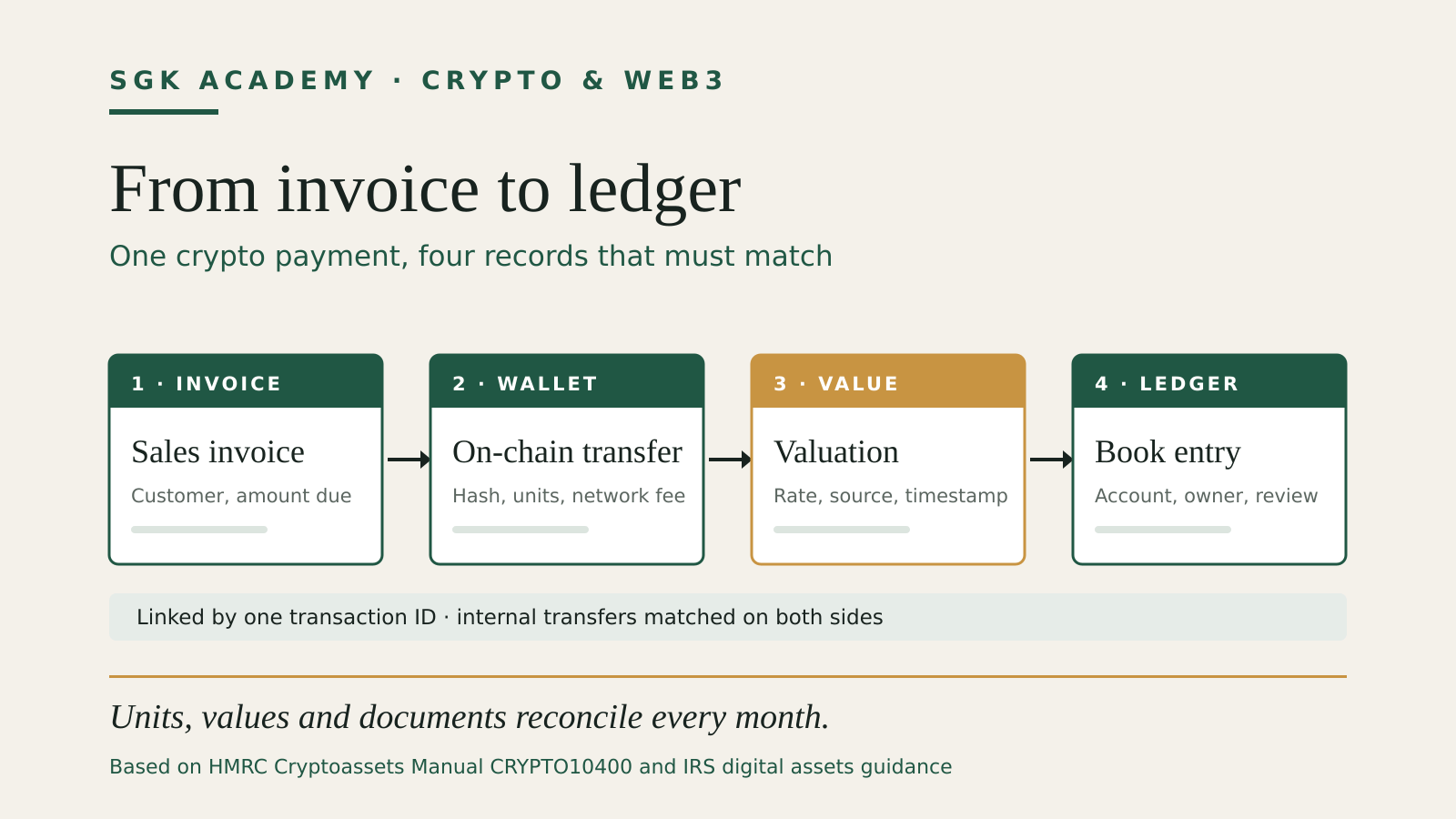
If a business receives, buys or spends cryptoassets, the accounting problem is not solved by keeping a year-end wallet balance. The useful record is a chain from the commercial event to the on-chain transfer and then to the fiat value used in the books.
This guide sets out a practical record pack for a small business. It is an operational checklist, not tax advice. The tax treatment still depends on the country, legal entity and reason for each transaction.
Start with the business event
A blockchain transaction shows that assets moved between addresses. It does not show why the transfer happened. Keep the document that explains the commercial event:
- the sales invoice or supplier bill;
- the order, contract or expense claim;
- the customer or supplier name held in your normal records;
- the asset and network agreed for payment;
- the amount due in your accounting currency;
- the wallet or exchange account used by the business;
- the date and time the payment was accepted as complete.
That first layer matters because the same transfer could be sales income, a purchase, a loan, an owner contribution, a payroll payment or a movement between wallets controlled by the same business. Those events do not necessarily receive the same accounting or tax treatment.
If you accept crypto from customers, keep the receipt value and the later disposal as separate events. Our guide to accepting crypto payments as a small business explains why receiving, holding and selling are three different stages.
Keep the blockchain evidence
For each inbound or outbound transfer, save:
- the network name;
- transaction hash;
- sending and receiving addresses;
- asset contract address where a token could be confused with another asset using the same ticker;
- units sent or received;
- network fee and the asset used to pay it;
- block time and, if your system records it, the point at which you treated the transfer as confirmed;
- a note identifying transfers between wallets you control.
A block explorer link is useful, but do not rely on a bookmark alone. Interfaces change and some services disappear. Export the wallet or exchange activity in a reusable format and keep a copy with the accounting period.
HMRC’s cryptoasset record-keeping guidance warns that exchanges may keep transaction data only for a short period, or may no longer exist when a return is prepared, so the onus is on the taxpayer to keep their own records. The manual says those records must include the type of cryptoasset, the transaction date, whether it was bought or sold, the number of units, the sterling value at the date of the transaction, the cumulative units held, and bank statements and wallet addresses. HMRC also treats a wallet download, or a link to a public blockchain transaction together with acknowledgement that the person owns the public key involved, as a record. The page is written about individuals, but the same evidence is what a company’s accountant will ask for.
Never store a private key or seed phrase in an invoice folder, spreadsheet or accounting attachment. Your records need to identify the business wallet; they do not need to expose the secret that can spend its assets.
Record the value at the transaction time
A business ledger needs a value in its accounting currency. Save the rate rather than trying to recreate it later.
A valuation record should include:
- the exact date and time;
- the trading pair or conversion route;
- the price source;
- whether the figure is a market price, an exchange execution price or a payment processor’s quoted settlement amount;
- the calculation from asset units to accounting currency;
- any separately charged fee.
For a sale priced in pounds, dollars or euros but paid in a token, the invoice amount remains a strong starting point for the revenue record. If the customer sends more or less than required because the asset price moved, record the actual settlement and the difference according to your accounting policy.
The IRS digital-assets guidance tells US taxpayers to keep records of purchases, receipts, sales, exchanges and other disposals, and of the fair market value in US dollars of digital assets received as income or as payment in the ordinary course of a trade or business. For a gain or loss calculation, its checklist covers the type of asset, the date and time of the transaction, the number of units, fair market value at the time and the basis of the units sold.
A screenshot without a timestamp, source or asset pair is weak evidence. A spreadsheet cell that says “price from internet” is weaker still. Save the source URL or export and the formula used.
Separate transfers from disposals
Moving assets between two wallets controlled by the same business is not the same commercial event as selling or spending them. Your records should let an accountant match both sides of an internal transfer.
Use an internal-transfer ID that connects:
- the outgoing transaction;
- the incoming transaction;
- the network fee;
- both business-controlled wallets;
- any bridge, exchange deposit or custody step between them.
The IRS page lists a transfer from one wallet or account you own or control to another as something that is not, on its own, a reportable digital asset transaction, unless you paid a transaction fee with digital assets. Paying that fee in tokens is itself treated as a disposal. This is one reason to record the fee asset and units separately.
Do not delete a transfer from the ledger because it “cancels out.” Without the link, an exchange deposit can look like unexplained income and an outgoing wallet transfer can look like a sale.
Track cost records by asset and legal owner
The person or company that owns the asset matters. Avoid a shared exchange login that mixes company assets, personal holdings and client money.
For each asset, maintain a transaction table with:
| Field | What it proves |
|---|---|
| Transaction ID | One stable key across invoice, wallet and ledger |
| Legal owner | Which company or individual owns the asset |
| Event type | Receipt, purchase, sale, spend, fee or internal transfer |
| Asset and network | The precise unit that moved |
| Units | Quantity before any fiat conversion |
| Fiat value | Book value at the transaction time |
| Valuation source | How the fiat amount was derived |
| Basis or pool reference | Link to the relevant tax calculation |
| Counterparty document | Invoice, bill, contract or expense claim |
| Wallet evidence | Hash, addresses and confirmations |
| Review status | Who checked the match and when |
UK companies holding tokens should connect this record pack to the treatment described in crypto in a limited company. That guide covers chargeable gains and pooling at a higher level; the transaction pack here supplies the evidence underneath the calculation.
US businesses: basis now lives in each wallet
Since 1 January 2025, US basis has to be tracked wallet by wallet and account by account rather than in one pool across everything the taxpayer holds. The IRS digital-assets page explains that the broker regulations require this basis identification, and Revenue Procedure 2024-28 gave taxpayers a transitional method to allocate unused basis to the units held in each wallet or account at that date. If your business made that allocation, keep the working papers with the record pack. Every later transfer between wallets then needs to carry its basis with it, which is another reason the internal-transfer ID above matters.
Broker reporting adds a second set of figures to reconcile. Custodial platforms and certain hosted wallet providers report gross proceeds on Form 1099-DA for sales on or after 1 January 2025, and basis for certain transactions from 1 January 2026. Notice 2024-57 also excludes some transactions, including staking, wrapping and unwrapping and liquidity provider activity, from 1099-DA reporting until further guidance. Those events still belong in your own records. Our guide to Form 1099-DA walks through the boxes; the practical step here is to tick each line on the broker’s form against a line in your transaction table, and to keep a note for every difference.
Reconcile three systems, not one
A useful monthly reconciliation compares:
- the accounting ledger;
- wallet and exchange balances;
- the business documents that explain each movement.
Start with opening units, add receipts and purchases, subtract sales, spending and fees, then compare the result with closing units. Do this per asset and network. A ticker is not always enough: a bridged token or a token with the same symbol can be a different asset.
Then reconcile fiat movements. Match bank deposits and withdrawals to exchange settlement, payment-processor payouts and crypto purchases. Investigate unmatched items while the people involved still remember them.
A wallet balance can be correct while the income record is wrong. The reconciliation needs both units and fiat values.
An illustrative month for one stablecoin
The figures below are invented to show the arithmetic. A business holds USDC on Ethereum in a self-hosted wallet (wallet A) and has an exchange account. Network fees on Ethereum are paid in ETH, so ETH gets its own line.
| Movement | Wallet A (USDC) | Exchange (USDC) | Fee wallet (ETH) |
|---|---|---|---|
| Opening balance | 4,000.00 | 0.00 | 0.0120 |
| Three customer invoices paid | +6,500.00 | ||
| Supplier bill paid | −2,750.00 | −0.0009 | |
| Internal transfer T-07, wallet A to exchange | −5,000.00 | +5,000.00 | −0.0011 |
| Sale for pounds on the exchange | −3,000.00 | ||
| Closing balance | 2,750.00 | 2,000.00 | 0.0100 |
Check the totals. Wallet A: 4,000 + 6,500 − 2,750 − 5,000 = 2,750. Exchange: 5,000 − 3,000 = 2,000. Fee wallet: 0.0120 − 0.0009 − 0.0011 = 0.0100 ETH. Across both USDC locations the business holds 4,750, which equals opening units plus receipts less the supplier payment and the sale (4,000 + 6,500 − 2,750 − 3,000). The 5,000 internal transfer appears twice and nets to zero, but only because transfer T-07 links the two lines.
The fiat side is a separate check. The exchange sale should match a sterling deposit in the bank statement, less any exchange fee shown in the trade confirmation. The three customer receipts should match three invoices marked paid. The two ETH fees are small, but each one is a disposal of ETH for US tax purposes and a cost in the books, so each needs a value at its own timestamp.
Build an export routine before you need it
Run a test export from every wallet, exchange and processor. Check whether it includes transaction hashes, fees, timestamps, asset contract addresses and status changes.
Store:
- the raw export;
- a read-only normalized copy used for accounting;
- a note explaining any manual adjustments;
- the import report or error log from the accounting system;
- the reviewer’s approval.
Repeat the export on a schedule and after closing an account. Do not assume a former provider will keep the data until the end of your statutory retention period.
How long to keep the pack
Crypto records follow the same retention rules as the rest of the business’s books, with one trap: the cost record for a token has to survive until the token is sold, which may be years after it was bought.
UK limited companies must keep records for 6 years from the end of the last company financial year they relate to, and longer if a transaction covers more than one accounting period, if the company bought something it expects to last more than 6 years, if the Company Tax Return was sent late or if HMRC has opened a compliance check. GOV.UK also says a company can be fined £3,000 by HMRC, or a director disqualified, for not keeping accounting records. Tokens held over several years fall into the “more than one accounting period” case.
In the US, the IRS page on how long to keep records ties retention to the period of limitations for the return, generally 3 years, with longer periods in some cases. For property, it says to keep the records until the period of limitations expires for the year in which you dispose of the property. A token bought in 2025 and sold in 2031 needs its purchase record until the 2031 return is out of time.
The broader rules for invoices, VAT records and US and EU retention are in how long to keep business records.
A practical month-end checklist
Before closing the month:
- export all wallet, exchange and processor activity;
- match each movement to a business event;
- identify and link internal transfers;
- capture the valuation source and calculation;
- separate network fees;
- reconcile units by asset and network;
- reconcile fiat deposits and withdrawals;
- tick broker forms or statements against your own table, where you receive them;
- investigate unmatched transactions;
- save the raw evidence and the reviewed ledger;
- confirm that backups can be restored without exposing private keys.
The result should let another person trace a ledger entry back to the invoice and on-chain transfer without asking the wallet owner to reconstruct the story.



