
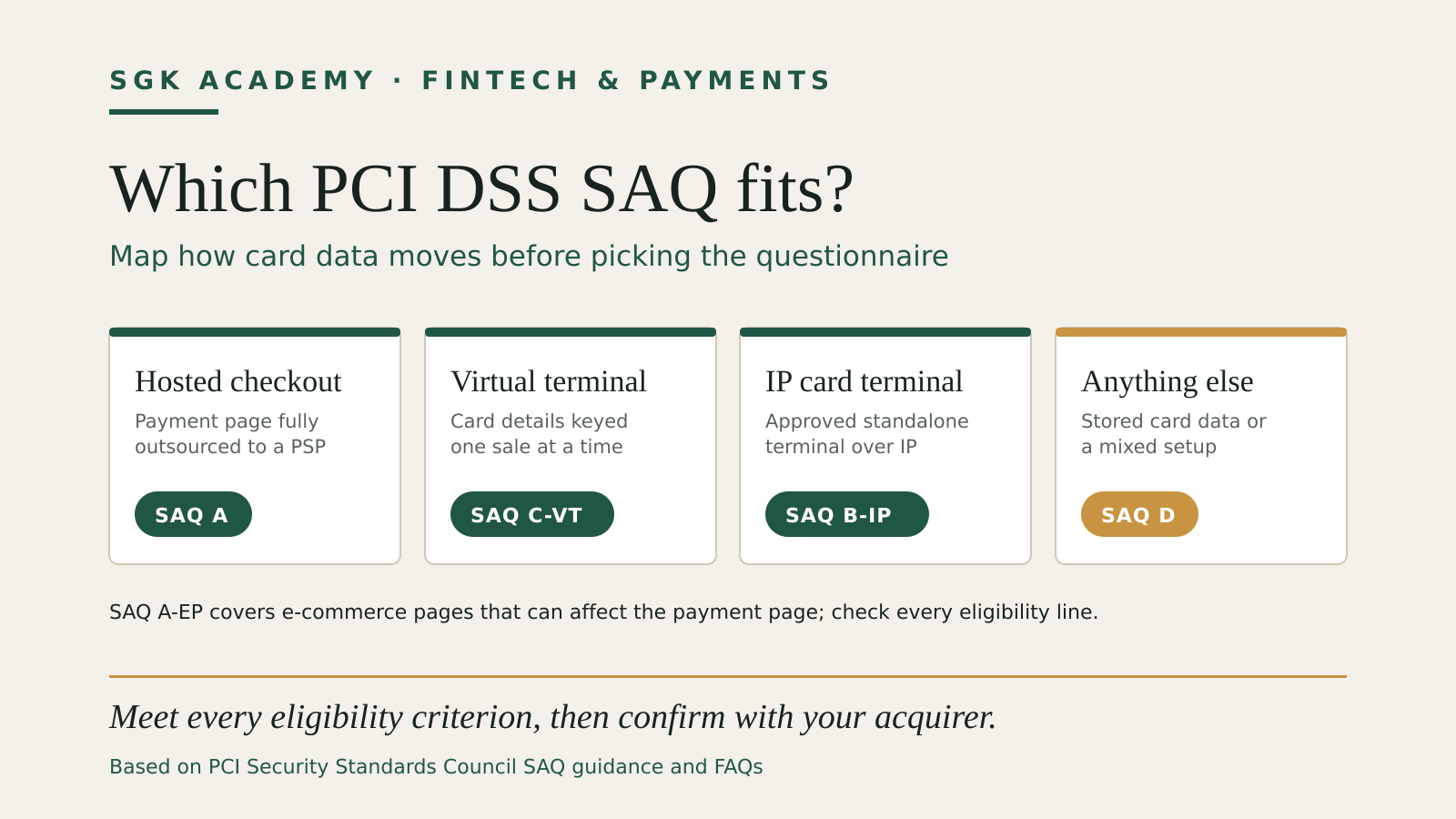
A PCI DSS self-assessment questionnaire is not chosen by business size or by whichever form looks shortest. The right SAQ depends on the exact path card details take through your business: who captures them, which systems can affect the payment, whether anything is stored, and how each payment channel is isolated.
That is why two small shops using the same processor can need different questionnaires. One redirects customers to a hosted payment page. The other embeds a payment form in its own website. A third keys phone orders into a virtual terminal. Their brands may look similar, but their technical environments are not.
Version note: This guide uses PCI DSS v4.0.1 and the current PCI Security Standards Council guidance reviewed on 30 October 2026. Your acquirer or payment brand decides whether you may validate by SAQ and which form it will accept.
What an SAQ does
The PCI Security Standards Council describes SAQs as validation tools for eligible merchants and service providers to perform and report a PCI DSS self-assessment. Each questionnaire combines:
- a set of PCI DSS questions that applies to a defined payment environment; and
- an Attestation of Compliance confirming eligibility and the result of the assessment.
An SAQ is therefore both a security exercise and a reporting form. It does not replace PCI DSS, and selecting a reduced questionnaire does not make other systems disappear from scope. You must meet every eligibility criterion printed in the chosen SAQ.
The Council also makes an important distinction: merchant SAQs are for merchants. For an SAQ-eligible service provider, SAQ D for Service Providers is the only SAQ.
Start with the payment flow, not the form name
Before opening a questionnaire, draw each route by which a customer can pay. Include:
- where the customer enters card details;
- whether your website hosts, redirects to or embeds the payment page;
- every terminal, browser, phone-order process and point-of-sale application;
- any system that stores, processes or transmits cardholder data;
- systems that can affect payment security, even if they do not receive the card number;
- the payment processor and other service providers involved; and
- the network segments that separate one payment channel from another.
Do this for the real environment. A policy saying “we do not store card data” is not enough if staff export reports containing full account numbers, payment software writes logs, or encrypted card data remains in a database. PCI SSC says encrypted cardholder data still counts as cardholder data for SAQ eligibility.
If you have more than one payment channel, treat them separately at first. PCI SSC says a merchant may sometimes use a different SAQ for each channel, or one questionnaire covering all channels. Different SAQs require each channel to meet its own eligibility criteria and adequate segmentation between them. The final arrangement must be agreed with the acquirer or payment brand.
The main merchant SAQs
The table is a route map, not a substitute for the eligibility section inside the current form.
| SAQ | Typical payment environment | Immediate exclusion to check |
|---|---|---|
| A | Card-not-present merchant that fully outsources account-data functions to PCI DSS compliant providers | Not for face-to-face payments; the merchant must not electronically store, process or transmit account data |
| A-EP | E-commerce merchant that outsources payment processing but operates a website that can affect payment security | Only for e-commerce; the site still influences the transaction |
| B | Imprint machines or standalone dial-out terminals only | No electronic cardholder-data storage; not for e-commerce |
| B-IP | Standalone, PTS-approved payment terminals with an IP connection to the processor | The permitted terminal environment must remain isolated from other system types |
| C-VT | Staff key one transaction at a time into a third-party hosted web virtual terminal | The computer and process must meet the strict isolation and no-storage criteria; not for e-commerce checkout |
| C | Internet-connected payment application systems | No electronic cardholder-data storage; not for e-commerce |
| P2PE-HW | Hardware terminals included in and managed through a PCI SSC-listed P2PE solution | The solution and terminals must match the validated listing |
| D for Merchants | Merchant environments that do not fit the other descriptions | Broader assessment; often relevant to mixed, connected or data-storing environments |
| D for Service Providers | SAQ-eligible service providers | The only SAQ for service providers |
Hosted checkout: A or A-EP?
“Outsourced” is too vague to answer this question. Look at how the payment page appears.
A merchant may fit SAQ A when all account-data functions are fully outsourced and the merchant does not electronically store, process or transmit account data. A redirect from the merchant website to the provider’s payment page can fall into this pattern if all other SAQ A criteria are met.
SAQ A-EP is aimed at e-commerce merchants whose websites do not directly receive account data but can affect payment security. A merchant-controlled page that loads or shapes the checkout may create that influence.
Embedded forms require special care. PCI SSC’s February 2025 FAQ explains that the SAQ A script-attack eligibility criterion applies to e-commerce pages containing a processor’s embedded payment page or form, such as an iframe. The criterion does not apply in the same way to redirects or fully outsourced payment functions. For an embedded form, the merchant must confirm protection against script attacks using appropriate techniques or obtain confirmation from the compliant payment provider that its implemented solution supplies that protection.
Do not decide between A and A-EP from the processor’s marketing label. Record whether the checkout is a redirect, embedded form or merchant-hosted page, then compare the implementation with every criterion in the current SAQ.
Virtual terminal: C-VT is narrow
A virtual terminal is a browser-based interface where staff manually key card details. SAQ C-VT applies to a specific setup: one transaction at a time, through an internet-based virtual terminal provided and hosted by a PCI DSS validated service provider, with no electronic cardholder-data storage.
The surrounding computer matters. PCI SSC’s eligibility guidance expects the permitted system type to be isolated from other systems. A laptop used for email, file sharing, accounting downloads and remote support should not be assumed to qualify merely because it can open the virtual terminal.
Write down where phone-order notes are made, whether card details enter email or chat, what the browser stores, what staff paste into other tools, and how the workstation is segmented. Those details often decide whether C-VT fits.
Card terminals: B-IP, P2PE-HW or something broader
SAQ B-IP is for merchants using only standalone, PTS-approved point-of-interaction terminals with an IP connection to the payment processor and no electronic cardholder-data storage. The eligibility is about both the device and its environment.
SAQ P2PE-HW is different. It applies when the merchant uses only hardware payment terminals included in and managed through a validated, PCI SSC-listed point-to-point encryption solution. A terminal that supports encryption is not automatically part of a listed P2PE solution; confirm the solution name, version, approved components and merchant responsibilities against the official listing.
If the point-of-sale application shares a network with broader business systems, or payment software runs on general-purpose equipment, a narrower SAQ may not fit. Network segmentation can isolate permitted systems, but the segmentation has to work in practice.
When SAQ D becomes the likely route
SAQ D for Merchants covers merchants not included in the narrower descriptions. Common signals include:
- electronically stored cardholder data, including encrypted cardholder data;
- a payment application or website that does not meet a narrower SAQ’s full criteria;
- connected systems outside the permitted environment;
- mixed payment channels without adequate segmentation;
- bespoke payment integrations; or
- uncertainty about where account data travels.
SAQ D is not a penalty. It is the questionnaire designed for environments that need a broader set of PCI DSS requirements.
A practical seven-step selection process
1. List every payment channel
Include website checkout, payment links, recurring billing, phone orders, invoices, terminals, mobile acceptance and any fallback process used during outages.
2. Trace account data
For each channel, mark where the primary account number is captured, transmitted, displayed, printed, downloaded, logged or stored. Include service-provider dashboards and staff workarounds.
3. Identify systems that can affect security
For e-commerce, this can include the merchant website and scripts even when a third party receives the card details. For terminals, it can include connected point-of-sale equipment, remote-support tools and the surrounding network.
4. Check service providers
Confirm that the processor or other third-party service provider is PCI DSS compliant for the services you use. Record the service, validation evidence, responsibility split and expiry or review date. Outsourcing changes your scope; it does not remove your responsibility to manage the provider.
5. Test the current SAQ eligibility criteria
Open the current PCI DSS v4.0.1 form. Read its “Before You Begin” or eligibility section line by line. Mark each criterion with evidence. If one criterion is false, unresolved or depends on an assumption, do not sign the attestation for that SAQ.
6. Confirm with the compliance-accepting entity
Send the payment-flow summary to the acquirer, merchant bank or payment brand that receives the assessment. Ask it to confirm:
- whether self-assessment is permitted;
- which SAQ it expects for each channel;
- whether multiple SAQs are acceptable;
- whether an Approved Scanning Vendor scan is required; and
- which documents and submission date apply.
PCI SSC repeatedly directs merchants to this entity because payment-brand compliance programs set validation and reporting requirements.
7. Complete and retain the evidence
PCI SSC’s published sequence is to select the SAQ, confirm scope and eligibility, perform the expected testing, complete the SAQ and Attestation of Compliance, obtain any required ASV scans, and submit the required documents.
Keep the evidence behind each answer. Useful records include network diagrams, terminal inventories, processor agreements, responsibility matrices, provider compliance evidence, scan reports, configuration screenshots, policies, test results and remediation dates.
Common selection mistakes
Choosing by transaction volume
Low volume can affect a payment brand’s validation program, but it does not by itself select the SAQ. PCI DSS applies to payment environments regardless of merchant size, while the payment route determines which questionnaire may fit.
Treating a processor badge as proof
A compliant processor does not automatically make the merchant’s website, terminal network or staff process compliant. Verify exactly which functions are outsourced and which controls remain yours.
Ignoring scripts on an embedded checkout
An iframe can keep card entry inside a provider-hosted form while the surrounding merchant page still affects the transaction. Apply the current SAQ A criteria and the Council’s script guidance to the implementation you actually use.
Assuming encryption removes data from scope
PCI SSC says encrypted cardholder data remains cardholder data for SAQ eligibility. Storage may move the environment toward SAQ D.
Mixing channels into one vague answer
A hosted website, virtual terminal and shop terminal are separate payment channels. Document each, the segmentation between them, and the basis for the questionnaire chosen.
Treating “not applicable” as a shortcut
A reduced SAQ is available only when the complete eligibility statement is true. It is not a menu from which a merchant can remove inconvenient requirements.
Keep the payment environment stable
SAQ selection is only accurate while the environment matches the evidence. Review it when you change processors, add a checkout plug-in, embed a new form, introduce a terminal, allow remote support, connect a point-of-sale system, store new report fields or open another location.
Access changes matter too. Use a repeatable cloud access offboarding checklist when staff or contractors leave. If fraud or an unknown transaction appears, the guide to unauthorised business-account payments explains the UK reporting and refund framework. Businesses considering a non-card route can also compare the operating model in Pay by Bank for business.
The useful outcome is not the shortest questionnaire. It is a documented payment flow, a form whose eligibility criteria are all true, and confirmation from the organization that will accept the assessment.
Official sources
- PCI SSC: What is a PCI DSS Self-Assessment Questionnaire?
- PCI SSC: Self-Assessment Questionnaire payment-environment guide
- PCI SSC: Intent of SAQ eligibility criteria
- PCI SSC: Steps to perform a PCI DSS self-assessment
- PCI SSC: SAQ A guidance for e-commerce scripts
- PCI SSC: Multiple processing environments
- PCI SSC: Encrypted cardholder data and SAQ eligibility
- PCI SSC bulletin: SAQs for PCI DSS v4.0.1



