
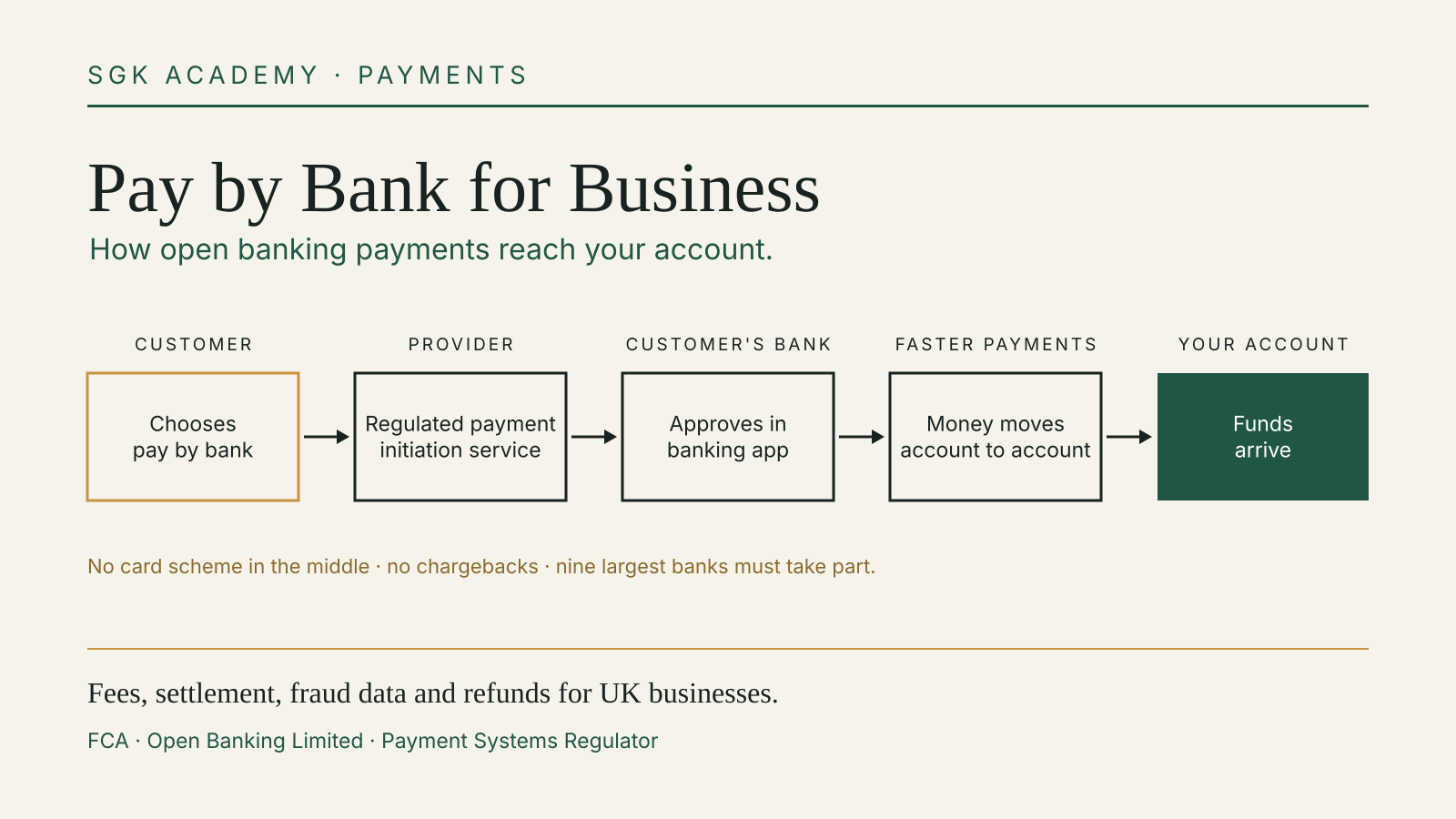
Pay by bank lets a business take payment straight from a customer’s bank account, without a card. The customer picks their bank at checkout or on an invoice link, approves the payment in their banking app, and the money moves as a bank transfer, usually through Faster Payments. A regulated payment initiation provider sits in the middle. For a small business, the appeal is lower fees, fast settlement and no mistyped account details; the trade-offs are weaker dispute rights for customers and patchier support for recurring payments.
Source and version check: reviewed 22 October 2026 against the Payment Services Regulations 2017, the FCA’s page on payment services, Open Banking Limited’s consumer and VRP pages and its June 2026 fraud monitor, and the Payment Systems Regulator’s pages on account-to-account payments and APP scams. Provider pricing and features change often and are not covered here. This guide is general information, not financial or legal advice.
If you are comparing ways to get paid, read this alongside our guides to card processing fees and Direct Debit for small businesses.
The short answer
| Question | Answer |
|---|---|
| What is pay by bank? | A payment the customer authorises in their own banking app, sent directly from their account to yours |
| What makes it legal and safe? | The provider must be authorised or registered by the FCA to offer payment initiation services |
| Which rail does it use? | Usually Faster Payments, the same rail as an ordinary UK bank transfer |
| Which customers can use it? | Customers of UK banks and building societies that offer open banking; the nine largest are required to |
| Is it good for subscriptions? | Only partly. Variable recurring payments are mandated for sweeping between a customer’s own accounts, not for paying businesses |
| How common is fraud? | Open Banking Limited reports around one fraudulent payment in 6,000 during 2025, against one in 2,500 across UK payments |
| Can the customer charge it back? | Not in the card sense. Disputes go through refunds you make and the customer’s bank |
How a pay by bank payment works
In its simplest form, an account-to-account payment moves money directly from a payer’s bank account to a payee’s bank account without intermediaries such as card schemes. That is how the Payment Systems Regulator describes it on its account-to-account payments page. Open banking adds a regulated provider that starts the payment for the customer, so they never type your sort code or account number.
A typical journey looks like this:
- The customer chooses “pay by bank” at checkout, on a payment link or from a QR code on an invoice.
- They pick their bank from a list.
- The provider sends them to their banking app or online banking, with the amount and your account already filled in.
- The customer authenticates with their bank, as they would for any transfer, and approves the payment.
- The bank sends the money, and the provider tells your system it has been initiated.
Open Banking Limited’s page on what open banking is stresses that customers opt in explicitly and that you only connect to services they have chosen. It also notes that many organisations, including HMRC, already accept open banking payments, so many of your customers will have seen the flow before.
Who is allowed to offer it
The legal name for what the provider does is a payment initiation service. Regulation 2 of the Payment Services Regulations 2017 defines it as an online service to initiate a payment order at the request of the payment service user with respect to a payment account held with another payment service provider. It is one of the payment services listed in Schedule 1, Part 1 of the regulations.
The FCA’s page on the Payment Services Regulations and E-Money Regulations says firms providing payment services in the UK as a regular business need to be authorised or registered, unless they are already another type of payment service provider or are exempt. Before signing up, check two things:
- the provider, or the regulated firm it works with, appears on the FCA register with payment initiation permissions;
- it is enrolled in the open banking ecosystem. Open Banking Limited keeps a list of regulated providers, and says only firms regulated by the FCA or a European regulator can enrol in its Directory.
Many payment gateways now offer pay by bank as one method alongside cards. In that case the regulated payment initiation firm may be a partner rather than the gateway itself; your contract should say who it is.
Which customers can pay this way
Open Banking Limited says only the UK’s nine largest banks and building societies are required to make their customers’ accounts available through open banking. Smaller banks and building societies may take part voluntarily. Most UK personal and business current account holders can therefore pay by bank, but not all. Keep another payment method available.
Costs and settlement
Pay by bank does not run on card scheme rails, so there is no interchange or scheme fee in the price. Providers usually charge a fixed fee per payment or a small percentage, and some bundle it into a gateway plan. Compare their quotes with the costs set out in our card processing fees guide, including any monthly minimums.
Speed matters as much as price. When the customer’s bank sends the payment through Faster Payments, it normally arrives in your account within minutes, rather than waiting for a card acquirer’s settlement cycle. For a business that watches its cash position closely, that can shorten the gap between a sale and usable cash. Our cash runway calculator shows how a few days of settlement time affect your buffer.
Our guide to CHAPS and Faster Payments explains how the underlying rail handles limits and timing.
Recurring payments and VRPs
One-off payments are where pay by bank works best today. For repeat payments, the relevant technology is variable recurring payments (VRPs). Open Banking Limited’s VRP page describes them as a payment instruction that lets customers connect an authorised provider to their bank account to make payments on their behalf within agreed limits, such as a maximum per day, week, month or year, and an end date. Customers can see and cancel the permission in their banking app.
The important limit is the mandate. The Competition and Markets Authority required the nine largest banks to offer VRPs for sweeping, meaning moving money between a customer’s own accounts. Using VRPs to pay a business, sometimes called commercial VRPs, is not part of that mandate, so availability depends on each bank and provider. For subscriptions and invoices you collect regularly, Direct Debit remains the widely supported option.
| Direct Debit | Card on file | VRP | |
|---|---|---|---|
| Customer can see a limit on future payments | No cap on future amounts | No | Yes, set in the mandate |
| Customer cancels | Through their bank or with you | Through you or the card issuer | In the banking app |
| Availability for paying a business | Widely available | Widely available | Depends on bank and provider |
The first two rows follow Open Banking Limited’s own comparison on its VRP page.
Fraud, mistakes and disputes
What the data says
Open Banking Limited’s Payments Fraud Monitor, June 2026 edition reports that during 2025 around one in 6,000 open banking payments were fraudulent, compared with around one in 2,500 across the wider UK payments industry. Authorised push payment (APP) fraud made up more than two-thirds of reported open banking related fraud cases, and VRPs showed lower fraud rates than single immediate payments. The same report counts more than 19 million active user connections and over 40 million payments a month.
Because the provider fills in your account details, the customer cannot mistype them. That removes one common source of misdirected payments, though not every scam. If you also send payments, our guides to Verification of Payee and invoice fraud checks cover the other side.
What protection the customer has
Card payments come with chargeback rights through the card schemes. Pay by bank does not. Open Banking Limited says a customer’s bank will normally refund unauthorised payments, and customers can complain to the Financial Ombudsman Service. For scams, the Payment Systems Regulator’s APP scams page says its reimbursement requirement covers payments made by Faster Payments or CHAPS from one UK account to another, with sending and receiving firms splitting the cost 50:50 and most victims reimbursed within five business days.
None of those routes covers a customer who simply wants their money back for goods that never arrived or did not match the description. The PSR itself lists dispute processes as one of four barriers to wider use of account-to-account payments for retail, alongside functional capability, access and reliability, and pricing. In practice, this means:
- publish a clear refund policy and process refunds promptly as a transfer back to the customer;
- record the payment reference the provider gives you, so you can match refunds to orders;
- consider keeping cards available for higher-value or first-time customers who expect chargeback protection.
Is pay by bank right for your business?
| Your situation | Pay by bank fit |
|---|---|
| You send invoices to business customers | Strong. A payment link removes typing errors and speeds up settlement |
| You sell online with average orders of tens of pounds or more | Worth testing alongside cards |
| You run monthly subscriptions | Weak for now; use Direct Debit unless your provider supports commercial VRPs |
| Many customers bank with small or overseas providers | Limited; keep cards as the default |
| You take payments in person | Possible through QR codes, but check how your staff confirm a payment has been sent |
A worked example
This scenario is illustrative and the fees are invented for the arithmetic.
A design studio invoices about £20,000 a month across 40 clients. Card payments cost it 1.5% plus 20p each, about £308 a month. A pay by bank provider quotes 30p per payment. If half the clients switch, the card cost on the remaining £10,000 is about £154, and the pay by bank fees are £6, so the monthly cost falls by roughly £148. The studio also sees those payments arrive within minutes instead of waiting for card settlement. Its real decision is about the minimum monthly fee, the onboarding effort and whether clients are willing to approve payments in their app.
Official sources
- Payment Services Regulations 2017, regulation 2 (definitions)
- Payment Services Regulations 2017, Schedule 1 Part 1
- FCA: Payment Services Regulations 2017 and Electronic Money Regulations 2011
- Open Banking Limited: What is open banking?
- Open Banking Limited: Variable recurring payments
- Open Banking Limited: Regulated providers
- Open Banking Limited: Payments Fraud Monitor, June 2026 edition
- Payment Systems Regulator: Account-to-account payments
- Payment Systems Regulator: APP scams



