
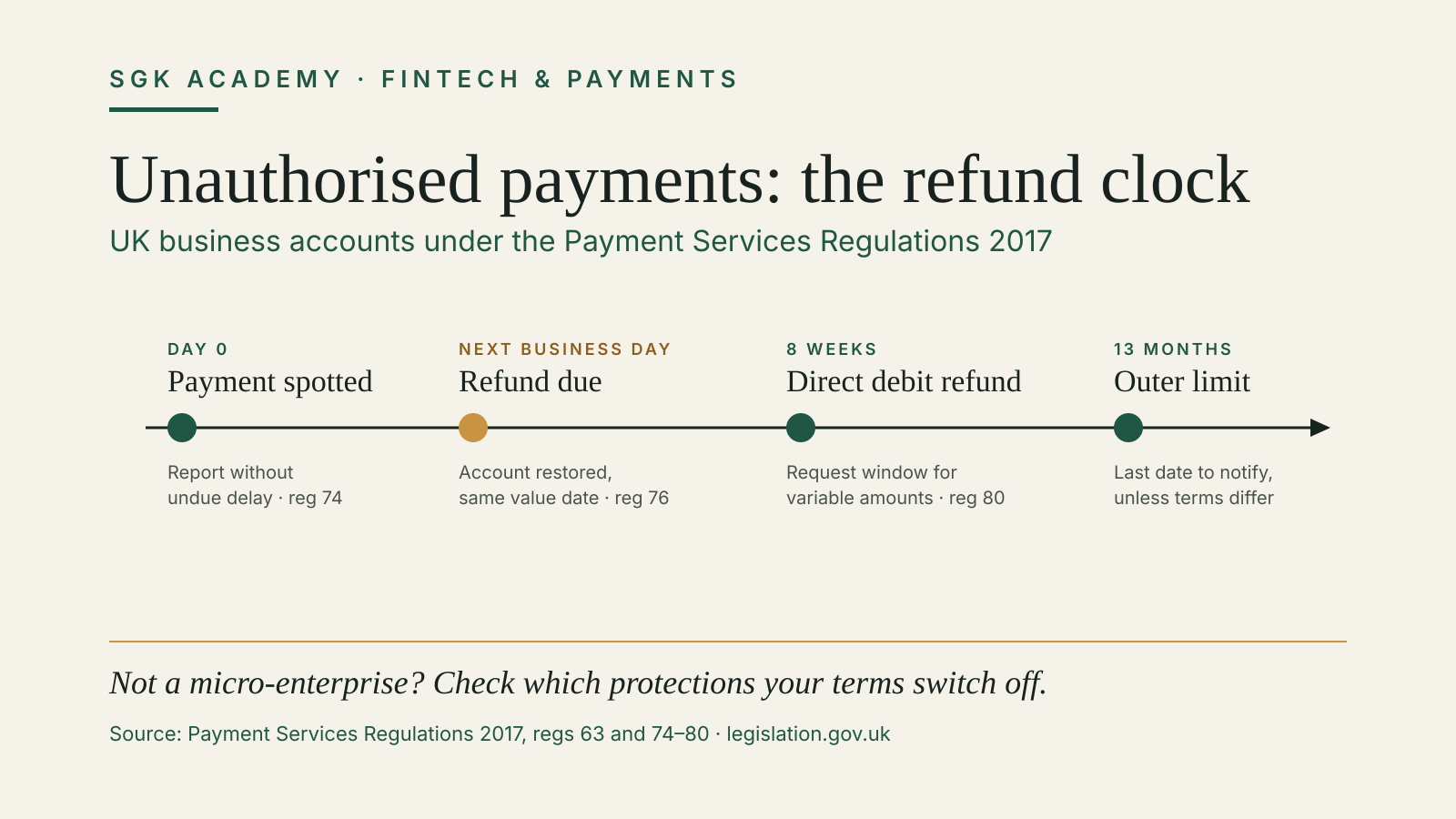
If a payment leaves your business account and nobody in the business authorised it, UK law usually puts the loss on the bank, not on you. Under the Payment Services Regulations 2017, the provider must refund an unauthorised payment by the end of the next business day after it learns of it. The catch for businesses is size: larger companies can sign contracts that switch off parts of that protection.
This guide covers who is protected, what to do in the first day, and when the bank can refuse.
Source review date: 28 October 2026. The regulation references are to the Payment Services Regulations 2017 as published on legislation.gov.uk. This is general information, not legal advice.
What counts as unauthorised
A payment is authorised only if the payer gave consent in the form and by the procedure agreed with the bank or payment provider (regulation 67). In practice, unauthorised payments on a business account include:
- card payments made with a lost, stolen or cloned company card;
- transfers made by someone who obtained online banking credentials without the business’s permission;
- direct debits collected without a valid mandate;
- payments the bank executed after the business had withdrawn consent.
A payment your own staff member approved because a criminal tricked them is different. The business consented, so it is an authorised payment, even though it was a fraud. Different rules apply to it, and our guide to invoice fraud payment checks covers prevention. A payment sent to the wrong account because someone typed the wrong sort code is also authorised; the bank’s duty there is to make reasonable efforts to recover the money (regulation 90).
The line matters because the refund duty below applies only to unauthorised transactions.
Is your business protected? Check the size test first
The full set of protections applies automatically to consumers, charities and micro-enterprises. For everyone else, the 2017 Regulations allow the bank and the customer to agree that some of the key rules do not apply.
Regulation 2 defines a micro-enterprise by reference to the EU Recommendation 2003/361 definition. The European Commission’s SME definition page sets that at fewer than 10 staff and an annual turnover or balance sheet total of no more than €2 million. The test is applied when the payment services contract is made.
If your business is larger than that, regulation 63(5) allows your bank to agree with you that these protections do not apply:
| Rule that can be disapplied | What it normally does |
|---|---|
| Regulation 75 | Puts the burden of proving authentication on the bank |
| Regulation 77 | Caps the payer’s liability for unauthorised payments |
| Regulations 79 and 80 | Give refund rights for some payee-initiated payments, including direct debits |
| Regulations 91 and 92 | Make the bank liable for non-execution or defective execution |
| Regulation 94 | Covers charges and interest arising from those failures |
The same regulation lets the parties agree a different period from the 13-month notification limit in regulation 74. Regulation 40(7) gives similar freedom over the information rules.
The core refund duty in regulation 76 is not on the list. But if regulation 75 has been switched off, the burden of proof can shift, and that can decide a dispute. Read the business account terms for phrases such as “corporate opt-out” or “if you are not a micro-enterprise”. If you cannot find them, ask the bank in writing which regulations it has disapplied.
The refund rule
Where a payment was not authorised, regulation 76 requires the provider to:
- refund the amount of the unauthorised payment; and
- where applicable, restore the account to the state it would have been in had the payment not happened.
The refund must be made as soon as practicable, and no later than the end of the business day after the day the provider becomes aware of the unauthorised transaction. When the account is credited, the value date must be no later than the date the money was taken, so any interest or charges caused by the debit should be unwound.
There is one main exception to the timing. If the provider has reasonable grounds to suspect fraudulent behaviour by the customer and reports those grounds in writing under the Proceeds of Crime Act 2002, the next-business-day deadline does not apply. That pauses the clock; it does not by itself mean the claim fails.
Who has to prove what
When a customer denies authorising a payment, regulation 75 puts the burden on the provider. It must prove that the transaction was authenticated, accurately recorded, entered in its accounts and not affected by a technical breakdown.
Crucially, regulation 75(3) says that the bank’s record of a card, device or password being used is not in itself necessarily enough to prove that the payer authorised the payment, or that the payer acted fraudulently or with gross negligence. A bank that rejects a claim with “the correct PIN was used” has not, on that alone, met the test.
For a business that is not a micro-enterprise and has signed away regulation 75, this protection may not be available. That is one more reason to check the account terms now, before a dispute.
When the business can be left with some of the loss
Regulation 77 sets the payer’s share:
| Situation | Payer’s maximum liability |
|---|---|
| Lost or stolen card or other payment instrument, or misappropriation | Up to £35 |
| The loss or theft could not have been detected before the payment (unless the payer acted fraudulently) | Nothing |
| The loss was caused by the bank’s own staff, agents or outsourcers | Nothing |
| Payer acted fraudulently | All losses |
| Payer failed, intentionally or with gross negligence, to keep the instrument and credentials safe | All losses |
| Losses after the business notified the bank | Nothing (unless fraud) |
| Bank did not apply strong customer authentication where required | Nothing (unless fraud) |
| Bank did not provide a way to report a lost or stolen instrument | Nothing (unless fraud) |
The safekeeping duty comes from regulation 72: the user must take all reasonable steps to keep personalised security credentials safe and must notify the provider without undue delay on becoming aware of loss, theft, misappropriation or unauthorised use.
“Gross negligence” is a high bar. Writing the card PIN on the card, or sharing a banking password with someone outside the business, is the sort of conduct a bank will argue meets it. Ordinary carelessness generally should not.
For a business, the practical point is access control. If several staff share one login or one card, it becomes much harder to show that a payment was not made by someone the business authorised.
The deadline: 13 months, but report at once
Regulation 74 entitles the user to redress only if it notifies the provider without undue delay, and in any event no later than 13 months after the debit date. The 13-month limit does not bite if the provider failed to give the required transaction information.
Two cautions apply:
- Without undue delay is the real test. Thirteen months is the outer limit. A business that sees an unknown payment in its monthly reconciliation and waits weeks to report it gives the bank an argument.
- Larger businesses may have a shorter period. Under regulation 63(5), a business that is not a micro-enterprise can be bound by a different, often shorter, notification period in its account terms.
A weekly bank reconciliation, rather than a monthly one, shortens the gap between the debit and the moment you notice.
Direct debits and card pre-authorisations
Some payments are authorised but still refundable. Under regulation 79, the payer is entitled to a refund of a payee-initiated payment where the authorisation did not specify the exact amount and the amount taken exceeded what the payer could reasonably have expected. Euro SEPA direct debits carry an unconditional refund right under the same regulation.
Regulation 80 says the request must be made within 8 weeks of the debit, and the provider must refund or justify a refusal within 10 business days.
UK sterling direct debits also have the Direct Debit Guarantee, which is a scheme rule rather than a regulation. Our guide to direct debit for small business explains how it works from both sides. Card disputes over goods or services that were authorised but not delivered go through the card scheme chargeback process; the card processing fees guide covers chargeback costs for merchants.
What to do in the first 24 hours
- Call the bank’s fraud line and report every payment you do not recognise. Ask for a reference number.
- Freeze the route. Cancel or freeze the card, revoke the user’s online banking access or reset credentials. Under regulation 77(4), losses after notification fall on the bank unless you acted fraudulently.
- Follow up in writing the same day. State that you did not authorise the listed payments, give dates and amounts, and ask for a refund under regulation 76.
- Preserve evidence. Export statements, login and device logs if your banking platform shows them, and a list of who holds cards and credentials.
- Check internal authority. Confirm with every card holder and banking user that none of them made the payment. If one did, it is probably an authorised payment and a different process applies.
- Report the crime to Action Fraud (or Police Scotland in Scotland) and give the crime reference to the bank.
- Diary the deadline. If no refund has arrived by the end of the next business day, chase it in writing and quote the regulation.
Record the date and time of every call. The time you notified the bank matters under both regulation 74 and regulation 77.
If the bank refuses
Make a formal complaint. For complaints about payment services rights and obligations, the FCA’s dispute rules in DISP 1.6.2A require a final response within 15 business days, extendable to 35 business days in exceptional circumstances if the bank sends a holding reply explaining the delay.
If the final response does not resolve it, the Financial Ombudsman Service may be able to help. Its eligibility page covers micro-enterprises (fewer than 10 staff and turnover or balance sheet not over €2 million) and small businesses with annual turnover under £6.5 million and either a balance sheet under £5 million or fewer than 50 staff. Larger businesses usually need to rely on their contract and the courts.



