A non-resident business does not escape the Construction Industry Scheme because it is incorporated, managed or paid outside the United Kingdom. If it pays subcontractors for construction work carried out in the UK, or receives payment as a subcontractor for that work, CIS can apply.
The practical questions are whether the work is within scope, which role the overseas business has, whether HMRC registration and verification are complete, and what evidence must travel with each payment.
Reviewed against HMRC’s CIS 340 guide and non-resident registration guidance on 29 October 2026. HMRC forms and processes can change; check the linked official pages before filing.
The short answer
| Situation | CIS consequence |
|---|---|
| Overseas contractor pays subcontractors for UK construction work | It normally registers as a contractor, verifies subcontractors, makes required deductions and files returns |
| Overseas subcontractor is paid for UK construction work | It should register before starting so HMRC can determine its payment status |
| Construction work is carried out outside the UK | CIS does not apply merely because a UK customer makes the payment |
| Payment is sent to an overseas account | The payment location does not remove UK work from CIS |
| HMRC returns gross payment status | The contractor can pay without a CIS deduction |
| HMRC returns registered status | The contractor normally deducts at 20% |
| HMRC cannot verify the subcontractor | The higher 30% rate may apply |
HMRC’s CIS 340 guide says there is no difference in CIS treatment between UK and non-resident contractors and subcontractors. Residence affects the registration route and wider tax analysis, not the basic test of where the construction work is carried out.
Start with the work, not the invoice address
CIS covers construction operations carried out in the UK. HMRC’s examples include site preparation, alterations, dismantling, construction, repairs, decorating and demolition. The UK scope includes territorial waters up to the 12-mile limit.
That geographic test prevents two common mistakes. A foreign company cannot treat UK site work as outside CIS merely because its contract, bank account and billing are overseas. Section 5.1 of CIS 340 states that it does not matter where payment is actually made: if the construction work is carried out in the UK, the scheme applies to that payment.
A UK connection also does not pull every foreign project into CIS. Work physically carried out outside the UK is outside the scheme. Mixed contracts should separate UK and non-UK operations with enough evidence to support the allocation.
Contractor, subcontractor or both
A contractor is a business that pays subcontractors for construction work. A subcontractor is a business that carries out construction work for a contractor and is paid for it. One company can hold both roles in the same project chain.
An overseas main contractor that hires UK installers is a CIS contractor. An overseas specialist hired by a UK main contractor is a CIS subcontractor. If that specialist hires another firm to complete part of the UK work, it can be both.
Map the actual chain:
- Who promised the construction result to the customer?
- Who carries out the work?
- Who pays whom for that work?
- Where is each operation physically carried out?
- Does the payment include materials, plant, design or other components?
The labels used in a commercial contract are not conclusive. The payment and work determine the CIS role.
Register before the first UK payment
HMRC says a non-resident subcontractor should register before starting work in the UK. Otherwise, the contractor will have to make deductions at the higher rate.
A company based outside the UK can use HMRC’s non-resident CIS registration form to register as a contractor or subcontractor. The form has to be completed in one sitting before it can be printed, so gather everything first. The page’s change history records that HMRC reinstated the CIS305 print-and-post form so that businesses based outside the UK can register as a subcontractor and apply for gross payment status.
Have the legal name, country of incorporation, registered office, responsible persons, any UK tax references and details of the UK construction activity ready before starting. Do not invent a UK address or reuse another group entity’s identifier. For questions about how CIS applies to a non-resident company, CIS 340 lists the CIS helpline, which takes overseas calls on +44 161 930 8706.
CIS registration is not a statement that no other UK tax applies. Section 5.4 of CIS 340 says that if a business is trading in, dealing in or developing UK land, the profits are taxed in the UK and HMRC must be told so the company can register for Corporation Tax. VAT, payroll, permanent-establishment and employment-status questions remain separate. Our United Kingdom company profile collects the registry and tax links for a UK presence.
Verification determines the deduction instruction
A contractor verifies a subcontractor with HMRC before making the first payment, unless the contractor has included that subcontractor on a CIS return in the current or previous two tax years. A company in a group also does not need to verify a subcontractor that another company in the same group verified within that period.
HMRC returns a payment status and verification reference. The usual outcomes are:
- gross payment status: pay without a CIS deduction;
- registered for payment under deduction: normally deduct at 20%;
- not registered or not successfully verified: normally deduct at 30%.
Verification is an instruction from HMRC to the contractor. A subcontractor’s invoice, status with another contractor or old screenshot is not a substitute.
Keep the legal name and unique taxpayer reference aligned with HMRC’s record. A group name or another company’s identifier can produce failed verification and the higher deduction.
Calculate the deduction on the correct amount
CIS is not simply a percentage of the invoice total. HMRC’s worked examples in CIS 340 apply the deduction after excluding the direct cost of materials and VAT.
Separate:
- the subcontractor’s own cost of materials used in the work;
- labour and other amounts within the deduction base;
- VAT, where applicable;
- plant hire and consumables under the detailed CIS rules.
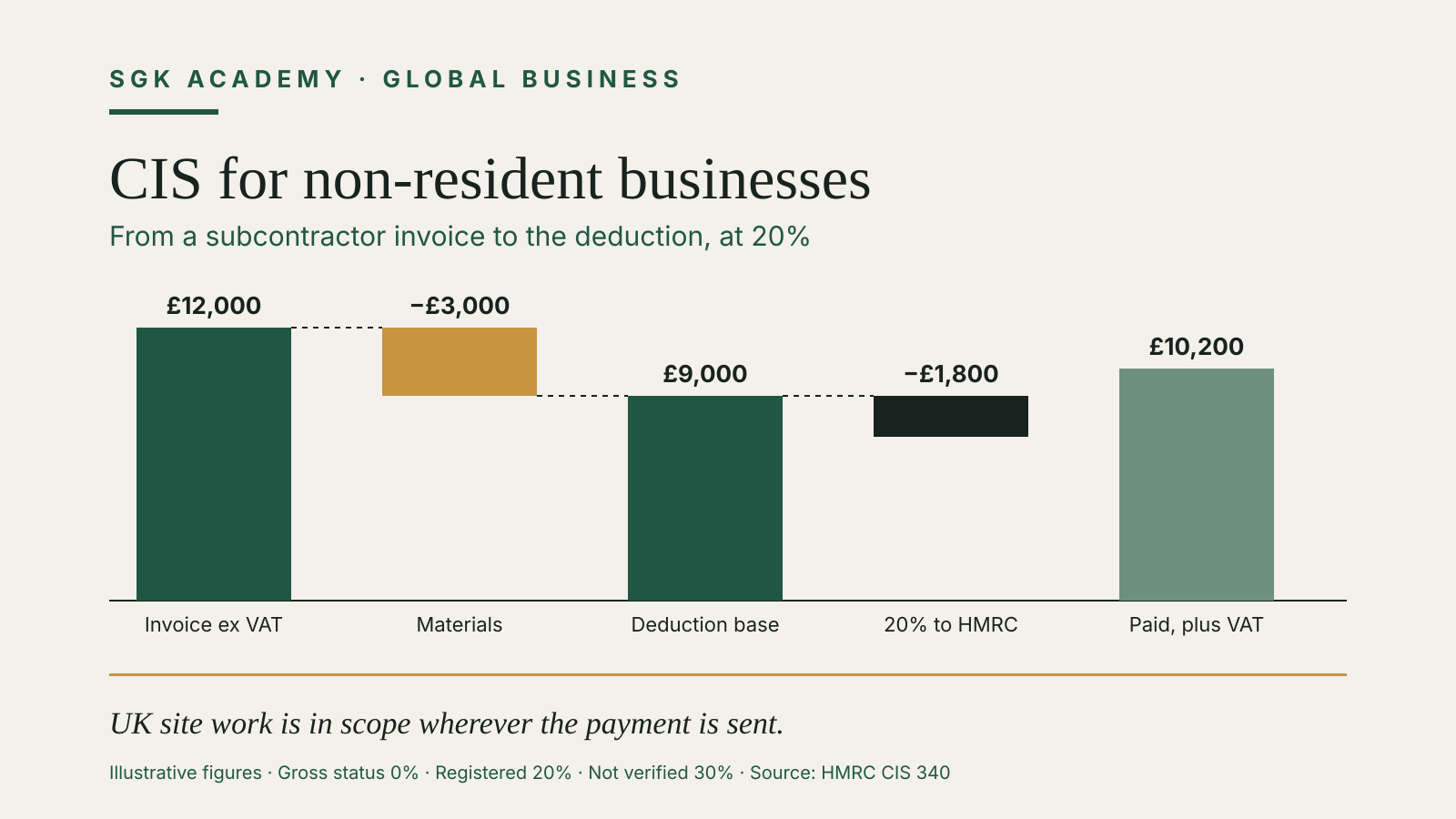
Suppose an invoice is £12,000 before VAT and includes £3,000 of qualifying materials. At 20%, the illustrative deduction base is £9,000 and the CIS deduction is £1,800. The contractor pays the subcontractor £10,200 (£12,000 minus £1,800), plus any VAT due on the invoice, and reports the gross payment, the materials and the deduction on the monthly return. The £1,800 goes to HMRC.
If the same subcontractor had failed verification, the 30% rate would apply to the same £9,000 base: a £2,700 deduction and a £9,300 payment before VAT. If it held gross payment status, the full £12,000 would be paid without a deduction.
Mixed supplies, fuel, accommodation, plant and materials bought by another party need a closer reading of HMRC’s rules. Ask for invoices or other evidence rather than accepting a round materials estimate.
Issue a payment and deduction statement
When a deduction is made, the contractor gives the subcontractor a statement showing the gross payment, amounts excluded from the calculation, the deduction and identifying details. CIS 340 requires it within 14 days of the end of each tax month, so by the 19th. It may be sent electronically only where both sides agree and the subcontractor can store and print it.
The statement lets the subcontractor reconcile receipts and claim credit in the correct tax process. A bank receipt showing only the net amount is not enough.
For a cross-border group, issue the statement to the legal entity that earned the income. Do not address it to a parent, branch or treasury agent merely because that party handles cash.
File the monthly return and pay the deductions
CIS tax months run from the sixth of one month to the fifth of the next. HMRC’s monthly return guidance requires the return by the 19th after the tax month ends.
The return records subcontractors, payments and deductions. It includes declarations about employment status and verification. A mainstream contractor that paid no subcontractors in a month must file a nil return or tell HMRC about a period of inactivity by the 19th, rather than silently omitting the period.
Paying HMRC is separate from filing the return. HMRC’s payment guidance says to pay every month by the 22nd, or the 19th if paying by post, in the same way as PAYE and National Insurance. Reconcile payment statements, the monthly return, the CIS ledger and the amount remitted.
Keep employment status separate
CIS registration does not turn a worker into a self-employed subcontractor. The monthly return includes a declaration that the contractor has considered employment status.
Review control, substitution, financial risk, equipment, integration and mutual obligations. If the facts point to employment, PAYE may apply even where the person has a UTR and previously worked as a subcontractor.
Revisit status when the project or working method changes. A contract label cannot override daily reality.
Pre-project checklist
Before the first UK site payment:
- Identify every UK construction operation.
- Map contractor and subcontractor roles.
- Register the overseas entity for the correct role.
- Obtain identifiers needed for verification.
- Check employment status for each individual engagement.
- Verify each new subcontractor and save the response.
- Agree how materials and VAT will be evidenced.
- Configure payment statements and the CIS ledger.
- Assign responsibility for returns and HMRC payments.
- Reconcile deductions before the filing deadline.
- Review Corporation Tax, VAT and payroll separately.
- Keep records where both the overseas finance team and UK adviser can retrieve them.
The process should survive staff changes. A workflow held only in one project manager’s inbox is likely to fail.
Common mistakes
Treating gross payment status as a tax exemption
Gross payment status removes deduction at source. It does not mean the subcontractor has no UK tax obligations.
Verifying a trading name instead of the legal entity
Verify the entity being paid. Group brands can hide a mismatch.
Deducting from VAT or unsupported materials
Use HMRC’s calculation rules and evidence the material cost. Do not apply a percentage to the whole invoice by habit.
Assuming an overseas payment is outside CIS
HMRC follows the location of the construction work, not the bank account.
Filing without paying the deductions
The return and remittance are related but separate obligations, with different deadlines. Reconcile and complete both.
When the UK project ends
CIS 340 also covers the exit. A non-resident company can de-register once it has no CIS activity in the UK. A contractor that stops trading may still need to file the return for the last month, pay any deductions already taken and tell HMRC the date it stopped paying subcontractors. A non-resident subcontractor writes to PT Operations North East England at the address in the guide.
How this fits a wider setup
CIS is one operating requirement. A non-resident company may also need UK tax registration, payroll, VAT analysis, insurance and site-access documentation. If staff from the overseas company work on site for long periods, read our guide to permanent establishment risk as well.
Our EIN guide for non-residents illustrates why identifiers must follow the correct legal entity. A 13-week cash-flow forecast can make withheld CIS amounts and HMRC payment dates visible before they become a funding surprise.
The core rule is direct: UK construction work can put an overseas business inside CIS. Register the correct entity, verify before payment, calculate from supported figures and keep the return, statement and bank movement tied together.