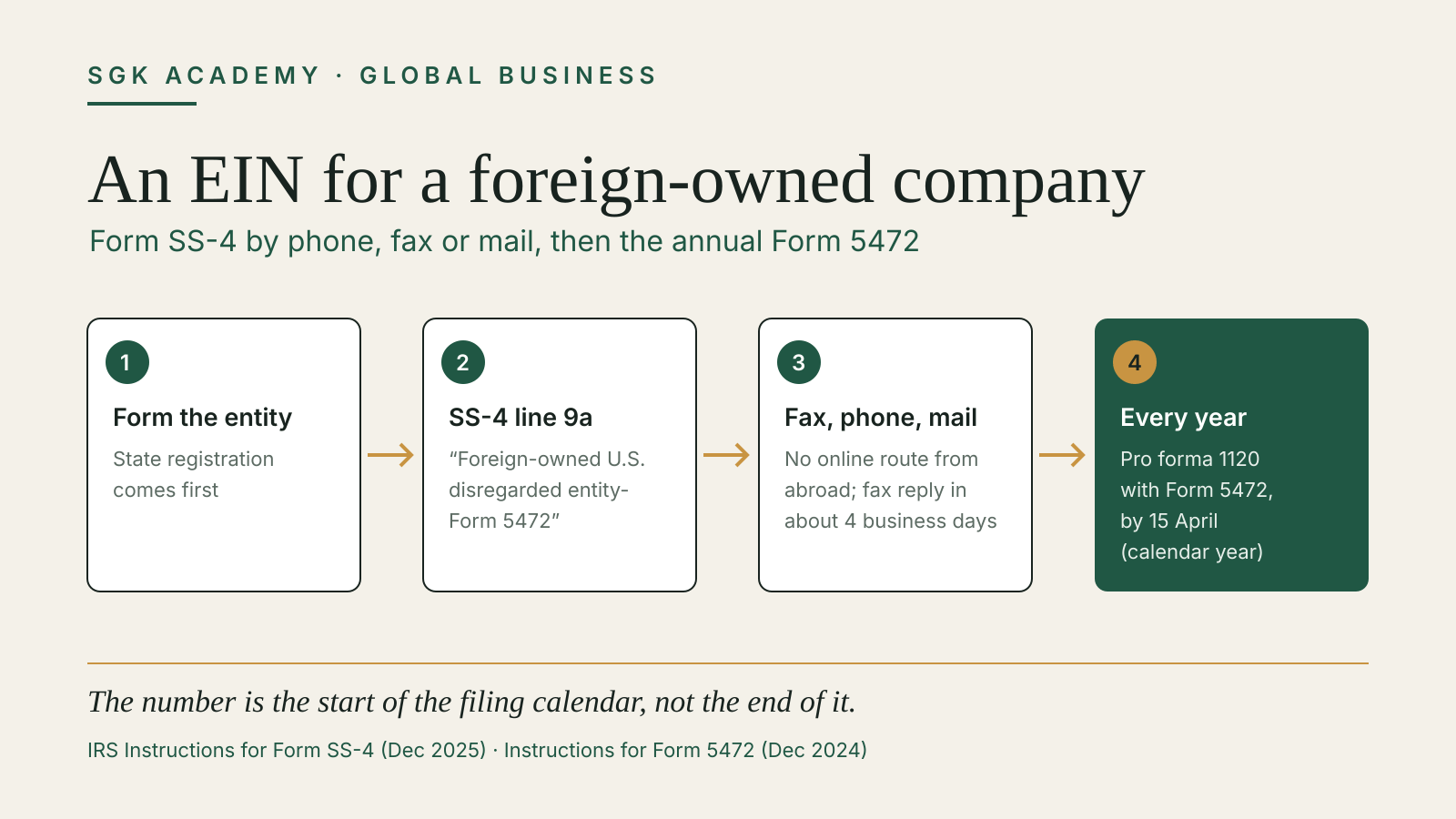
An EIN for non resident owners is issued to the company, not to the person behind it. The usual case is a US LLC or corporation owned and run from abroad, which cannot use the IRS online application and must send Form SS-4 by phone, fax or mail. What the IRS records on that form also sets the returns the company files afterwards.
This guide covers the entity side: which structure is applying, how the classification lines work and what follows the number. If your question is how an individual without an SSN or ITIN completes the responsible-party line, read our guide to getting an EIN without an SSN alongside this one.
Sources checked 27 October 2026: IRS Instructions for Form SS-4 (December 2025), Instructions for Form 5472 (December 2024), 2025 Instructions for Forms 1120 and 1120-F, and FinCEN’s beneficial ownership page.
What an EIN is and what it is not
An employer identification number is a nine-digit federal tax number, written like 12-3456789. The Form SS-4 instructions describe it as the number assigned to corporations, partnerships, estates, trusts and other entities for tax filing and reporting, and say the information on the form establishes the business tax account. Despite the word “employer,” a company with no staff may still need one.
An EIN does not give its owner immigration status, work authorization, a US address or automatic access to a bank account. It does not replace an SSN or ITIN when an individual return requires one, and it does not decide how the entity is taxed. The IRS says plainly that the entity-type line on Form SS-4 is not an election of tax classification.
Start with the entity that is applying
Non-resident owners usually apply for one of four structures. Each one is described differently on line 9a of Form SS-4, and each leads to a different federal filing pattern.
| Entity owned from abroad | Default federal treatment | What line 9a shows | Federal return that usually follows |
|---|---|---|---|
| Single-member US LLC, owned by one foreign person | Disregarded as separate from its owner | “Other”, with “Foreign-owned U.S. disregarded entity-Form 5472” | Pro forma Form 1120 with Form 5472 attached |
| US LLC with two or more members | Partnership | “Partnership” | A partnership return |
| US corporation, or an LLC that elects corporate treatment on Form 8832 | Corporation | “Corporation”, plus the return number (for example, 1120) | Form 1120 |
| Foreign company with US business activity | Depends on the foreign entity rules | The box matching its classification | Form 1120-F if it is a foreign corporation with a US filing duty |
The defaults in the first three rows come from the SS-4 instructions. By default a domestic single-member LLC is disregarded and a domestic LLC with two or more members is a partnership. A foreign LLC follows different defaults: it is treated as a corporation if all members have limited liability, as a partnership if it has two or more members and at least one lacks limited liability, and as disregarded if its single owner lacks limited liability.
The last row matters for founders who never form a US entity. The Instructions for Form 1120-F say a foreign corporation must file that return if it was engaged in a trade or business in the United States during the year. That applies whether or not it had US-source income from that business, and whether or not a tax treaty exempts the income. A foreign company in that position needs an EIN for its own return. The protective-return rules in those instructions are worth reading if the company thinks its US activity is too limited to count.
If you are still choosing where to form, compare the options in SGK Academy’s company formation directory before applying. The EIN should be the step after formation, not the first decision.
Confirm the entity exists before applying
The IRS asks applicants forming an LLC, partnership or corporation to finish the state registration first. Applying too early can attach the EIN to a name or structure that later changes.
Use the legal name exactly as it appears on the formation document. A trade name goes on its own line. A mismatch causes trouble when the company later shows the IRS confirmation to a bank, a payment provider or a tax preparer.
The responsible party is a person, not the agent
Form SS-4 asks for the entity’s responsible party. The IRS generally expects the individual who ultimately owns or controls the entity, or who has effective control over its funds and assets. The IRS page on responsible parties and nominees says a nominee, such as a formation agent who only signs incorporation papers, is not the responsible party.
When that person has no SSN or ITIN and is not eligible for one, the December 2025 instructions allow “foreign” or “N/A” on line 7b. Our EIN without an SSN guide explains that entry line by line. For an entity, the practical point is consistency. The person named on line 7a should be the same owner who appears in the bank’s ownership checks and on any information return.
The IRS issues one EIN per responsible party per day, whichever method is used. Sending the same application by fax and by mail creates conflicting records, not a faster result.
The entity lines on Form SS-4
These are the lines where entity applications from abroad most often go wrong.
- Lines 8a to 8c. Say whether the applicant is an LLC and how many members it has. A single-member LLC enters 1.
- Line 9a. For a foreign-owned single-member LLC that needs an EIN to file Form 5472, check “Other” and write “Foreign-owned U.S. disregarded entity-Form 5472.” If the same LLC will elect to be taxed as a corporation, the instructions say to check “Corporation” and write “Single-member” and the return number instead. A corporation enters the income tax form it will file.
- Line 10. Check exactly one reason for applying. The instructions say a selection is required and “N/A” is not accepted.
- Line 11. For foreign applicants, this is the date the business began or was acquired in the United States, not the date the owner’s home business started.
- Line 12. Enter the closing month of the accounting year. The example below uses December.
- Line 16. Check the box that best describes the principal activity, or “Other” with a specific description.
Correction, 27 October 2026: an earlier version of this guide placed the Form 5472 wording on line 10. The instructions put it on line 9a, as the type of entity.
How international applicants submit the form
The IRS EIN page says an applicant whose principal place of business is outside the United States can apply by:
- phone at 267-941-1099, Monday to Friday, 6 a.m. to 11 p.m. Eastern time (not a toll-free number);
- fax to 855-215-1627 from within the United States or 304-707-9471 from outside it; or
- mail to Internal Revenue Service, Attn: EIN International Operation, Cincinnati, OH 45999.
The SS-4 instructions say a complete fax application is generally answered by fax in about four business days, and a mailed one in about four weeks. The caller on the phone route must be authorized to receive the EIN and answer the form’s questions, so have the completed SS-4 in front of you. The IRS does not charge for an EIN.
What a foreign-owned LLC files once it has the number
For a single-member LLC owned from abroad, the EIN is usually the start of an annual filing, not the end of the paperwork. The Instructions for Form 5472 say a foreign-owned US disregarded entity has no income tax return requirement of its own. It must still file a pro forma Form 1120 with Form 5472 attached, by the due date of that Form 1120 including extensions.
The pro forma return is short. The 5472 instructions say only the entity’s name and address and items B and E on the first page of Form 1120 need completing, with “Foreign-owned U.S. DE” written across the top. The 2025 Form 1120 instructions put the due date at the 15th day of the 4th month after the tax year ends, which is 15 April for a calendar year.
Three practical rules surprise many owners:
- It cannot be e-filed. A foreign-owned US disregarded entity files by fax to 855-887-7737 or by mail to the IRS PIN Unit in Ogden, Utah, at the address in the 5472 instructions.
- Small transactions count. Part V of Form 5472 covers amounts paid or received in forming, dissolving, acquiring or disposing of the entity. The instructions say these include contributions to the entity and distributions from it. An owner who pays the formation costs or puts in starting capital has usually created a reportable transaction in the first year.
- The penalty is large. The instructions set a $25,000 penalty for failing to file Form 5472 when due and in the manner prescribed, and say a substantially incomplete form counts as a failure to file. If the failure continues for more than 90 days after IRS notice, a further $25,000 applies for each 30-day period. The same penalty covers failure to keep the required records.
An extension is available on Form 7004, filed by the original due date with the Form 1120 code and “Foreign-owned U.S. DE” written across the top.
A worked example
The following situation is illustrative. A founder who lives in Spain forms a single-member LLC in a US state in March 2026 and pays the state filing fee from a personal account. In May she transfers $5,000 of starting capital to the LLC’s new bank account.
On Form SS-4 she checks “Other” on line 9a and writes “Foreign-owned U.S. disregarded entity-Form 5472.” She enters 1 on line 8b, gives a line 11 date in March 2026 and enters December on line 12. As she has no SSN or ITIN and is not eligible for one, line 7b shows “foreign.” She faxes the form to the international number with a return fax number.
The capital transfer is a contribution to the entity, which Part V lists as a reportable transaction. Her payment of the filing fee is an amount paid in connection with forming the LLC, which Part V also covers. Her pro forma Form 1120 and Form 5472 for 2026 are due by 15 April 2027, unless she files Form 7004 by that date. She sends them by fax or mail, because electronic filing is not available for this return.
If she later adds a second member, the LLC’s default classification changes and its filing pattern changes with it. That is a point to take to an adviser before the change, not after.
Keep the record current after approval
Keep the IRS assignment notice with the formation documents. If the mailing address, business location or responsible party changes, the IRS page on Form 8822-B is the update route. A change of responsible party must be reported within 60 days. Do not apply for a second EIN to update those details.
Beneficial ownership reporting to FinCEN has narrowed. FinCEN’s beneficial ownership page, updated 11 August 2026, says its final rule exempts US companies from filing BOI reports. A company formed abroad and registered to do business in a state should check the current FinCEN rules.
Banks and payment processors run their own checks. They may ask for formation records, ownership evidence, proof of address and a tax form such as the W-8BEN-E. An EIN confirmation alone does not satisfy them.
Preventable errors
Most problems come from inconsistency. One legal name, one entity classification and one responsible party should appear on every document. Errors often start when a formation agent’s details appear where the owner’s belong, when an abbreviation differs from the state record, or when a slow reply leads to a second application.
Do not pay a private website because it resembles the IRS form. The IRS does not charge for an EIN; a filing service may charge for its own help, but that fee is not an IRS fee. Do not treat the EIN as the end of compliance either. The annual Form 5472 duty, state annual reports and registered-agent renewals continue whether or not the LLC earns anything.