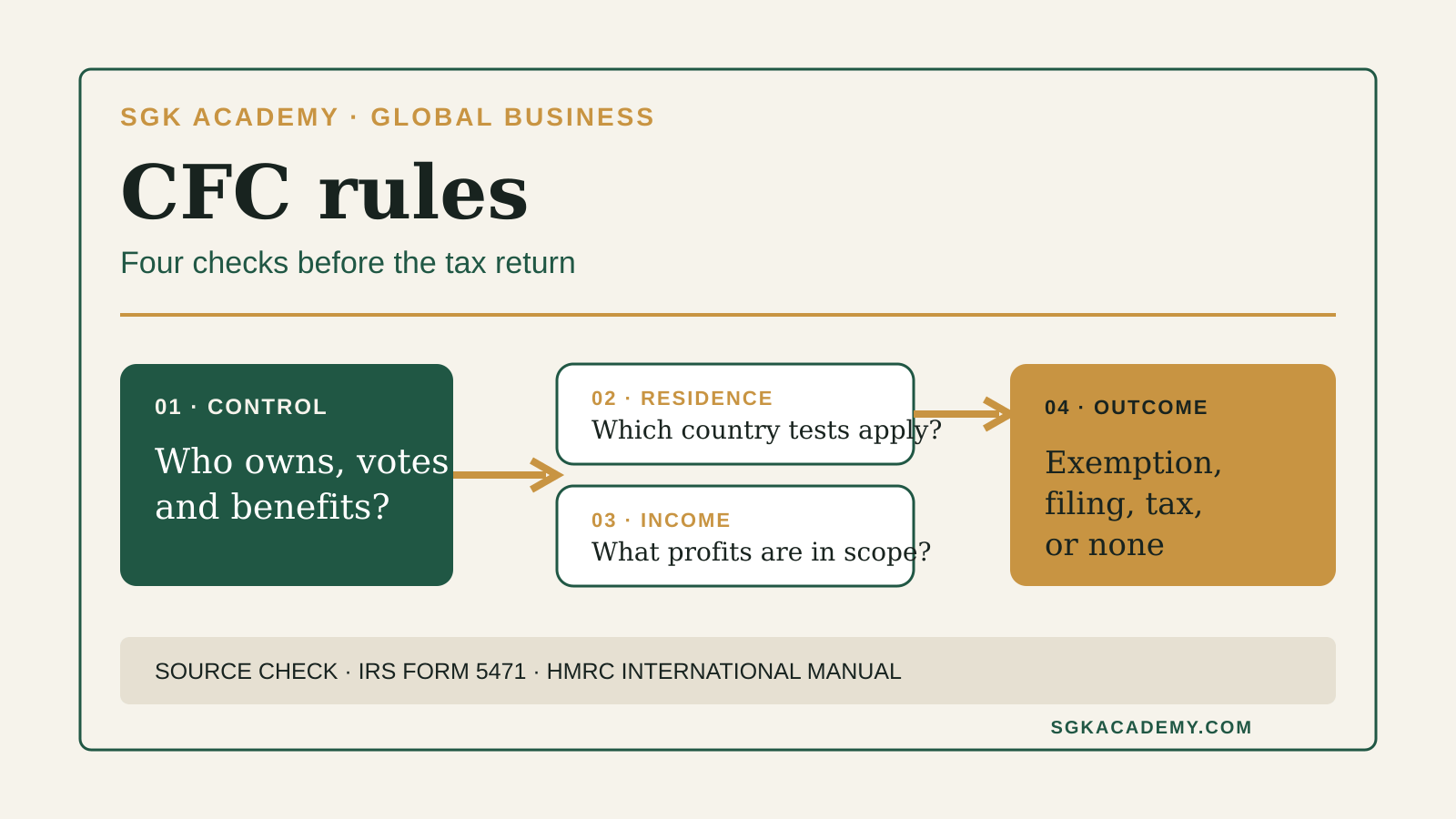
CFC rules can make a foreign company relevant to the tax return of an owner or parent company in another country. The practical question is not simply where the company was incorporated. You need to check who controls it, where the controlling person is tax resident, what income the company earns and whether an exemption or filing rule applies.
This guide is a screening tool for founders and owner-managers. It does not replace advice on a particular ownership chain. CFC rules are jurisdiction-specific, and indirect or family ownership can change the answer.
Start with the controlling person’s tax residence
A foreign company is tested from the perspective of the country applying the CFC regime. That normally means starting with the tax residence of the shareholder, owner or parent company, not the address on the foreign company’s certificate of incorporation.
Write down the following before opening a tax form:
- every direct and indirect shareholder;
- voting rights and economic rights;
- agreements that alter control;
- the tax residence of each owner;
- the foreign company’s place of incorporation, management and tax residence;
- the accounting period used by both the owner and the company.
This first pass also helps separate CFC questions from a different issue: whether the company itself may be tax resident somewhere else because of management. SGK Academy’s guide to company tax residence explains that distinction. If people work or negotiate contracts across borders, also review the guide to permanent establishment and remote work.
Control is wider than a name on the share register
A share percentage is important, but it may not be the whole control test. Some regimes look at voting power, rights to profits or assets, indirect ownership, connected persons, joint arrangements or accounting control.
The UK rules are a clear example. HMRC says its CFC regime applies to companies resident outside the UK that are controlled by UK residents. Its manual describes legal control, economic control and accounting control, as well as a joint-venture test for certain split-control arrangements. That means a founder should not stop after checking ordinary shares.
For a useful ownership map, show each link between people and entities. Record the percentage of votes, capital, profits and liquidation proceeds at every link. Add shareholder agreements, options and rights that may shift control. If family members, trusts or connected companies appear in the chain, flag them for professional review rather than assuming their holdings are separate.
The US screening route starts with Form 5471 categories
For US owners, Form 5471 is the main information return used for certain interests in foreign corporations. The current IRS instructions divide filers into categories and ask for different schedules depending on the category. Category 4 covers certain control relationships; Category 5 covers certain US shareholders of controlled foreign corporations. Other categories can apply to acquisitions, dispositions and specified foreign corporations.
The filing analysis therefore has two parts. First, identify the filing category and any exception. Second, determine whether income inclusions or other computations apply, including Subpart F or related rules. An information filing can be required even when a founder expects no immediate cash tax.
Do not treat the foreign company’s inactivity, low bank balance or local filing status as proof that no US return is needed. The IRS instructions include separate rules for dormant foreign corporations, multiple filers, constructive owners and other exceptions. Each exception has conditions.
A practical US file should contain:
- the ownership chart for the entire accounting period;
- acquisition and disposal dates;
- the foreign company’s financial statements in its functional currency;
- a record of related-party transactions;
- distributions and changes in equity;
- the prior year’s Form 5471 and schedules, if any;
- the tax preparer’s written conclusion on the filing category and required schedules.
The IRS instructions warn that penalties can apply when required information is not filed. If a filing may be late, get advice before submitting a partial form or an unsupported reasonable-cause statement.
The UK test separates control, chargeable profits and exemptions
The UK CFC regime also requires a sequence rather than one percentage check. HMRC’s overview starts with whether a non-UK resident company is controlled by UK residents. The rules then consider whether the company has chargeable profits and whether an entity-level exemption removes the need for a CFC charge.
HMRC lists five entity-level exemptions:
- the exempt period exemption;
- the excluded territories exemption;
- the low profits exemption;
- the low profit margin exemption;
- the tax exemption.
The tax exemption has its own calculation. HMRC’s manual says it can apply when the local tax amount is at least 75% of the corresponding UK tax, subject to the residence rules, detailed calculation and anti-avoidance provisions. A simple comparison of headline corporate tax rates is not enough.
The low-profit and low-margin exemptions also have defined conditions. A founder should not infer eligibility from the ordinary-language label. Use the relevant accounting figures and the current statutory definitions, then retain the calculation.
Where no entity-level exemption applies, the CFC charge gateway asks what profits fall within the regime. HMRC explains that business profits may be in scope where they derive from UK activities connected with assets or risks held by the foreign company. The exact analysis depends on what people in each country actually do, so contracts and organisation charts need to match the operating facts.
Use a four-check working paper
A short working paper makes the first meeting with an adviser more productive.
| Check | Evidence to collect | Decision to record |
|---|---|---|
| Control | Share register, options, voting agreements, group chart and connected-person details | Who controls the company under each relevant regime? |
| Residence | Owner tax-residence records, incorporation documents and management facts | Which country’s CFC rules must be tested? |
| Income | Financial statements, ledgers, related-party agreements and where functions are performed | Which income categories or gateway rules need analysis? |
| Outcome | Exemption calculations, filing-category analysis and prior returns | Is there an exemption, information return, income inclusion or tax charge? |
Keep the working paper for every accounting period. Ownership and activity can change during the year, and a conclusion for one period should not be rolled forward without checking those changes.
Common shortcuts that create filing risk
“The company pays tax locally, so CFC rules cannot apply.” Local tax may matter to an exemption or credit calculation, but the result depends on the importing country’s rules. HMRC’s tax exemption, for example, uses a defined comparison with corresponding UK tax.
“I own less than half, so I cannot control it.” Indirect ownership, connected persons, agreements and economic rights may affect control. The applicable legal test must be applied to the whole chain.
“There was no dividend, so there is nothing to report.” CFC regimes can attribute income or impose information reporting without a dividend.
“The accountant in the company’s country handles this.” The local accountant may handle the company’s local return. The owner may still need a separate analysis in the owner’s country of residence.
“The company is dormant.” Dormancy may change a filing or allow a simplified route, but it is not a universal exemption.
Build the review into the annual close
Add a CFC checkpoint before the foreign company’s accounts are finalised. Confirm ownership changes, tax residence, business activities, related-party transactions and local tax paid. Ask the adviser to state which rules were considered and why a filing, exemption or income inclusion does or does not apply.
For a group spanning several countries, use SGK Academy’s jurisdiction directory to collect the official company and tax sources for each entity. Keep the CFC conclusion beside the annual ownership chart rather than in an email thread that may be difficult to reconstruct later.