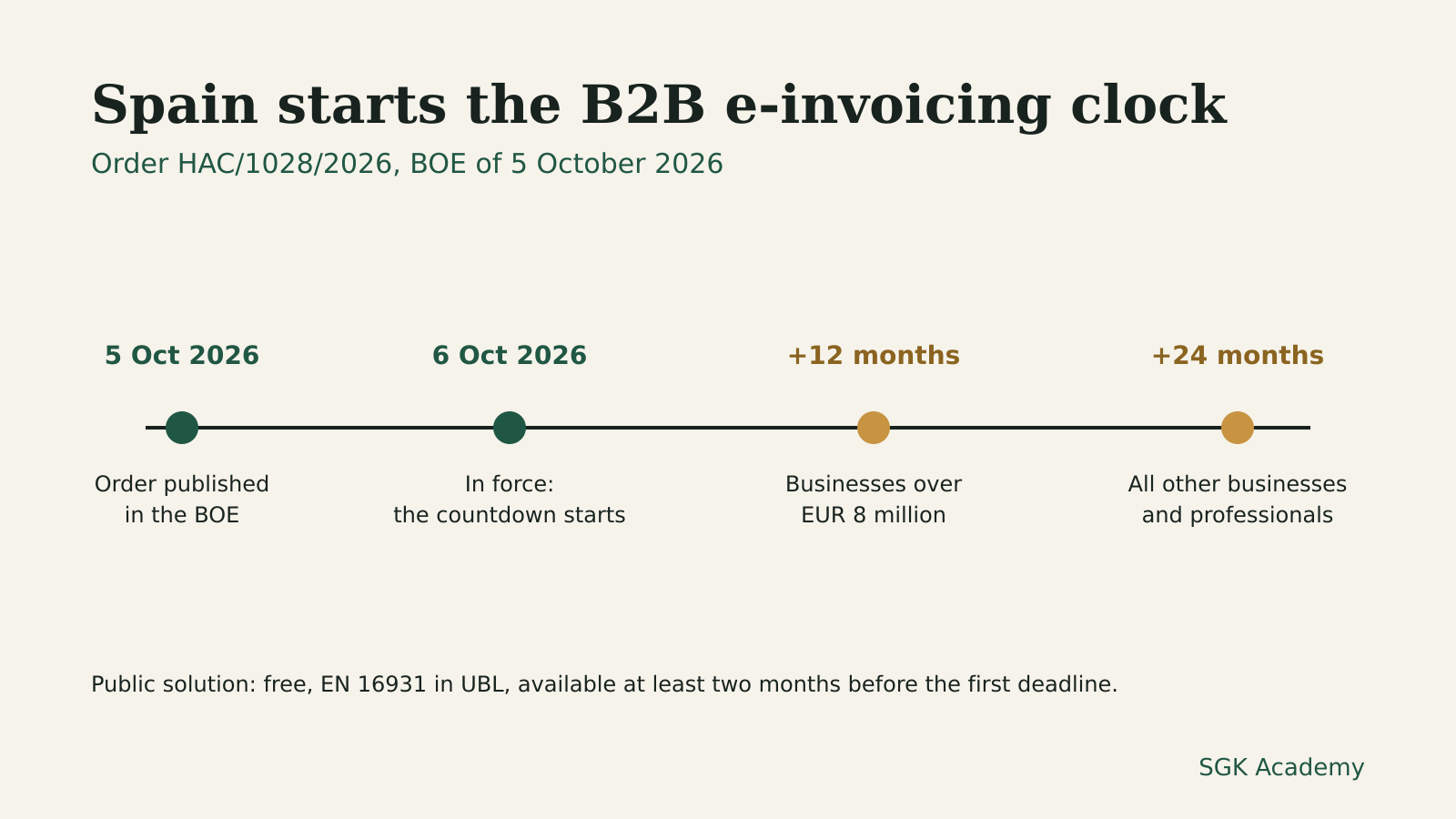
Spain’s mandatory B2B e-invoicing now has a start date mechanism. Order HAC/1028/2026, signed on 2 October and published in the Official State Gazette (BOE) on 5 October 2026, regulates the Tax Agency’s free public e-invoicing solution. It enters into force the day after publication, 6 October 2026, and that date starts the countdown for every Spanish business and self-employed professional that invoices other businesses.
What the order starts
The order is the technical piece that Royal Decree 238/2026 was waiting for. Its final provision says the order “entrará en vigor el día siguiente al de su publicación”, starting the periods set in Law 18/2022 and in the Royal Decree (BOE-A-2026-20587).
Final provision four of the Royal Decree sets those periods, counted from the order’s entry into force:
| Who | When the obligation applies |
|---|---|
| Businesses and professionals whose volume of operations exceeded EUR 8 million in the previous calendar year | 12 months after 6 October 2026 |
| All other businesses and professionals | 24 months after 6 October 2026 |
| Private e-invoicing platforms (faithful copies, interconnection) | 12 months after 6 October 2026 |
Two transitional rules soften the first year. For 12 months after the obligation starts, businesses above EUR 8 million must send a PDF copy alongside each e-invoice unless the customer expressly accepts the original format. Self-employed individuals and entities under the income-tax attribution regime at or below EUR 8 million only have to report invoice status 12 months after their own obligation starts; until then it is voluntary.
Who is covered
Article 3 of the Royal Decree applies the obligation to businesses and professionals who must issue invoices under Spain’s invoicing regulation when the customer is a business or professional with its seat, a permanent establishment or, failing those, its residence in Spain. Simplified invoices are excluded unless they are “facturas simplificadas cualificadas” (Article 4).
Under EU rules, a supplier that is not established in the country of the sale and bills a business customer under the reverse charge follows the invoicing rules of its own country (Article 219a of the VAT Directive). Founders billing Spanish clients from abroad should check with their adviser whether any part of the Spanish system reaches them.
How the public solution works
The order sets out what the Tax Agency’s platform does:
- Issuing and exchanging invoices. Businesses may use private platforms, the public solution or both. Invoices issued through the public solution must follow the EN 16931 semantic model in UBL syntax and may not carry embedded attachments.
- Faithful copies. A business that issues through a private platform must send a faithful electronic copy of each invoice, in UBL, to the public solution at the same time as issuing it.
- A unique code per invoice. Each invoice is identified by joining the issuer’s tax number (NIF), series, number and issue date.
- Payment and rejection reporting. The customer must report full payment or rejection of an invoice to the public solution; the issuer may report collection or non-payment voluntarily.
- Access. Electronic certificates and, in some cases, Cl@ve, with representation allowed under tax rules. Technical specifications and volume limits will be published on the Tax Agency’s electronic office.
Under additional provision two, the public solution must be available “al menos dos meses antes” (at least two months before) the first effective application.
What to do now
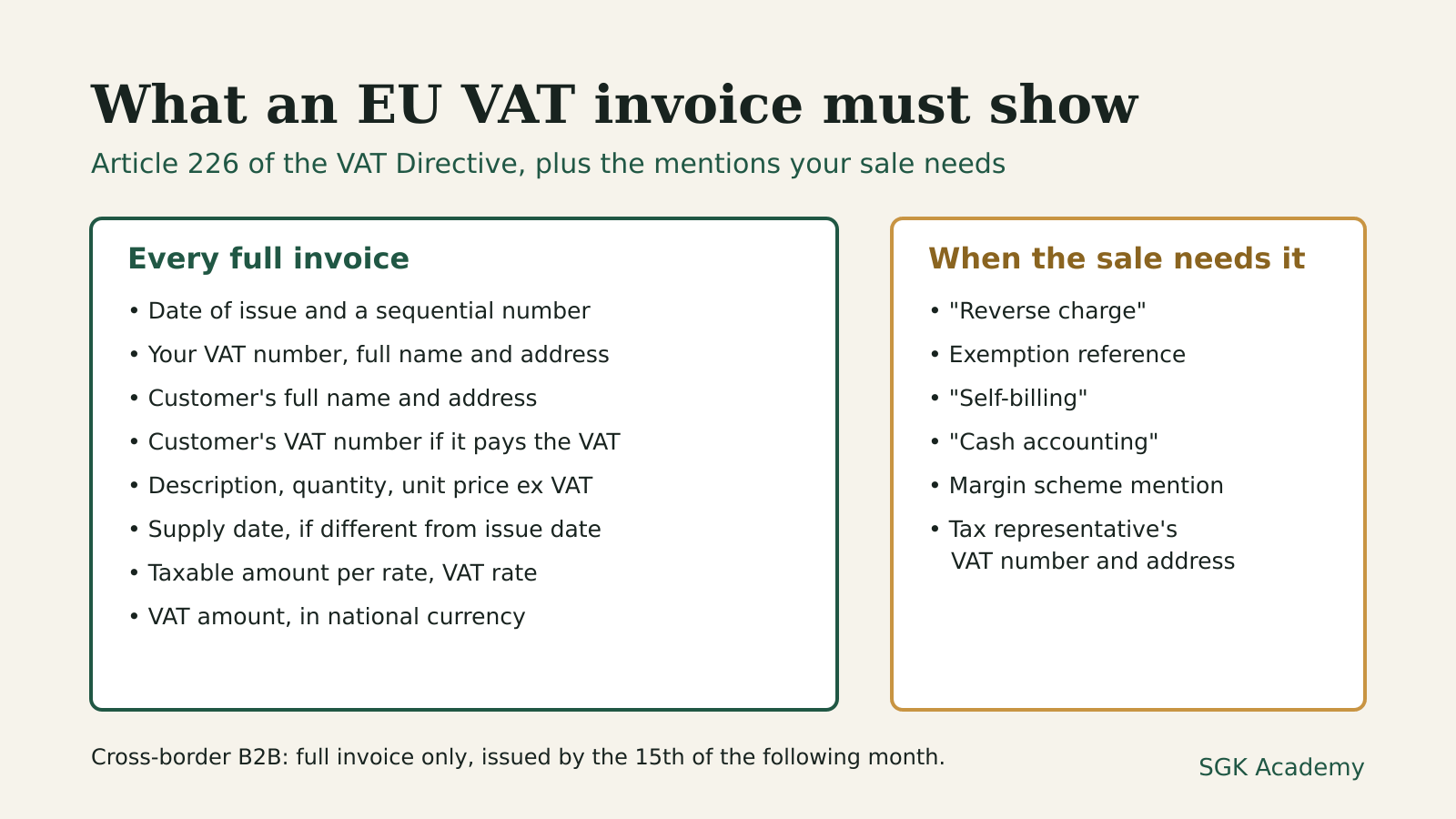
If you run a business established in Spain, work out which group you fall into from your volume of operations for the previous calendar year, then ask your invoicing software provider whether it will connect to the public solution or send faithful copies, and when. Our guide to e-invoicing mandates in Europe covers the other countries’ dates, and What an EU VAT invoice must show lists the details every invoice needs regardless of format. Spain’s VAT registration rules are in our VAT thresholds catalog.