
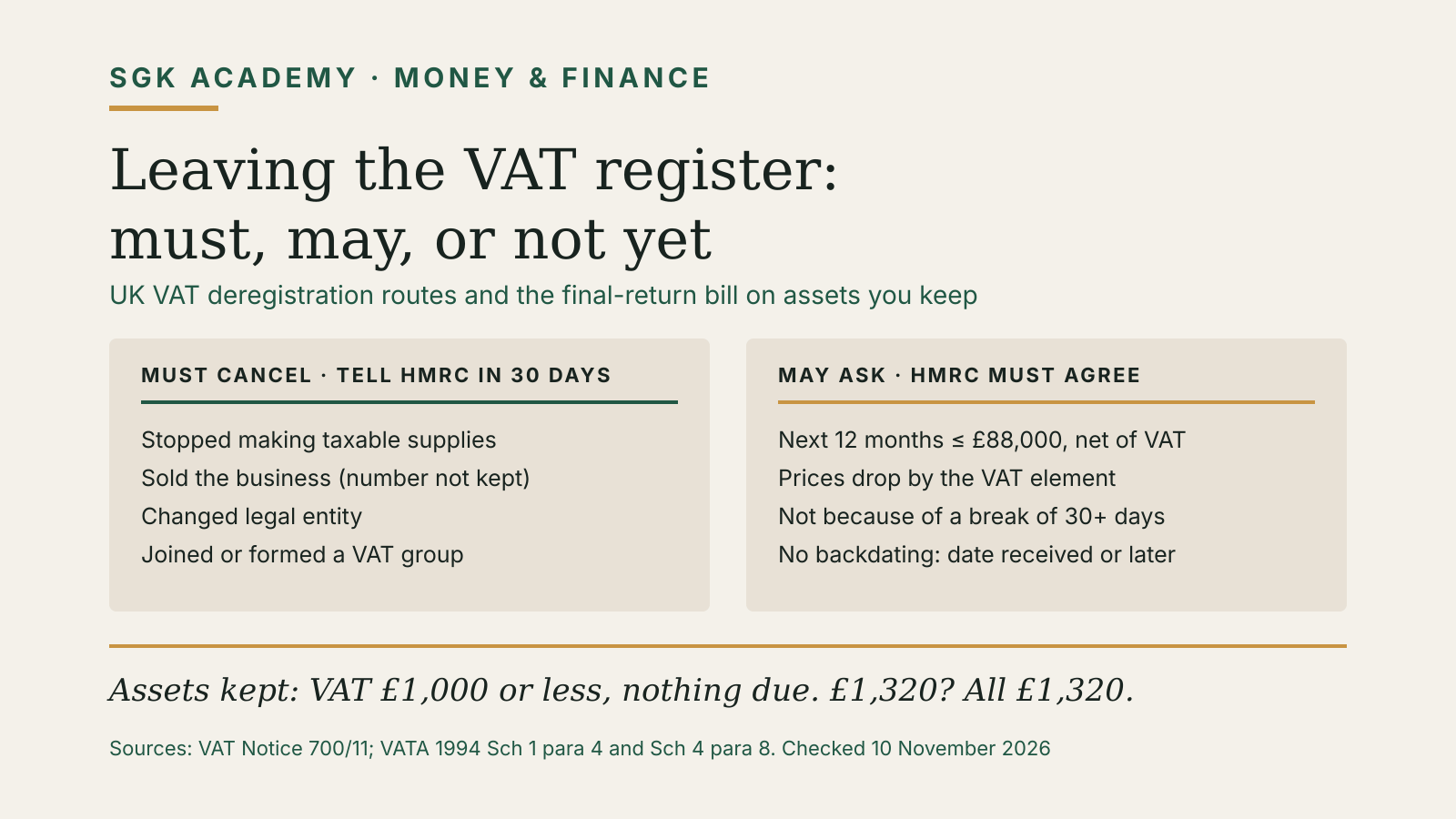
VAT deregistration in the UK takes one of two routes. You must cancel, and tell HMRC within 30 days, if you stop making taxable supplies, sell the business, change legal entity or join a VAT group. You may ask HMRC to cancel if you can show that your VAT-exclusive taxable turnover in the next 12 months will not exceed £88,000.
Either way, your final VAT Return can carry a bill for VAT on the stock and equipment you still own, and that bill is all or nothing once it passes £1,000. This guide works through both routes, the pricing decision that decides whether a voluntary application will be accepted, and the stock calculation, with numbers.
Checked on 10 November 2026 against HMRC’s VAT Notice 700/11 (updated 31 March 2026), its supplement, the GOV.UK cancel your VAT registration guide and the VAT Act 1994. Figures in the examples are illustrative.
Must cancel, may cancel, or neither
Start with why you want out, because it decides the date, the deadline and whether HMRC can refuse.
| Your situation | Route | Deadline or condition | Cancellation date |
|---|---|---|---|
| You stop making taxable supplies, or no longer intend to | Compulsory | Tell HMRC within 30 days | The date you stopped, or stopped intending to |
| You sell the business and the buyer does not take your VAT number | Compulsory | Form VAT7, by post | Date of transfer |
| You sell the business and the buyer keeps your VAT number | Transfer, not cancellation | Form VAT68 | Number moves to the buyer |
| Sole trader becomes a limited company (or another legal entity change) | Compulsory, or transfer with VAT68 | VAT7 plus a new registration, or VAT68 | Date of the change |
| You join or form a VAT group | Compulsory | Group registration replaces yours | Date the group takes effect |
| Turnover will not exceed £88,000 in the next 12 months | Voluntary | HMRC must be satisfied | Date HMRC receives the request, or a later agreed date |
| Supplies are wholly or mainly zero-rated | Voluntary (exemption) | Input tax normally exceeds output tax if any supplies are standard-rated | Agreed with HMRC |
| Turnover falls because you will stop trading or pause for 30+ days | Neither on turnover grounds | Para 4(2), Schedule 1 VATA 1994 | Cancel as compulsory when you actually stop |
The compulsory list is in paragraph 3.1 of Notice 700/11. The 30-day notice and the penalty warning are in paragraph 3.3. Missing it does not cancel anything: you stay registered, and HMRC can still charge VAT on what you sold in the meantime.
The last row trips people up. The law behind the £88,000 test, paragraph 4 of Schedule 1 to the VAT Act 1994, says you do not cease to be liable on turnover grounds if the reason turnover will be low is that you are going to stop trading or suspend taxable supplies for 30 days or more. A founder planning a six-month sabbatical cannot use the voluntary route to get off the register for that break.
Non-resident businesses. If you are a non-established taxable person (no UK establishment), the threshold does not apply to you in either direction. Paragraph 2.13 of the notice says you cannot apply to cancel on reduced turnover; you can only cancel when you stop making taxable supplies in the UK altogether.
The £88,000 test, read carefully
HMRC calls £88,000 the “VAT registration cancellation limit”. It has applied since 1 April 2024 (S.I. 2024/307), and the supplement to Notice 700/11 lists every earlier figure back to 1999. Our UK VAT threshold entry carries the current registration and deregistration limits side by side.
Four details decide whether you pass:
- It looks forward. The question is what your taxable turnover will be in the 12 months starting now. A quiet past year is evidence, not the test. HMRC asks you to explain why turnover will fall, for example lost contracts, shorter opening hours or a changed business model, and what you expect it to be.
- It is net of VAT. Paragraph 3.2 says to calculate turnover on a VAT-exclusive basis. So the answer to “gross or net?” is net, with a condition attached (next section).
- Capital asset sales are left out. Selling your van or old laptops does not count towards the £88,000 (Schedule 1, paragraph 4(3)), except for some taxable, non-zero-rated supplies of land.
- It cannot be backdated. The earliest cancellation date on the voluntary route is the day HMRC receives your application. You cannot cancel from the start of a quiet quarter that has already passed.
Taxable turnover includes zero-rated and reduced-rated sales, not only standard-rated ones. Exempt sales are outside it.
The condition behind “net”: what happens to your prices
Paragraph 3.2 adds a condition many guides skip. HMRC may agree to cancel only if it is satisfied that you will stop charging VAT, or, for a retailer, that you will cut prices by the VAT element. If you keep charging the same VAT-inclusive prices, your unregistered turnover is the gross figure, and that can push you straight back over the registration threshold.
Worked example: a consultant deciding whether to deregister
A sole trader sells standard-rated consultancy services. Next year’s forecast is £84,000 of fees before VAT and £9,000 of costs plus £1,800 VAT (software, equipment, a coworking desk). She is registered, so she invoices £84,000 + 20% = £100,800.
| Option | Clients pay | Taxable turnover | VAT she pays HMRC | Her costs after VAT | What she keeps |
|---|---|---|---|---|---|
| A. Stay registered | £100,800 | £84,000 | £16,800 − £1,800 = £15,000 | £9,000 | £75,000 |
| B. Deregister, charge £84,000 | £84,000 | £84,000 | £0 | £10,800 | £73,200 |
| C. Deregister, charge £88,000 | £88,000 | £88,000 | £0 | £10,800 | £77,200 |
| D. Deregister, keep charging £100,800 | £100,800 | £100,800 | Not available | n/a | Turnover is over the registration threshold: she would have to register again |
What the table shows:
- Business clients who reclaim VAT pay £84,000 net in option A (they recover the £16,800). In option B they pay the same £84,000, and she loses the £1,800 of input VAT she could no longer reclaim. Deregistering costs her money unless the time saved on returns is worth more than £1,800 a year.
- Consumer clients cannot reclaim VAT, so they pay £16,800 less in option B. Option C sits exactly at the limit HMRC tests (“will not exceed £88,000”), leaves her £2,200 better off than staying registered, and still cuts consumers’ bills by £12,800. It also leaves no headroom: one extra project and she is over the limit HMRC agreed to.
- Option D is not available. HMRC will refuse the application if it is not satisfied that prices will change, and if it later finds she should not have cancelled, GOV.UK says it will re-register her automatically and collect the VAT she should have charged.
The pattern holds generally: deregistering helps when your customers cannot reclaim VAT and your own costs carry little VAT. When your customers are VAT-registered businesses, you mostly lose input tax recovery and save paperwork.
How to apply, and how long it takes
Online, through your VAT online account, if you have stopped trading and are not in a VAT group, your turnover is below £88,000, you have stopped making taxable supplies, or you are applying for exemption because most or all of your sales are zero-rated.
By post on form VAT7 if your legal status changed and you want a new number, you sold the business and the buyer is not keeping the number, your VAT group is disbanding (with form VAT50/51), or the business stopped trading after liquidation. GOV.UK notes you must complete the online-fill form in one go; it cannot be saved part way.
Then the timeline:
| Step | When | Source |
|---|---|---|
| You notify HMRC (compulsory cases) | Within 30 days of the event | Notice 700/11, para 3.3 |
| HMRC replies with your official cancellation date | Usually within 40 working days | GOV.UK cancel guide; Notice para 8.1 |
| Keep charging and accounting for VAT | Until HMRC confirms the cancellation | Notice para 3.4 |
| Stop charging VAT, stop issuing VAT invoices | From the cancellation date | Notice paras 8.1 and 8.3 |
| Final VAT Return | For the period up to and including the cancellation date, by the due date HMRC gives you | Notice para 8.2 |
| Keep VAT records and the list of assets on hand | 6 years | Notice para 8.1 |
Notice 700/11 tells you both to keep charging VAT until HMRC confirms and to stop from the cancellation date. On the voluntary route the two usually line up, because you choose the date. Where confirmation arrives after the cancellation date, check every invoice raised in between before you file the final return, and ask VAT: general enquiries if any carried VAT you no longer owed. If you have not heard after 40 working days, HMRC asks you to contact the VAT Registration Service then, not earlier.
Two side effects to plan for. HMRC cancels your EORI number at the same time as the VAT registration, which matters if you still import or export. And if you make payments on account of VAT, keep paying the instalments until cancellation is confirmed (paragraph 7.12).
VAT on stock and assets you keep
When your registration ends you are treated as selling, to yourself, the goods the business still holds. Paragraph 8 of Schedule 4 to the VAT Act 1994 calls this a deemed supply, and paragraph 7 of the notice explains it. VAT on it goes on your final return, unless the total VAT would be £1,000 or less, in which case nothing is due.
Include tangible goods on which you claimed input tax: unsold stock, plant, furniture, commercial vans, computers, and goods that came to you VAT-free as part of a business you bought as a going concern. Land and buildings count only where a sale would be taxable, typically because you opted to tax.
Leave out goods you claimed no VAT on: anything bought from unregistered sellers or private individuals, most cars, margin-scheme goods, items used wholly for business entertainment, and goods tied to exempt activity. Intangibles such as patents, copyrights and goodwill are also out.
Value each item at what you would pay for the same or similar goods in their present condition, or the cost of producing them if there is no such price (paragraph 7.8). The original cost and the depreciated book value are not the measure.
Worked example: the £1,000 cliff
A small online shop deregisters on 31 March 2027 and keeps:
| Item | Input VAT claimed? | Value in present condition (ex VAT) | Included? |
|---|---|---|---|
| Unsold stock | Yes | £3,200 | Yes |
| Panel van, bought new in 2023 | Yes | £2,800 | Yes |
| Laptop, bought 2024 | Yes | £600 | Yes |
| Desk and shelving from a private seller | No | £900 | No |
| Owner’s car | No (cars normally blocked) | £7,500 | No |
| Domain name and brand | n/a (intangible) | n/a | No |
| Included total | £6,600 |
VAT on the deemed supply: £6,600 × 20% = £1,320. Because that is over £1,000, all £1,320 goes on the final return, not just the £320 above the line. HMRC states the same thing in gross terms: with only standard-rated goods, nothing is due if their VAT-inclusive value is £6,000 or less.
Now suppose the shop sold the van in February for £2,800 plus VAT, charged the VAT and accounted for it on its normal return. The included total drops to £3,800, the VAT to £760, and nothing is due on the final return. The van sale itself does not count towards the £88,000 forecast either, because it is a capital asset. Timing disposals before the cancellation date is legitimate; under-valuing what you keep is not, and paragraph 7.8 warns of penalties for under-declaring.
Separate rules apply to items still inside the Capital Goods Scheme adjustment period, to retail schemes, and to cash or annual accounting users (paragraphs 7.7, 7.10 and 7.11). If you are leaving because you sold the business as a going concern to a VAT-registered buyer, you do not charge VAT on the assets at all (paragraph 7.5).
After you cancel: what you can still claim
Deregistering does not end every VAT transaction. Paragraph 9 of the notice lets you reclaim:
- VAT on purchases made while registered that you did not claim on a return, within 4 years;
- VAT on services received after cancellation that relate to the old taxable business, such as the accountant’s fee for the final accounts;
- bad debt relief on sales made while registered, within 4 years and 6 months.
You cannot reclaim VAT on goods bought after the cancellation date. Claims go through HMRC’s online service or form VAT427 (VAT426 for insolvency practitioners), and HMRC aims to repay within 30 working days. Claim before you close the business bank account. For a company, claim before it is dissolved: paragraph 9.6 points out that a dissolved company no longer exists to be repaid, which is one of the items to clear before you strike off a company.
If you expect to incur VAT on selling exempt business assets after you stop trading, paragraph 9.3 lets you ask HMRC to delay the cancellation by up to 6 months.
Watch for re-registration
Cancellation is not permanent. Once you are off the register, the ordinary rules apply again: if taxable turnover over any rolling 12 months goes above the registration threshold, or you expect it to within the next 30 days, you must register again. Track the rolling total monthly rather than by tax year; our UK VAT threshold entry links to HMRC’s registration rules. If you opted to tax a property, the option survives cancellation and the rent counts in that total (paragraph 2.7).



