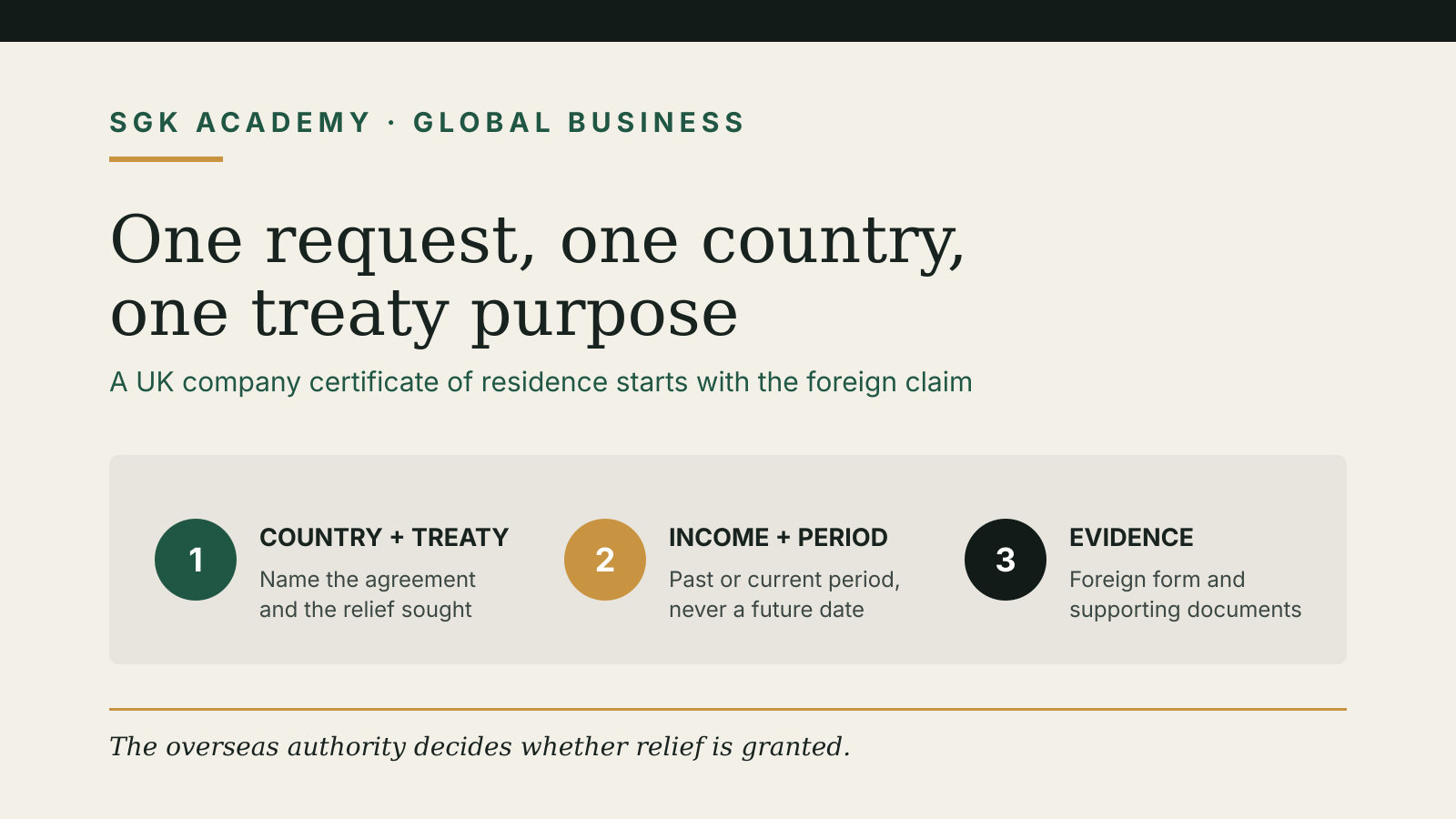
A UK company certificate of residence confirms to a foreign tax authority that HM Revenue & Customs treats the company as UK resident for a stated period. It supports a claim under a double taxation agreement; it does not itself approve the foreign tax relief.
On 26 August 2026 HMRC added a link to a new online application form to its guidance, together with information on who can apply and what happens after an application. A company should prepare the foreign country, treaty, income type and period before starting the request.
HMRC guidance checked on November 1, 2026. This guide explains the application workflow, not whether a particular company qualifies for treaty relief.
When a UK company needs the certificate
A foreign customer, bank or tax authority may withhold tax from interest, royalties, service income or another payment. A double taxation agreement may reduce that tax when the UK company is entitled to treaty benefits.
The certificate is evidence of UK residence for that claim. The overseas authority still decides whether the income and claimant meet its relief process. How relief at source differs from a refund claim, and how the US equivalent (Form 6166) works, is covered in Certificate of Tax Residence: A Practical Cross-Border Guide.
Do not request a certificate merely because a counterparty asks for “proof of tax.” First identify:
- the country applying the foreign tax;
- the relevant double taxation agreement;
- the income covered by the claim;
- the period for which residence must be certified;
- whether the foreign authority requires its own form.
If there is no treaty, or the document is needed for another purpose, HMRC may issue a letter of confirmation of residence instead.
Certificate or letter of confirmation?
| Document | Typical use |
|---|---|
| Certificate of residence | Claiming relief under a double taxation agreement |
| Letter of confirmation | Showing UK residence where no treaty applies or for another non-treaty purpose |
| Foreign authority form | A country-specific form that HMRC must certify; upload it with supporting documents |
HMRC says it will not issue a certificate where the applicant is not entitled to treaty benefits. That is why the treaty and purpose belong at the start of the request, not as an afterthought.
For the wider question of where a company is resident, read Company Tax Residence: Incorporation, Control and Treaties.
What a company must provide
HMRC’s certificate of residence guidance asks for:
- confirmation that the request relates to a double taxation agreement, where applicable;
- the agreement being relied on;
- the country for which the certificate is required;
- the type of income involved;
- the period covered by the request;
- any foreign form and supporting documents.
A request cannot cover a future date. Match the period to the payment, accounting period or foreign claim process rather than requesting an open-ended certificate.
Some treaties also require confirmation that the company is the beneficial owner of the income and is subject to UK tax on the income. Read the relevant treaty article and foreign form before making those statements.
Newly incorporated companies need more detail
A new company may need the certificate before filing its first Corporation Tax return. HMRC says that a newly incorporated company without a filed Corporation Tax Self Assessment return must also provide:
- the name and address of each director;
- the name and address of each shareholder;
- why the company considers itself UK resident.
HMRC points to chapter INTM120030 of its International Manual for company residence. Incorporation is relevant, but management and treaty rules can also matter. Keep board minutes, decision records and information about where the company’s central management operates. Those records should support the residence explanation rather than being created only after HMRC asks.
How to apply
Companies can use the GOV.UK online service, signing in with existing sign-in details or with an email address and a confirmation code. Progress can be saved and finished later. An authorised agent applies with the sign-in details of its agent services account.
A practical sequence is:
- ask the foreign payer or adviser which treaty article and form apply;
- confirm the UK company and income are within the claim;
- collect the exact period and any foreign form;
- sign in to the HMRC service and complete the request;
- save the submission confirmation and final certificate with the related payment records;
- give the document only to the party running the relief or refund process.
If online access is not possible, HMRC accepts a postal request with the same information. On November 1, 2026 the guidance gave this address for companies and public bodies: Corporation Tax Services, HM Revenue and Customs, BX9 1AX, United Kingdom. Check the live page before posting rather than relying on a saved copy.
Bulk and pre-order requests
The online service may ask for a spreadsheet when the request covers multiple countries or entities.
HMRC’s Large Business Service also accepts requests before the end of an accounting period, which it calls a pre-order. Pre-orders are only available for accounting periods ending in December, and the request goes by email to the company’s usual Large Business contact mailbox.
HMRC gives its own timing example, which works like this for a calendar-year company:
| Step | Date |
|---|---|
| Accounting period ends | 31 December 2026 |
| Pre-order sent to the Large Business contact mailbox | November 2026 |
| Certificate created | January 2027 |
So even a pre-order does not produce a certificate dated in the future. It only moves the request earlier so the certificate can be created soon after the period closes. A company outside the Large Business Service, or with a March or June year end, applies after the period through the normal route.
What the certificate does not prove
A certificate of residence does not, by itself:
- prove the company is the beneficial owner of every payment;
- determine whether a permanent establishment exists abroad;
- guarantee a zero withholding rate;
- replace a foreign refund form;
- settle a treaty tie-breaker dispute;
- certify residence for a future period.
A remote team or foreign office can create separate permanent-establishment questions. See Permanent Establishment and Remote Work before treating the residence certificate as the whole cross-border analysis.
A document pack to keep
Keep one folder for each country and income stream:
| Record | Why it matters |
|---|---|
| Treaty article and foreign instructions | Shows the basis and local procedure |
| Contract and invoices | Links the claim to the income |
| HMRC submission confirmation | Records what was requested |
| Certificate or confirmation letter | Evidence supplied to the foreign authority |
| Foreign decision or reduced-rate proof | Shows how the other country treated the claim |
| Refund calculation and receipt | Reconciles tax recovered |
Use a new request when the country, period or claimant changes. A certificate prepared for one foreign process should not be assumed to cover another.