If you own two companies that trade with each other, the invoice price is not just an internal bookkeeping choice. Tax authorities may ask whether the same terms would have been agreed between independent businesses. That is the central question in transfer pricing for a small business.
This guide is written for a founder with two related companies, not for a tax department inside a large multinational. It explains the practical records worth keeping before the first invoice, why a cost-plus percentage is not automatically defensible, and when a small-company exemption may help. It does not replace advice on the law in either country.
The international reference point is the OECD arm’s-length framework. Local rules decide whether it applies, what documentation is required and how an adjustment is made. If the companies operate across borders, review transfer pricing alongside company tax residence and permanent establishment risk, not as an isolated calculation.
Start with the transaction, not the tax rate
Transfer pricing becomes relevant when associated businesses exchange value. The obvious examples are goods, software licences, management services and loans. Less obvious examples include a founder working for one company while another invoices customers, shared staff, guarantees, intellectual property, rent and expenses paid on another entity’s behalf.
Write down what is actually happening:
- which legal entity provides the product, service, loan or right;
- which entity receives the benefit;
- what each party does before, during and after the transaction;
- which assets each party uses;
- which risks each party really controls and bears;
- how the price, payment term and currency were chosen.
The company named on an invoice does not settle those questions by itself. A contract saying that Company B bears product risk is weak evidence if Company A’s team makes every product decision and absorbs every loss.
What “arm’s length” means
The OECD describes the arm’s-length principle as the international consensus for pricing cross-border transactions between associated enterprises. In plain language, related companies should use conditions that make commercial sense when compared with what independent businesses would agree in comparable circumstances.
That does not mean there is always one perfect market price. Independent suppliers may charge different amounts because volume, geography, credit risk, contractual protection, valuable intellectual property and the work performed differ. Transfer pricing analysis is therefore a comparison of economically relevant conditions, not a search for a convenient public price.
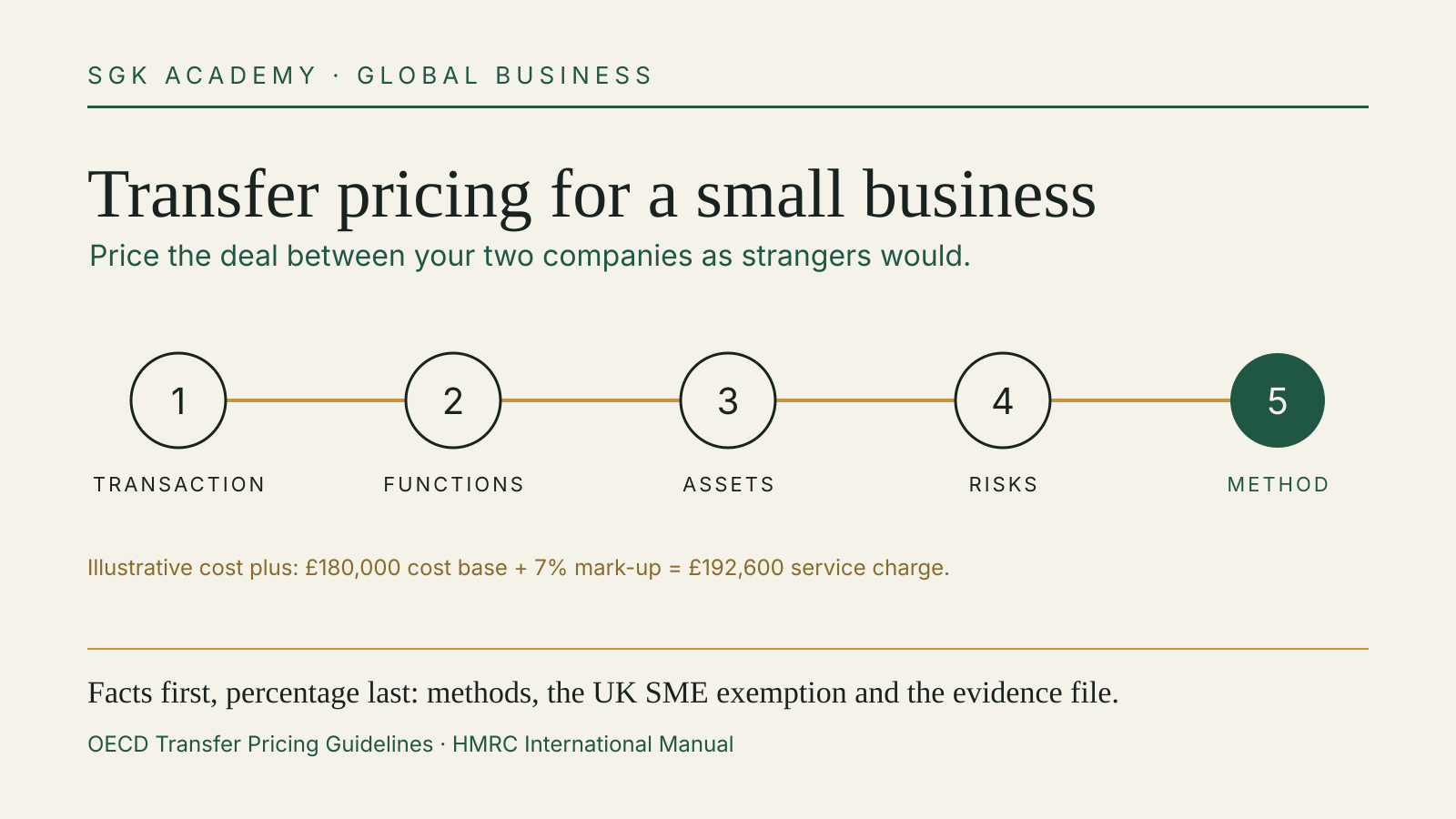
A defensible result normally begins with five questions:
- What is the accurately described transaction?
- What functions does each party perform?
- What assets does each party use?
- What risks does each party control and carry?
- Which pricing method best fits those facts?
The order matters. Choosing a percentage first and writing a rationale afterwards is how small groups end up with a policy that does not match the business.
A worked founder example
Suppose a founder owns a UK software company and a second company in another country. The overseas company employs two developers and invoices the UK company each month. The UK company owns the product, signs customers, sets the roadmap and bears refund and market risk.
The intercompany payment might be analysed as a development service. A cost-plus method could be suitable if the overseas company performs routine work, uses no unique intangible property and does not control the important product risks. But the analysis changes if that company created the core technology, chooses what to build or can exploit the code independently.
Assume its eligible annual operating costs are £180,000 and reliable evidence supports a 7% mark-up for genuinely comparable services:
| Item | Amount |
|---|---|
| Eligible cost base | £180,000 |
| Illustrative 7% mark-up | £12,600 |
| Illustrative service charge | £192,600 |
The arithmetic is easy. The difficult parts are defining the cost base and supporting the mark-up. Pass-through costs may deserve different treatment. Shareholder activity may not be chargeable. A public consultancy margin may be a poor comparison with an internal development centre. “Cost plus 7%” is a conclusion, not evidence.
Common pricing methods
The right method follows the transaction and available evidence.
Comparable uncontrolled price
This compares the controlled price with a price used in a sufficiently comparable independent transaction. It can be strong when the same product or service is sold to outsiders on similar terms. Differences in volume, geography, timing, warranty or credit terms may require careful adjustment.
Resale price
This starts with the price charged to an independent customer and subtracts an appropriate resale margin. It can fit a distributor that buys from a related company and resells without adding substantial value or owning valuable intangibles.
Cost plus
This adds an arm’s-length mark-up to an appropriate cost base. It is often considered for routine services or manufacturing, but the included costs, accounting consistency and comparable mark-up all need support.
Transactional net margin
This compares a net profit indicator, such as operating margin on sales or mark-up on costs, with comparable independent businesses. It may be more workable when gross-margin data or exact product comparisons are unavailable.
Profit split
This divides combined profit according to economically relevant contributions. It may be appropriate where both parties make unique and valuable contributions or operate in a highly integrated way. It is usually more demanding than a simple founder group needs.
Method names are not a menu for choosing the lowest taxable result. The aim is a reasonable arm’s-length outcome based on the best reliable information available.
Check whether a local exemption really applies
Countries do not apply transfer pricing rules identically. Size exemptions, thresholds, domestic-transaction rules and documentation duties vary. A company can be small in everyday language and still sit inside a statutory test because group figures are aggregated. SGK Academy’s jurisdiction directory can help you locate official company and tax authorities, but the transaction still needs advice in both countries.
For the United Kingdom, HMRC’s SME exemption guidance says section 166 of TIOPA 2010 exempts the vast majority of transactions carried out by small or medium-sized enterprises. The size definitions in INTM412080 follow a modified EU recommendation: a small enterprise has fewer than 50 staff and turnover or a balance-sheet total below €10 million; a medium-sized enterprise has fewer than 250 staff and either turnover below €50 million or a balance-sheet total below €43 million. Where the business belongs to a group or has associated entities, the limits apply to the whole group.
The exemption has exceptions. The same HMRC guidance says it does not apply to transactions with a related business in a territory whose UK tax treaty lacks an appropriate non-discrimination article. HMRC may also issue a transfer pricing notice to a medium-sized enterprise, and a business can make an irrevocable election to disapply the exemption for a chargeable period.
The UK government’s consultation outcome on transfer pricing scope and documentation confirmed that small and medium-sized enterprises will continue to benefit from the existing exemption. It also said an International Controlled Transactions Schedule is expected to take effect for accounting periods beginning on or after 1 January 2027, subject to the legislation and regulations. Do not confuse a policy announcement with a filing obligation that already applies.
An exemption from a particular transfer pricing rule is not permission to move money without a commercial basis. The other jurisdiction may have no matching exemption. Company-law duties, expense deductibility, withholding tax, VAT, customs valuation and financial-reporting rules can still affect the same transaction.
Build a proportionate evidence file
You do not need a hundred-page report to record a straightforward service arrangement. You do need evidence prepared close to the time the price is set.
Keep one file containing:
- an ownership chart for the related entities;
- the signed intercompany agreement;
- a plain description of the transaction;
- the functions, assets and risks of each party;
- the selected method and why it fits;
- the source and date of any comparable data;
- the calculation, including the cost base and exclusions;
- invoices, time records or delivery evidence;
- board minutes or approval records for unusual transactions;
- an annual check showing whether the facts changed.
HMRC’s guidance on common risks in transfer pricing approaches (GfC7) covers scoping, governance and evidencing an arm’s-length return. It says the degree of support needed varies with the size and complexity of the business, its risk profile and the volume and materiality of intra-group transactions. Proportionate does not mean undocumented.
If you run the companies alone, create the record before memory fades. A two-page note written when the arrangement begins is usually more persuasive than a detailed narrative reconstructed after an enquiry.
Put the agreement before the invoice
An intercompany agreement should identify the parties, service or asset, pricing mechanism, currency, payment terms, ownership of work product, duration and termination process. It should also match what the companies do in practice.
Avoid vague wording such as “management support as required” when the invoice covers specific development, sales or administrative work. Describe deliverables, responsibility and how the charge is calculated. If the service changes materially, amend the agreement and the analysis rather than relying on the original label.
Loans need their own terms: principal, currency, interest, maturity, repayment, security and borrower credit position. A founder should not copy a consumer loan rate or central-bank policy rate without considering the actual borrower and instrument.
Review the policy when the business changes
A price can be reasonable when set and become unreliable later. Review it when:
- a company starts owning or developing intellectual property;
- staff or decision-makers move between entities;
- one company signs customers or assumes warranty obligations;
- a routine service provider begins taking entrepreneurial risk;
- volumes grow beyond the range used in the comparison;
- financing terms are extended or rewritten;
- a new country joins the structure;
- tax law or an exemption changes.
Also compare the policy with the accounts. If the contract says invoices are monthly but one large year-end journal moves the entire profit, investigate the gap. Transfer pricing should follow the operating model, not merely tidy up the result.
A practical first-month checklist
- List every flow of money, goods, services, rights and financing between the companies.
- Match each flow to a written agreement and a real business benefit.
- Describe functions, assets and risks before choosing a method.
- Check the transfer pricing law and exemptions in both jurisdictions.
- Select a method that fits the transaction and available data.
- Record the calculation and retain the source material.
- Issue invoices on the agreed schedule.
- Reconcile invoices, payments and year-end accounts.
- Review the arrangement at least annually and after material change.
The goal is not to manufacture a precise-looking percentage. It is to show, with records made at the right time, why the outcome is commercially reasonable for the work, assets and risks in each company.
Sources reviewed: OECD transfer pricing topic page; HMRC International Manual INTM412070 and INTM412080; HMRC GfC7 guidelines; UK government consultation outcome on transfer pricing scope and documentation. Last checked 25 October 2026.