
FSCS protection does cover business accounts. If a UK-authorised bank, building society or credit union fails, the Financial Services Compensation Scheme repays each eligible company up to £120,000, whatever the company’s size. The limit applies per depositor, per authorised firm. Two brands that share one banking licence count as one firm, and money in an e-money account is not covered at all.
Last checked 12 November 2026 against the FSCS, the Prudential Regulation Authority (PRA) and the FCA pages listed under Sources.
For a founder, the useful question is how much of the company’s cash would come back, and from where. This guide answers that with the rules for each kind of business and a worked example you can redo with your own balances.
The limit and when it changed
The limit rose from £85,000 to £120,000 on 1 December 2025. The PRA confirmed the change on 18 November 2025 and says eligible deposits are protected up to the limit in force when the bank fails. A failure after 30 November 2025 is therefore paid at £120,000. The £85,000 limit had applied from 1 January 2017 to 30 November 2025.
The PRA gave banks until the end of May 2026 to update their depositor information sheets and branch notices. If a leaflet or web page from your bank still says £85,000, it is out of date, not a different rule for business customers.
FSCS aims to pay deposit claims within seven working days of a failure, without a claim form. More complex cases, temporary high balance claims included, take longer and need an application.
Which businesses are eligible
The PRA’s supervisory statement on depositor protection (SS18/15, updated November 2025) sets out who is in and who is out. The short version for a small business:
| Depositor | FSCS deposit cover | How the £120,000 is counted |
|---|---|---|
| Limited company or LLP | Eligible, regardless of size | Its own £120,000, separate from the directors’ or members’ personal accounts |
| Sole trader | Eligible | Business and personal accounts at the same firm are added together under one £120,000 |
| Partnership | Eligible, regardless of size | One £120,000 for the partnership’s account; each partner keeps a separate limit for personal deposits |
| Charity set up as a company | Eligible | £120,000, as for any company |
| Bank, investment firm, insurer, fund or most pension schemes | Not eligible | No deposit cover |
| Public authority | Not eligible, except small local authorities | No deposit cover |
Two further points come from the FSCS page for small businesses. Most regulated financial services companies are not eligible depositors. And where a company holds money as a bare trustee, agent or nominee, FSCS may “look through” it and treat the person behind it as the claimant instead.
Cover also depends on where the money sits. FSCS protects deposits held with UK branches of authorised banks, building societies and credit unions. A UK company’s account with a bank’s branch abroad is outside this scheme.
Same group, same licence, one limit
The limit is per authorised firm, not per account or per brand. FSCS says that when several banks in one group share a banking licence, it treats them as one bank, and the £120,000 applies to the total across all of them.
This is the rule most likely to catch a company that spreads its money for safety. Opening a second account with a sister brand can look like diversification and add no protection at all. Check the firm reference number on the FCA Financial Services Register or use the FSCS protection checker, which lists the trading names and subsidiaries attached to each authorisation. Do it for every account the company holds, including notice and fixed-term deposit accounts.
E-money and payment accounts are not covered
Many business accounts are not bank deposits at all. The FCA says money held with a non-bank provider, such as an electronic money institution or an authorised payment institution, is not protected the same way. These firms must safeguard customer funds instead: keep them separate from their own money, or cover them with an insurance policy or guarantee. If the firm fails, the money is returned through an insolvency process rather than an FSCS payout, and the timing is not fixed at seven days.
Safeguarding was tightened this year. The FCA’s supplementary safeguarding regime (PS25/12) came into force on 7 May 2026 for authorised payment institutions, e-money institutions, small e-money institutions and credit unions that issue e-money. The FCA’s stated aims are fewer shortfalls in client funds and a faster return of money when a firm fails. That improves the position of an e-money balance. It still does not make it an FSCS-protected deposit.
The FCA’s advice is to find the company behind the brand, usually named at the foot of the website or in the terms, and look it up on the register, which shows whether it is a bank or a payment firm. Our guide to bank accounts, e-money accounts and wallets covers how to read that record.
Worked example: one company, £310,000
Take an illustrative company, Northgate Design Ltd, with £310,000 of cash in November 2026:
| Account | Provider type | Balance | FSCS position |
|---|---|---|---|
| Current account, Brand A | Bank, licence 1 | £180,000 | Counted with Brand B |
| Business deposit account, Brand B | Same group, licence 1 | £80,000 | Counted with Brand A |
| Multi-currency account | E-money institution | £50,000 | Not covered; safeguarded |
| Total | £310,000 |
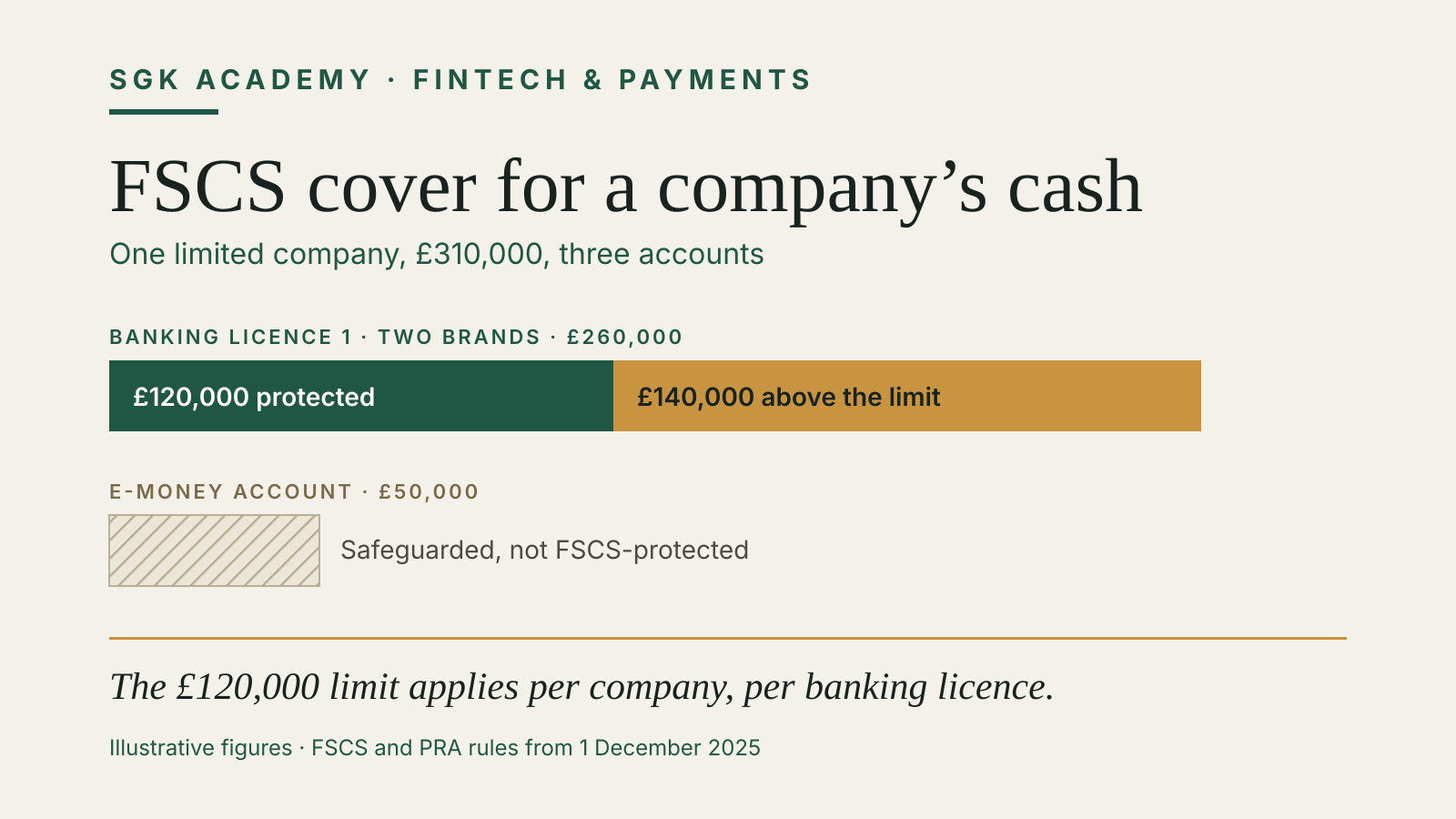
Under licence 1 the company holds £260,000. FSCS would pay £120,000 and leave £140,000 as a claim in the bank’s insolvency. The £50,000 e-money balance would come back through the e-money firm’s insolvency, not from FSCS. So £120,000 of £310,000, or about 39%, has a fixed seven-day route back.
The director also holds £40,000 personally with Brand A. Because the company is a separate legal entity, that personal money has its own £120,000 limit and is fully covered.
Now the same company spreads its cash across three banks that do not share a licence:
| Account | Balance | Protected |
|---|---|---|
| Bank X, licence 1 | £120,000 | £120,000 |
| Bank Y, licence 2 | £120,000 | £120,000 |
| Bank Z, licence 3 | £70,000 | £70,000 |
| Total | £310,000 | £310,000 |
Same money, full cover. The cost is three sets of onboarding, mandates and reconciliations, and a little more admin each month. Whether that trade is worth it depends on how long the company holds balances above £120,000 and what it would mean to lose access to the excess.
If you trade as a sole trader or a partnership
The arithmetic changes when the business is not a separate legal person.
A sole trader with £90,000 in a business account and £50,000 in a personal savings account at the same bank holds £140,000 under one name. FSCS treats both as the same depositor, so £120,000 is protected and £20,000 is not. As a limited company, the same balances would be two depositors and fully protected.
Two partners with £200,000 in the partnership account get one £120,000 claim for that account, not one each. Their personal accounts at the same bank keep a separate £120,000 per partner.
Temporary high balances
FSCS also protects temporary high balances of up to £1.4 million for up to six months. The PRA and FSCS describe these as linked to listed life events, such as selling a home, receiving an inheritance or an insurance payout. A large balance from ordinary trading, such as a big customer payment or a funding round, is not one of the examples given. A company planning around a short-term high balance should read the PRA’s list of qualifying events before assuming the higher limit applies.
Deciding how much to keep where
Deposit protection is one input to a cash plan, not the whole plan. Start from what the business needs to reach quickly:
- Work out the operating buffer: payroll, VAT, rent and suppliers for the next one to three months. The cash runway calculator and a 13-week cash flow forecast give a figure based on your own numbers.
- Keep that buffer where you can pay from it, and note which part of it is above £120,000 per licence.
- For reserves above the buffer, decide whether a second or third banking licence is worth the extra admin. Check the licence, not the brand.
- Treat e-money and payment accounts as transaction tools. If a large balance sits there between payment runs, know that it is safeguarded and not FSCS-protected.
- Recheck after any bank merger, brand change or new account, and write the date of the check in your finance notes.
FSCS deposit protection answers one event: the failure of the bank. It does not cover a payment sent to a fraudster or an unauthorised transaction, which follow separate rules. See unauthorised payments on a business account for those.
Questions
Does FSCS cover business accounts?
Yes. Deposits held by companies, partnerships and sole traders with UK-authorised banks, building societies and credit unions are covered up to £120,000 per eligible depositor per authorised firm. Most regulated financial firms and public authorities are excluded.
What is the FSCS limit for business accounts?
£120,000 per eligible business, per authorised firm, for failures on or after 1 December 2025. It was £85,000 before that date.
Is a limited company’s account protected separately from the director’s?
Yes. A limited company or LLP is a separate depositor, so its £120,000 limit sits alongside the director’s personal £120,000 at the same bank. A sole trader gets one limit for business and personal money together.
Is an e-money business account FSCS-protected?
No. E-money and payment institutions safeguard customer funds instead. Since 7 May 2026 the FCA’s supplementary safeguarding rules apply to them, but that is not deposit insurance.
Does the £120,000 apply per account?
No. It applies per depositor per authorised firm. Several accounts with one bank, or with brands that share its banking licence, share one limit.



