
Not automatically. Being a director of a UK limited company does not, on its own, put you on GOV.UK’s list of people who must send a tax return. What usually decides it is the money you take out of the company and whether HMRC has already asked you to file. A director who takes more than £10,000 in dividends in a tax year must file a return. A director who takes less than that, with tax to pay on it, can usually settle through a tax code instead.
A director who has to file for any reason also faces extra, mandatory boxes on the 2025/26 return about the company itself. That change is the one many directors have not met yet. The first returns carrying it are for the year 6 April 2025 to 5 April 2026, and the online deadline is 31 January 2027.
The short test
Work through these questions in order. The first “yes” settles whether you are in Self Assessment for the year.
| Question | If yes |
|---|---|
| Has HMRC sent you a notice to file for the year? | You must file by the deadline on the letter, whatever your income. |
| Did you receive more than £10,000 in dividends in the tax year? | You must file a Self Assessment return. |
| Were you also a sole trader earning over £1,000, a partner, or liable for Capital Gains Tax or the High Income Child Benefit Charge (not paid through PAYE)? | You must file. |
| Do you have other untaxed income, such as rent, foreign income or untaxed savings interest? | You may need to file; use HMRC’s checker. |
| Did you receive dividends above your unused Personal Allowance and the £500 dividend allowance, but no more than £10,000? | You must tell HMRC, but you can do it by asking for a tax code change or calling the helpline before 5 October. A return is not required for that reason alone. |
| None of the above, and your salary is taxed in full through PAYE? | Being a director does not by itself require a return. |
The sources for each row are GOV.UK’s pages on who must send a tax return and on how to report tax on dividends. HMRC’s checker for the 2025 to 2026 tax year gives a personal answer and keeps no record of what you enter.
Two practical consequences follow. A director who takes a salary through payroll and a modest dividend can stay outside Self Assessment, provided HMRC hears about the dividend by 5 October. And a director who has always filed out of habit should check whether HMRC still expects a return: if you think you no longer need one, GOV.UK says you have to contact HMRC and explain, rather than simply stop.
Why “all directors must file” is out of date
Older accountancy guides often say every company director has to complete a tax return. The current GOV.UK list of people who must file does not mention directors at all. It names sole traders earning more than £1,000, business partners, people with Capital Gains Tax to pay, people who owe the High Income Child Benefit Charge outside PAYE, and off-payroll workers repaying a student or postgraduate loan. Untaxed income, including dividends, is listed as something that may require a return.
What has not changed is HMRC’s power to ask. Under section 8 of the Taxes Management Act 1970, an officer can give anyone a notice to file, and once the notice arrives the return is due. Many directors are in Self Assessment because a notice was issued years ago and never withdrawn. If that is you, the dividend thresholds below do not take you out; only HMRC can.
The dividend thresholds, in order
Dividends are where most director-shareholders cross the line, so it helps to be precise about the three figures involved.
- The dividend allowance, £500. GOV.UK sets the allowance at £500 for 2024/25, 2025/26 and 2026/27. Dividends inside it are taxed at 0%, and if all your dividends fall inside it you do not need to tell HMRC.
- Your unused Personal Allowance. Dividends that fall within the Personal Allowance (£12,570 in each of those years) are not taxed either. A director paid a £12,570 salary has already used it.
- £10,000 of dividends. Up to this amount, HMRC can collect the tax by adjusting your tax code, as long as you tell it after 5 April and before 5 October. Above it, you must complete a Self Assessment return, and if you do not usually file, you must register by 5 October after the end of the tax year in which you received the dividends.
The £10,000 figure is gross dividends received, not the taxable slice above the allowances. A director who takes £10,500 in dividends is in Self Assessment even though only part of it is taxed.
Three worked examples for 2025/26
The examples use the 2025/26 rates published by HMRC for England, Wales and Northern Ireland: Personal Allowance £12,570, basic-rate band up to £37,700 of taxable income, dividend rates of 8.75% (basic), 33.75% (higher) and 39.35% (additional). Scottish taxpayers have different bands for salary, though dividend rates are UK-wide. Each example assumes no other income and a director who is not already in Self Assessment for another reason.
Example A: salary of £12,570 and dividends of £9,000
- The salary uses the whole Personal Allowance, through PAYE.
- Dividends of £9,000: the first £500 is taxed at 0%; the remaining £8,500 sits in the basic-rate band.
- Tax on dividends: £8,500 × 8.75% = £743.75.
- Dividends are above the allowances but not above £10,000, so the director must tell HMRC between 6 April and 5 October 2026, either by asking for a tax code change or by calling the helpline. No return is required for this reason.
The tax code route means the £743.75 is collected through payroll in a later year, spread across pay days, rather than as a single bill on 31 January.
Example B: salary of £12,570 and dividends of £40,000
- Dividends exceed £10,000, so a Self Assessment return is compulsory.
- If the director has never filed, registration for Self Assessment was due by 5 October 2026. The online return for 2025/26 is due by 31 January 2027.
- Taxable income after the Personal Allowance is £40,000, all of it dividends.
- The first £500 is taxed at 0% (it still uses £500 of the basic-rate band).
- The next £37,200 is in the basic-rate band: £37,200 × 8.75% = £3,255.00.
- The final £2,300 is above the £37,700 band: £2,300 × 33.75% = £776.25.
- Total dividend tax: £4,031.25.
Because almost none of this is collected at source, a bill of that size normally brings payments on account for the following year as well. HMRC’s payments on account guidance says you must make them unless the tax you owed for the previous year was less than £1,000, or more than 80% of it was paid outside Self Assessment, for example through your tax code. In practice, the first January can carry the 2025/26 balance plus the first instalment towards 2026/27, which is worth planning for inside the company’s cash flow.
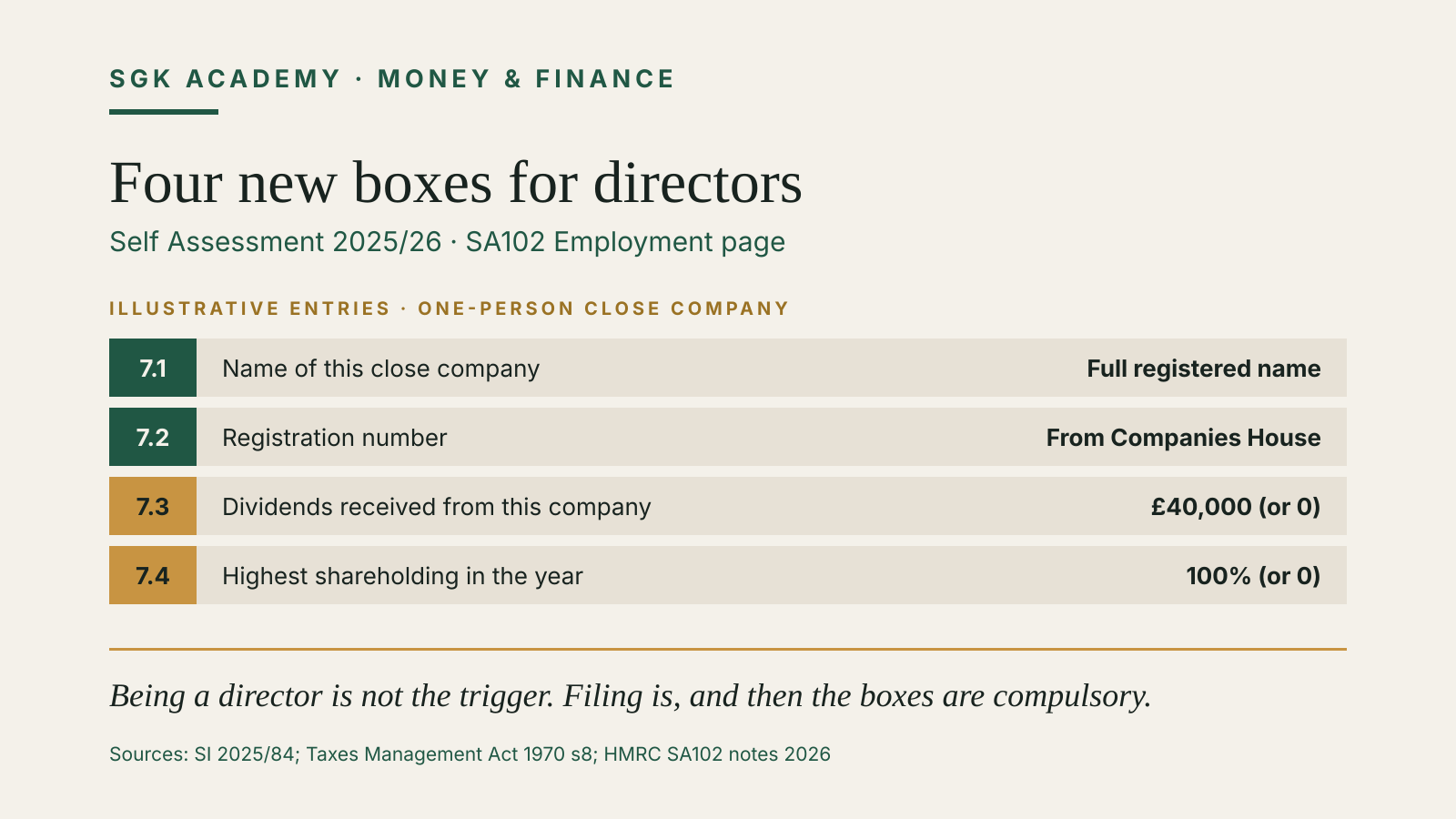
This director must also complete the new close-company boxes described below: for a one-person company, box 7.3 shows £40,000 and box 7.4 shows 100.
Example C: an unpaid director with rental income
A director of a family company takes no salary and holds no shares, but files a return because of rental income from a flat. The company is close because a small family group controls it.
Under the 2025 rules this director must still complete an Employment page for the directorship, answer “yes” to box 6 (director) and box 7 (close company), give the company name and number, and enter 0 in both box 7.3 (dividends) and box 7.4 (shareholding). The regulations themselves say both figures “may be zero”, and HMRC’s Agent Update 147 confirms that each directorship is generally reported through an SA102 page “including where no remuneration or shareholding exists”.
What changed on the 2025/26 return
The Income Tax (Additional Information to be included in Returns) Regulations 2025, made on 27 January 2025 and in force from 6 April 2025, apply to personal returns for tax years after 2024/25. They require anyone filing a return to say:
- whether they were a director of a company during the year; and
- if so, whether that company was a close company.
A director of a close company must then give:
- the company’s name and registered number;
- the dividends they received from that company in the year, which may be zero; and
- the percentage of its share capital they held, which may be zero. If the percentage changed during the year, the highest figure is the one to report.
HMRC put these into the Employment supplementary pages, the SA102. Boxes 6 and 7 existed before, but were effectively optional. From 2025/26 they are compulsory, and four boxes follow:
| SA102 box | What goes in it | Where to find it |
|---|---|---|
| 6 | Were you a director of this company? Includes dormant companies. | Your appointment record at Companies House |
| 7 | Was it a close company at any point in the year? | Your shareholder register and control position |
| 7.1 | Full name of the close company | Certificate of incorporation |
| 7.2 | Company registration number | Certificate of incorporation or Companies House record |
| 7.3 | Dividends you received from this company; enter 0 if none | Dividend vouchers for the tax year |
| 7.4 | Highest percentage shareholding during the year, by nominal value; enter 0 if none | Register of members and any share issues or transfers |
The 2025/26 SA102 notes, last updated on 8 September 2026, describe a company as close if it is UK resident and controlled by its directors or by five or fewer participators, such as shareholders. Most owner-managed companies meet that description. The notes point to HMRC’s Company Taxation Manual at CTM60060 where the position is not obvious, for example after outside investment.
The £60 penalty and HMRC’s stated approach
The regulations were made under powers added to section 8 of the Taxes Management Act by the Finance Act 2024. Subsection 8(1K) sets a penalty of £60 for failing to comply with a requirement to include the specified information. It does not depend on whether any tax is due.
In Agent Update 147, published on 17 September 2026, HMRC said it “will take a considered approach to compliance on a case-by-case basis”, taking into account the reasonable efforts people have made with the guidance available at the time. That is a statement of approach, not a waiver. A blank box is not the same as a zero, so enter 0 where the figure is nil.
Who the new boxes do not catch
Three groups are outside the requirement or treated differently:
- Directors who are not in Self Assessment. The regulations apply to a person who is already required to make a return. They do not create a duty to register just to report a directorship.
- Unpaid directors of charities and community interest companies. HMRC’s notes say directors of a registered charity or a CIC do not need to complete these pages if they did not receive, and did not become entitled to, any employment income, dividend or other distribution from that company or a connected company.
- Directors of non-UK companies with no pay. The SA102 notes ask for an Employment page for a director of a non-UK company where there is pay or benefits. A founder who sits unpaid on the board of their own foreign company does not file an SA102 for that directorship.
If you hold more directorships than your filing software has Employment pages, Agent Update 147 says to use the pages first for directorships with pay, benefits or expenses to report, and to list the rest in the “Any other information” box.
If you live outside the UK
Founders who run a UK company from abroad often assume the UK has no interest in their personal tax. GOV.UK’s own list says otherwise: a non-UK resident with any taxable UK income may need to send a return. Residence questions go on the SA109 supplementary pages.
How UK dividends are taxed for a non-resident depends on residence status and any tax treaty, which is beyond this guide. The practical step is not to assume a return is unnecessary: use HMRC’s checker or ask an adviser who deals with non-residents, and keep a record of the answer. Our guide to company tax residence covers the separate question of where the company itself is resident.
A year-end routine for director-shareholders
The new boxes make sloppy dividend paperwork visible, because box 7.3 has to match what the company says it paid. A short routine after each 5 April keeps the two in line:
- Total the dividends by tax year, not by company year. A company with a 31 December year end will have dividends in two tax years. Use the payment dates on the vouchers.
- Check the £10,000 line. If you crossed it and you are not registered, register before 5 October. If you did not cross it but have tax to pay, tell HMRC by the same date.
- Record the highest shareholding in the year. Look for share issues, transfers or new classes of shares. Box 7.4 is calculated by nominal value, so growth shares or alphabet shares need care.
- Confirm close-company status. If an investor came in during the year, check whether the company stopped being close, and when. The boxes apply if it was close for any part of the year.
- Note the 2026/27 rates. From 6 April 2026, the basic and higher dividend rates rose to 10.75% and 35.75%; the additional rate stays at 39.35%, according to GOV.UK’s dividend tax page. The same £40,000 dividend in Example B would cost more in 2026/27, and payments on account calculated from 2025/26 will not reflect that.
Filing and payment dates for the company’s own returns are in our company filing deadlines tool. How you split salary and dividends in the first place is covered in salary vs dividends for a UK director, and money taken out before either route is set up is usually a director’s loan rather than a late dividend.
Questions directors ask
Do I need to do Self Assessment if I only take a salary through PAYE?
Not because of the directorship. If your salary is taxed in full through payroll and you have no other income that needs reporting, and HMRC has not sent you a notice to file, being a director does not put you in Self Assessment.
Do I need to file if my dividends were under £10,000?
Not for that reason. If the dividends exceed your unused Personal Allowance and the £500 dividend allowance, you must tell HMRC by 5 October so it can change your tax code, or call the helpline. If you already file a return for another reason, the dividends go on it.
I am a director of a dormant company. Do the new boxes apply?
If you are already filing a return, yes. HMRC’s Agent Update 147 says directors of UK companies, including dormant ones, must give the additional information through the Employment pages. A dormant company that is close still needs boxes 7 to 7.4, with zeros where nothing was paid or held.
Are company directors self-employed?
Not as a director. HMRC treats pay from your own company as employment income: it runs through payroll and goes on the Employment pages (SA102) of a return, not the self-employment pages. A director can separately be a sole trader in a different business, which would bring its own reasons to file.
What is the deadline for the 2025/26 return?
For an online return, 31 January 2027. A paper return was due by 31 October 2026. If HMRC’s notice to file was issued after 31 October 2026, section 8 of the Taxes Management Act gives three months from the date of the notice instead.
Official sources
- GOV.UK: who must send a tax return
- GOV.UK: check if you need to send a Self Assessment tax return (2025 to 2026)
- GOV.UK: how to report tax on dividends
- HMRC: Income Tax rates and allowances for current and previous tax years
- legislation.gov.uk: The Income Tax (Additional Information to be included in Returns) Regulations 2025, SI 2025/84
- legislation.gov.uk: Taxes Management Act 1970, section 8
- HMRC: Self Assessment Employment (SA102) form and notes
- HMRC: Agent Update issue 147, 17 September 2026
- HMRC: payments on account
Rules and rates checked against the sources above on 4 November 2026. This is a general guide, not personal tax advice.



