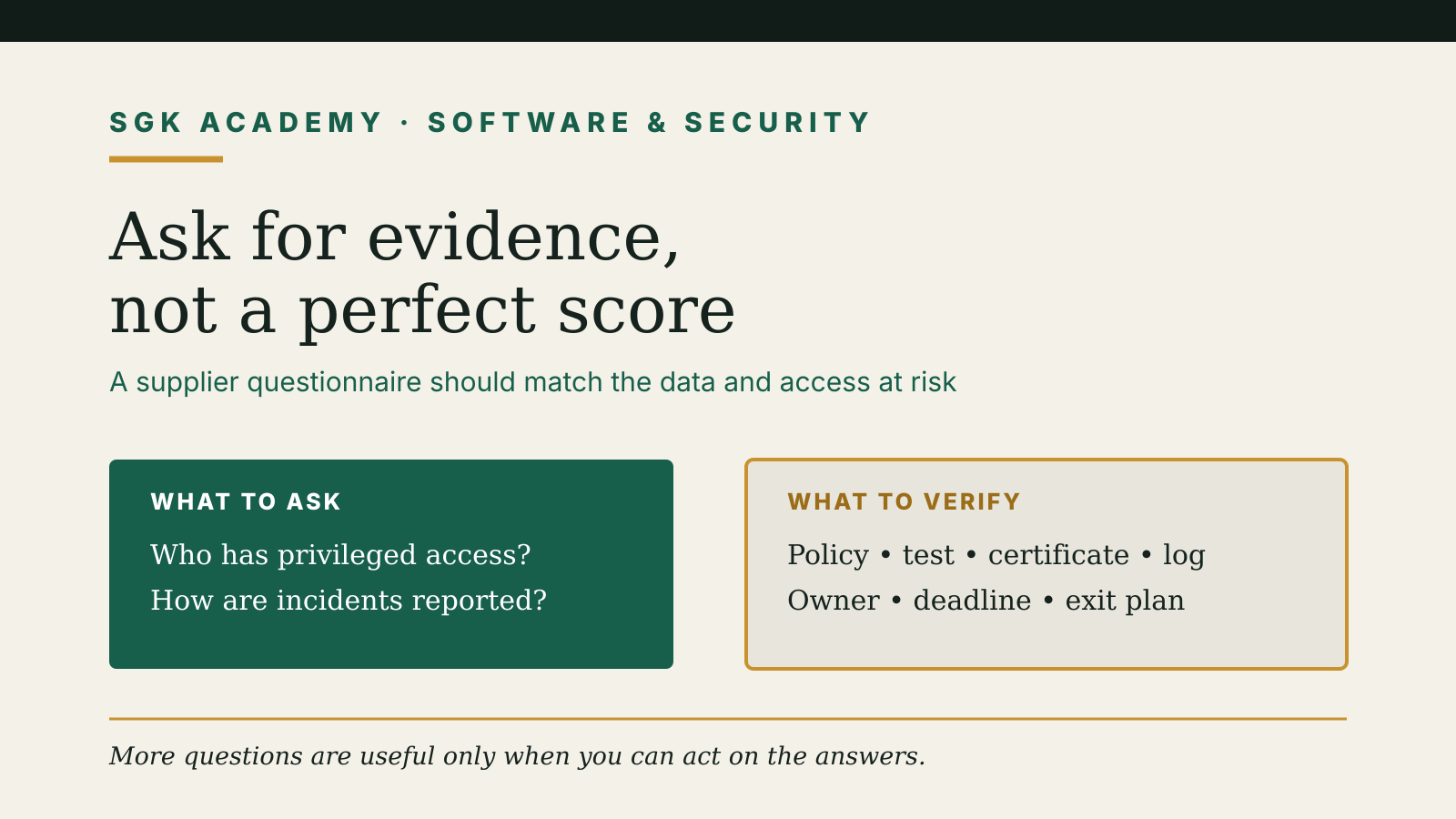
A SaaS supplier security questionnaire should help a small business decide what evidence it needs before giving a vendor data, accounts or privileged access. It should not be a hundred-question form copied from a large enterprise and filed without review.
Start with the service’s actual risk. Then ask the smallest set of questions that can change the buying decision, contract or configuration.
Based on UK National Cyber Security Centre guidance reviewed on November 1, 2026.
Start with the service, not the template
Write down four facts before sending a questionnaire:
- what data the supplier will store or process;
- what systems it can connect to;
- whether its staff or support team can access your environment;
- how long the business could operate without the service.
A payroll platform, a public newsletter tool and an administrator with remote access do not need the same assurance. The NCSC’s cloud provider guidance recommends matching the level of confidence to data sensitivity and the impact of a breach or outage.
Record the service in your software asset inventory before assessment. That gives the questionnaire an owner, data classification and review date. If you still need to decide how deep the review should go (ownership, provenance, dependencies), Software Supplier Checks Before You Connect Data covers that framing; this guide is the question set you send once the depth is decided.
The core questions
The NCSC publishes supplier assurance questions across governance, incidents, networks, data, personnel, physical security, testing and contracts. For a small SaaS purchase, the following set covers the main decision points.
| Area | Question to ask | Evidence to request |
|---|---|---|
| Ownership | Who is accountable for security? | Role, escalation contact, current policy |
| Access | Who can access customer data and production systems? | Privileged-access process, MFA policy, review schedule |
| Incidents | How and when will customers be notified? | Contract clause, incident plan, notification route |
| Recovery | What service level can be maintained after an incident? | Backup and recovery summary, recent test date |
| Data | Where is data stored, copied and backed up? | Data-flow or location statement |
| Subprocessors | Which third parties can access data? | Current list and change-notice process |
| Testing | How are vulnerabilities found and fixed? | Independent test or certification scope, remediation process |
| Exit | How will data be returned and deleted? | Export format, retention period, deletion confirmation |
A “yes” is not evidence. Ask for the document, report, screen or contract term that supports the answer.
Scale the evidence to the risk
For a low-risk tool with no confidential data, a published security page, MFA support and clear deletion process may be enough.
For a service holding customer records, payment information or administrator access, you may need:
- an independent assurance report or certification and its scope;
- a recent penetration-test summary;
- contractual incident-notification times;
- a data-processing agreement;
- subprocessor and international-transfer details;
- tested recovery objectives;
- a right to receive audit or assurance information.
The NCSC’s supply-chain principles say assurance requirements should be justified. A formal audit right may be useful, but it is not always practical for a shared cloud service. In that case, define the reports or certifications the provider must supply instead.
Read the scope, not the badge
ISO 27001, SOC 2, Cyber Essentials or a penetration test can help, but only within their scope and date.
Check:
- which legal entity and service are covered;
- the period or test date;
- whether customer-facing production systems are included;
- whether exceptions or material findings remain open;
- whether the report covers the subprocessors you rely on.
A certificate for a parent company or office network may say little about the SaaS product you plan to use.
Ask about the supplier’s suppliers
Cloud services are layered. A SaaS vendor may depend on a hosting platform, email provider, analytics service and support tools.
The NCSC’s cloud supply-chain principle says customers should understand what data is shared with third parties, how the provider manages those risks and who is responsible for each security function.
Ask for:
- the subprocessor list;
- the data each subprocessor receives;
- the notice period for changes;
- any way to object or terminate;
- how the vendor checks its own critical suppliers.
This is not a demand for every component name. It is a way to find material dependencies and changes.
Put the useful answers into the contract
A questionnaire is not a control unless the important commitments survive the sales process.
Move the decision-critical points into the contract or order form:
- incident notification deadline and contact;
- minimum authentication and access controls;
- data locations and approved subprocessors;
- availability and recovery commitments;
- evidence supplied at renewal;
- export assistance and deletion deadline at exit;
- notice of material security or ownership changes.
Keep marketing statements separate from binding commitments. If a promise matters to the risk decision, record where it is enforceable.
Record gaps and compensating controls
Few suppliers will answer every question perfectly. For each gap, choose one outcome:
- accept the risk with a named owner and review date;
- require a deadline and evidence;
- reduce the data or permissions given to the service;
- add your own control, such as single sign-on or export backups;
- choose another supplier.
For example, a vendor without single sign-on might be acceptable for a low-risk, two-user tool with MFA. It may be unsuitable for a service with many staff accounts and sensitive records.
Recheck after purchase
Supplier assurance is not a one-time gate. Review the record:
- at renewal;
- after a significant incident;
- when the service gains new data or permissions;
- when a material subprocessor changes;
- when the vendor changes ownership;
- when the contract or security terms change.
Link the review to your cloud access offboarding checklist so an exit decision can be carried out, not merely discussed.