Home › Guides › Holding company for a small business
A holding company can put an extra legal layer between you and the business that trades. That layer may make sense when a founder owns several operating companies, wants to keep investment assets away from day-to-day trading risk, or is planning a future sale. It is not an automatic tax discount, and it is rarely the cheapest structure for a simple one-company business.
In brief A typical UK structure has an individual or family owning a parent company, and the parent company owning one or more subsidiaries. The arrangement can help separate activities and move qualifying dividends within the group, but every company keeps its own legal, accounting and tax obligations. Before restructuring an existing company, model the purpose, ownership, tax treatment and professional costs—not just the Companies House fee.
This guide is UK-focused. If the owner, companies or key decisions sit in different countries, start with company tax residence and obtain cross-border advice before moving shares or assets.
The structure in one picture
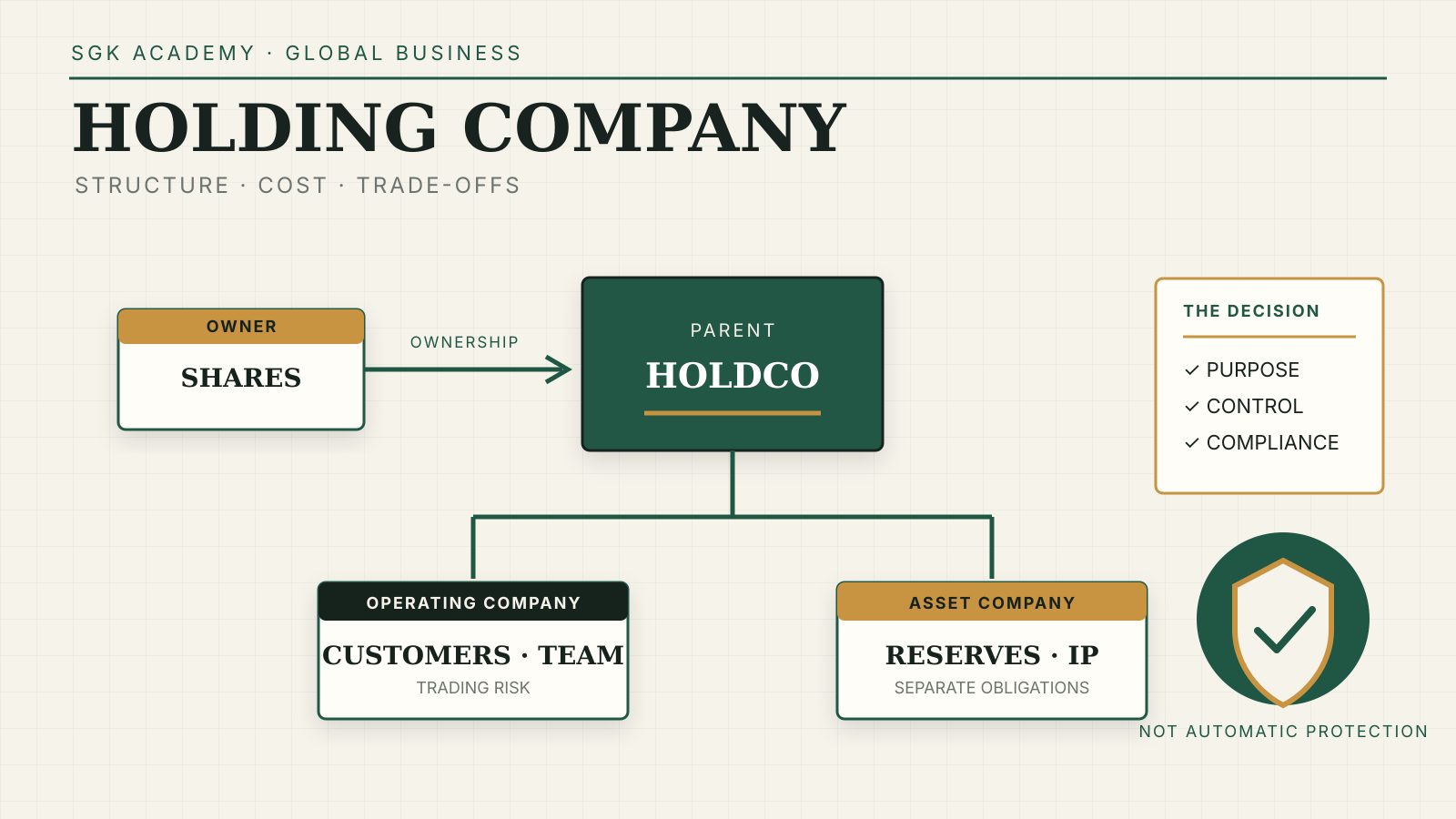
A basic group looks like this:
| Level | Typical role | What it owns or does |
|---|---|---|
| Founder or family shareholders | Ultimate owner | Shares in the holding company |
| Holding company | Parent or “HoldCo” | Shares in the operating company; sometimes cash, investments or intellectual property |
| Operating company | Trading subsidiary or “OpCo” | Contracts with customers, employs staff and incurs day-to-day trading risk |
The parent does not make the subsidiary disappear. Both remain separate companies. Each has its own register entry, directors, bank and accounting records, annual accounts, confirmation statement and Corporation Tax position.
That distinction matters. Group accounts may be required in some circumstances, but a group is not a single legal pot. An unpaid supplier of the operating company does not normally become a creditor of the parent simply because the parent owns it. The practical separation can be weakened by guarantees, poorly documented intercompany transfers, common security, insolvency issues or conduct that creates another basis for liability.
When a holding company can help
You have more than one operating business
A parent can provide a clear ownership point above several subsidiaries. A founder might keep a software business and a consulting business in different operating companies while holding both through one parent.
This can make a future investment or sale easier to frame: an investor can buy into one subsidiary rather than the founder’s entire commercial portfolio. It can also keep contracts, staff and liabilities connected to the relevant activity.
The benefit depends on the records matching the diagram. If the companies share money informally, use each other’s assets without agreements, or sign cross-guarantees for every loan, the operational separation will be less useful.
You want to keep some assets away from trading activity
A profitable operating company may pay a dividend to its corporate shareholder. HMRC’s company distributions manual says most distributions received by UK companies are exempt under Part 9A of the Corporation Tax Act 2009, subject to the statutory classes and exceptions.
That can allow qualifying cash to move to a parent for reinvestment without first being paid to the individual shareholder. Cash held by the parent is outside the operating company’s balance sheet, although it remains exposed to the parent’s own creditors and any guarantees the parent has given.
“Moving cash up” is not the same as taking money home. A later dividend, salary, loan or other benefit from the parent to the individual has its own tax and company-law treatment. See the separate guide to salary versus dividends.
Intellectual property, property or investments may also be held outside the trading company, but this is not a filing-box exercise. Transfers can create tax, VAT, stamp duty, valuation, lender, contract and regulatory consequences. The operating company may need a commercial licence or lease, and the arrangement must reflect what actually happens.
You are planning for a sale or investment
A parent can help a founder sell one subsidiary while retaining another. The UK substantial shareholding exemption may exempt a company’s gain on the disposal of shares where the statutory conditions are met. HMRC says the exemption is automatic when it applies; there is no separate claim.
The word “may” is important. The exemption has conditions, exclusions and anti-avoidance rules. The seller, shareholding, period of ownership and companies’ activities all need to be tested against the rules that apply at the disposal date. A sale of assets by the operating company is also different from a sale of shares by the holding company.
If a transaction is already in view, obtain advice before inserting a new parent. A late restructuring can affect buyer due diligence, tax clearances, warranties, banking and the timetable.
You need a clearer succession or ownership plan
A parent can concentrate voting and economic ownership in one place. That may help when introducing family shareholders, employee ownership, different share classes or a long-term investment vehicle.
It can also make things more complicated. Rights written into the parent’s articles or shareholders’ agreement can affect every company below it. Share issues, transfers and dividend rights need to be designed rather than copied from a generic template. Review where to register an online business if the companies or owners are not all UK-based.
What a holding company does not do
A second company is not a protective wrapper that fixes every risk.
- It does not erase personal guarantees signed by a founder or parent company.
- It does not turn money paid to the individual into a tax-free corporate dividend.
- It does not combine all companies into one Corporation Tax return.
- It does not remove each company’s filing, record-keeping and director duties.
- It does not make every transfer between group companies tax-neutral.
- It does not create VAT recovery simply because the companies are in a group.
- It does not rescue assets transferred after insolvency is foreseeable or when creditor duties are engaged.
The useful question is therefore not “Is a holding company better?” It is “Which identifiable risk, transaction or ownership problem is this extra company solving?”
The main UK tax mechanics
Dividends between companies
Most company distributions received by UK companies are exempt, but the exemption is not a blanket statement that all group cash movements are tax-free. The payment must legally be a dividend, the company must have distributable profits, and the recipient must fall within the rules.
Record the board decision and dividend paperwork. If the operating company cannot lawfully make a distribution, labelling a transfer “dividend” does not cure it.
Group relief
Group relief can let qualifying companies surrender certain losses and other amounts to another company in the group. HMRC’s guidance explains that the group relationship generally requires at least 75% ownership, with additional entitlement tests.
This is not full tax consolidation. Each company calculates its own results and files its own Company Tax Return. The amount available, claimant period, surrendering period and restrictions still matter.
Associated companies and Corporation Tax thresholds
The UK Corporation Tax main rate is 25%. A 19% small profits rate applies at profits of £50,000 or less, with marginal relief between £50,000 and £250,000. Those limits are reduced where there are associated companies and for short accounting periods.
Companies are associated where one controls the other or both are under common control, subject to detailed rules. A holding-company structure can therefore reduce the profit thresholds available to each company. For example, if two active companies are associated throughout a normal 12-month period, the headline £50,000 and £250,000 limits are generally divided by two before other adjustments.
There is a narrow exclusion for certain passive holding companies, but HMRC’s conditions are strict. The company must broadly hold shares only in qualifying subsidiaries, receive only dividends, pass those dividends on, have no chargeable gains and have no management expenses or charitable donations. Do not assume every non-trading parent is ignored.
VAT grouping
Eligible companies under common control can apply to form a VAT group. The group submits one VAT return, and most supplies between members are disregarded for VAT.
That can simplify administration, but it creates joint and several liability for VAT debts. HMRC also makes clear that joining a VAT group does not automatically turn holding-company costs into recoverable input tax. Recovery depends on the holding company’s economic activity and the link between costs and taxable supplies. Management services and charges need commercial and VAT analysis.
Selling a subsidiary
A qualifying share sale by the parent may fall within the substantial shareholding exemption. An asset sale by the subsidiary normally produces tax consequences inside the subsidiary, after which extracting proceeds is a separate step.
That distinction can affect price, warranties, liabilities retained and the buyer’s tax position. Model both routes rather than building the group around one tax headline.
What the extra company costs
Companies House fees are the smallest and easiest part to price. Adviser, banking, software, audit and restructuring costs vary too much to state honestly without the facts.
As of 23 October 2026, the official digital incorporation fee is £100. The online confirmation-statement fee is £50. Companies House changed those fees on 1 February 2026.
| Cost or task | One-company structure | HoldCo plus one OpCo |
|---|---|---|
| Companies House digital incorporation for an added company | — | £100 one-off |
| Online confirmation statement | £50 per 12-month payment period | £50 for each company |
| Annual accounts | One set | Separate accounts for each company |
| Company Tax Returns | One, when required | Separate return for each company, when required |
| Bank, bookkeeping and software | One company’s arrangements | Often an additional account, ledger and subscription |
| Legal and tax design | Usually simpler | Often needed for ownership, transfers and intercompany terms |
A limited worked example
Suppose a founder already has one operating company and creates a new parent digitally. Looking only at the current Companies House fees, the extra government cost is £100 for incorporation and £50 for the parent’s first online confirmation-statement payment period: £150.
In later years, the extra government baseline is the parent’s £50 online confirmation-statement fee. That example excludes professional advice, accounts, tax returns, banking, software, valuation, share exchange, stamp duty, clearance applications and any audit requirement. For many small businesses, those variable costs decide whether the structure is worthwhile.
Check live fees before filing. Government charges can change, while old articles continue to rank in search.
Starting with a parent versus adding one later
A founder starting a new venture can incorporate the parent first and let it subscribe for shares in the operating company. Adding a parent above an existing company is more involved because the founder’s existing shares must move into the new structure.
A share-for-share exchange is one possible route, but it is not a do-it-yourself formality. The tax treatment, market value, stamp taxes, clearances, articles, investor rights and accounting entries depend on the transaction. Contracts or regulated permissions may also contain change-of-control provisions.
Do not simply transfer the operating company’s shares for £1 because the companies are yours. Ownership and consideration need a defensible legal and valuation basis.
A decision table
| Situation | Likely starting point |
|---|---|
| One modest trading company, no investors, no sale plan, profits mainly withdrawn for living costs | Keep the single-company structure unless a specific problem justifies more administration |
| Two distinct businesses with different customers, teams or risk | Model separate subsidiaries under one parent |
| Profits are retained for future acquisitions or investment | Compare holding cash in OpCo with moving qualifying dividends to HoldCo |
| Valuable IP or property will be licensed to the trading company | Obtain legal, tax and valuation advice before separating the asset |
| A sale of one business is plausible in the next few years | Model share-sale and asset-sale routes before restructuring |
| Founder needs money personally now | A parent may add work without changing the personal extraction question |
| Overseas owner, directors or subsidiaries | Review residence, withholding taxes, treaty access and anti-avoidance rules first |
| External debt requires guarantees across the group | Treat the proposed ring-fencing benefit cautiously |
Setup checklist
Before creating or inserting a holding company:
- Write down the commercial objective in one sentence. “Tax” is too vague.
- Map the current and intended shareholders, voting rights and economic rights.
- Decide which company will employ people, sign customer contracts and own each asset.
- List existing loans, guarantees, investor consents and change-of-control clauses.
- Model Corporation Tax thresholds with all associated companies included.
- Test whether dividends, group relief, VAT grouping or a future share sale are actually relevant.
- Price the recurring accounts, tax, banking and software work for every entity.
- Get advice on any share exchange, asset transfer, intellectual-property licence or property movement before signing it.
- Put intercompany loans, services, licences and cost sharing in writing and account for them consistently.
- Build a filing calendar for each company. The SGK Academy deadlines page can help with the standard timetable.
- Keep board minutes, dividend vouchers and ownership records with the accounting evidence.
- Review the structure when investors, debt, business activities or countries change.
If an unused company remains after a plan changes, do not leave it unattended. Compare keeping it dormant with the requirements for voluntary strike-off.