Bond duration describes how sensitive a bond’s price is to a change in yield. It helps explain why a bond issued by a financially strong borrower can still lose market value. If you may need to sell before maturity, price risk matters alongside the issuer’s ability to repay.
For money intended for a future bill, the first question is when the money must be available. The second is how much variation in value you can tolerate before that date. A high-quality bond fund and a short-term cash reserve answer different needs even when both are described as conservative.
Separate repayment risk from market-price risk
Credit risk concerns whether the issuer will meet its obligations. Interest-rate risk concerns how the market value of the promised payments changes when yields change. Reducing one does not remove the other.
The SEC’s investor bulletin on fixed-rate bonds, published on 26 June 2013, explains the basic relationship: market interest rates and fixed-rate bond prices generally move in opposite directions.
The Federal Reserve’s May 2026 Financial Stability Report provides a contemporary reminder that fair-value losses on fixed-rate assets remain sensitive to changes in longer-term rates. It is a system-level report, not a forecast of the return on a reader’s bond portfolio.
A borrower can remain fully capable of paying while an existing bond becomes less attractive relative to newly available yields. The price adjusts to reflect that comparison.
Work through a simple bond price
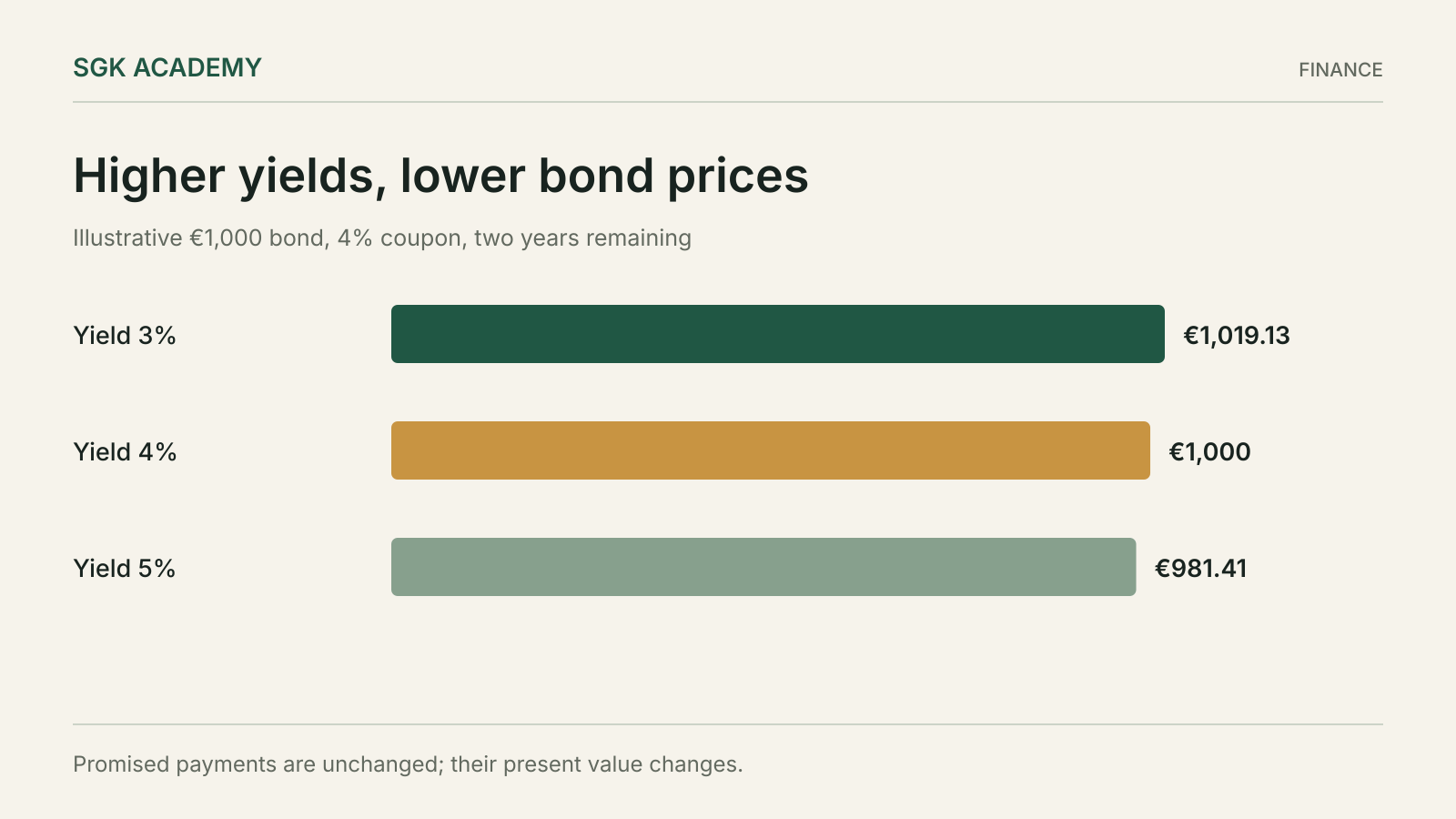
Consider an illustrative bond with a €1,000 face value, a 4% annual coupon and two years remaining. It pays €40 in one year and €1,040 in two years. Assume annual discounting and no credit or other complications.
If the required yield is 4%, the present value is €40 divided by 1.04, plus €1,040 divided by 1.04 squared. That gives €1,000.
If the required yield rises to 5%, the same promised payments are worth about €981.41. The issuer has not changed the coupon, but a buyer now demands a higher return, so the price falls.
If the required yield falls to 3%, the price rises to about €1,019.13. These are calculated scenarios, not market quotes. They isolate the effect of changing the discount rate on fixed promised cash flows.
Duration summarises sensitivity
Modified duration gives an approximate percentage price change for a small change in yield, holding other relevant factors constant. A common first-order estimate is: percentage price change is approximately minus modified duration multiplied by the yield change.
If modified duration is 6 and yield rises by one percentage point, the estimate is a price decline of about 6%. A half-percentage-point rise gives an estimated decline of about 3%.
Use the yield change as a decimal in the calculation: 0.01 for one percentage point. Confusing a percentage point with a percentage change can produce a large error.
| Illustrative modified duration | Yield rises 0.5 percentage points | Yield rises 1 percentage point |
|---|---|---|
| 2 | About −1% | About −2% |
| 6 | About −3% | About −6% |
| 10 | About −5% | About −10% |
This is a sensitivity estimate, not a total-return forecast. It omits coupon income, the passage of time, changes in credit spreads and nonlinear effects.
Know when the approximation becomes less useful
The relationship between price and yield is curved rather than perfectly straight. Convexity describes part of that curvature. For larger yield changes, a duration-only estimate can become less accurate.
Bonds with embedded options can behave differently when interest rates change because expected cash flows may change too. A callable bond, for example, should not be treated as if every future payment were unaffected by the issuer’s options.
A fund may publish effective duration or another measure appropriate to its holdings. Read the definition rather than assuming every number labelled duration is calculated identically.
You do not need to calculate every measure yourself to use the information. You do need to understand that a single sensitivity number is a summary under assumptions, not a guarantee of the worst possible loss.
Maturity and duration are related but different
Maturity is the date when the bond’s final principal payment is due under its terms. Duration reflects the timing and value of the cash flows and the chosen measure of sensitivity.
A coupon-paying bond returns some cash before maturity, which affects its duration. Two bonds with the same maturity can therefore have different sensitivities because their coupons, yields or structures differ.
For a simple zero-coupon bond, all the payment arrives at maturity, making the relationship more direct. Even then, distinguish the type of duration measure being quoted.
When reading a fund factsheet, do not use average maturity as a substitute for duration. Both can be useful, but they answer different questions about the portfolio.
A bond fund does not necessarily mature with your bill
An individual bond has contractual payment dates, subject to default and its other terms. A conventional bond fund usually holds and trades a portfolio that continues operating. Your fund shares do not automatically become cash at a fixed date matching your obligation.
If the fund maintains a particular duration range, it may replace maturing bonds with longer-dated ones. Its sensitivity can remain substantial even as you approach the date when you need the money.
This does not make the fund inherently inappropriate. It means the investment horizon and the fund’s strategy need to fit. A long-term investor seeking bond exposure has a different problem from a business setting aside money for a tax payment in six months.
Target-maturity products have their own structures and risks and should be read on their terms. A name suggesting a year is not enough to establish a guaranteed redemption amount.
Income does not cancel every price decline
A coupon or distribution contributes to total return, but it does not make the market value irrelevant. A fund can pay income while its share price falls by more than the amount distributed.
Consider an illustrative €20,000 holding with a modified duration of 7. A one-percentage-point yield increase suggests an initial price effect of roughly −7%, or €1,400, before other changes. A year’s income may offset part of that effect, but the timing matters.
If the owner needs to sell immediately after the price change, future income does not pay today’s bill. If the owner can hold longer, reinvestment at higher yields can affect the longer-term outcome.
Avoid comparing a quoted yield with a possible price loss as if they occur at the same instant under the same assumptions. Write down the holding period and the cash flows explicitly.
Credit spreads add another moving part
A corporate bond’s yield can change because of general interest rates and because investors demand a different premium for credit and liquidity risk. Duration to the relevant yield measure does not tell you why the yield changed.
During stress, interest rates and credit spreads may move in different directions. A broad statement that “rates fell, so bonds should rise” can therefore be incomplete for a particular portfolio.
Read the fund’s credit exposure and concentration alongside duration. A low duration does not imply that default or liquidity risk is low. A high credit rating does not imply that interest-rate sensitivity is low.
Currency exposure adds another layer if the investment and the future spending are in different currencies. Keep that risk separate rather than expecting the bond’s coupon to compensate for every source of variation.
Match the instrument to the spending date
Start with the amount, currency and date of the obligation. Decide which part must be reliably available and which part can tolerate market variation.
Then compare candidate instruments on maturity or dealing structure, duration, credit exposure, currency, fees and access. Use conservative scenarios rather than a single forecast of where rates will go.
For an emergency reserve, uncertain timing is itself a constraint. Our guide to emergency funds focuses on availability and the consequences of delayed income. That money has a different job from a long-term bond allocation.
For an investment portfolio, consider how bonds fit the overall strategy and risk tolerance. A sensitivity calculation is a tool for understanding exposure, not a personalised allocation recommendation.
Keep a small scenario sheet
Record the current value, quoted duration measure, relevant yield, currency and intended holding period. Add price-sensitivity estimates for modest upward and downward yield moves, clearly labelled as approximations.
List what the model excludes: credit changes, defaults, optionality, liquidity, tax, fees and currency movements where applicable. The exclusions are part of understanding the result.
Update the sheet when the fund’s holdings or your spending plan changes. A duration figure from an old factsheet may no longer describe the portfolio.
The useful outcome is the ability to explain a loss without assuming that the bond has defaulted. Fixed payments can become more or less valuable in the market, and your need to sell determines how much that market value matters.
Read the quoted yield’s definition
A factsheet may show a distribution yield, yield to maturity or another measure. They are not interchangeable promises. A distribution can reflect past payments, while a yield-to-maturity calculation uses assumptions about the portfolio’s cash flows and current price.
Check whether the measure is before or after fees and whether it assumes reinvestment. For a fund, holdings can change, and an investor’s own entry and exit prices affect the realised return.
Write the exact label in the scenario sheet rather than shortening every figure to “yield”. That small habit prevents a cash-flow estimate from using a number intended for a different purpose. If the definition is unclear, ask the fund provider to identify the calculation before relying on it.
Questions
Can a government bond lose value without a default?
Yes. Its market price can fall when required yields rise, even if the issuer continues making the promised payments.
Does duration predict the exact loss from a rate change?
No. It is an approximation under specified assumptions, especially useful for smaller yield changes. Other risks and nonlinear effects can alter the result.
Is a bond fund equivalent to holding one bond to maturity?
No. A conventional fund is an ongoing portfolio and may maintain its interest-rate exposure as holdings change.
Should money for a near-term bill go into a long-duration fund?
Assess the need for reliable value and access against the fund’s price sensitivity. The spending date matters more than a general description such as conservative.