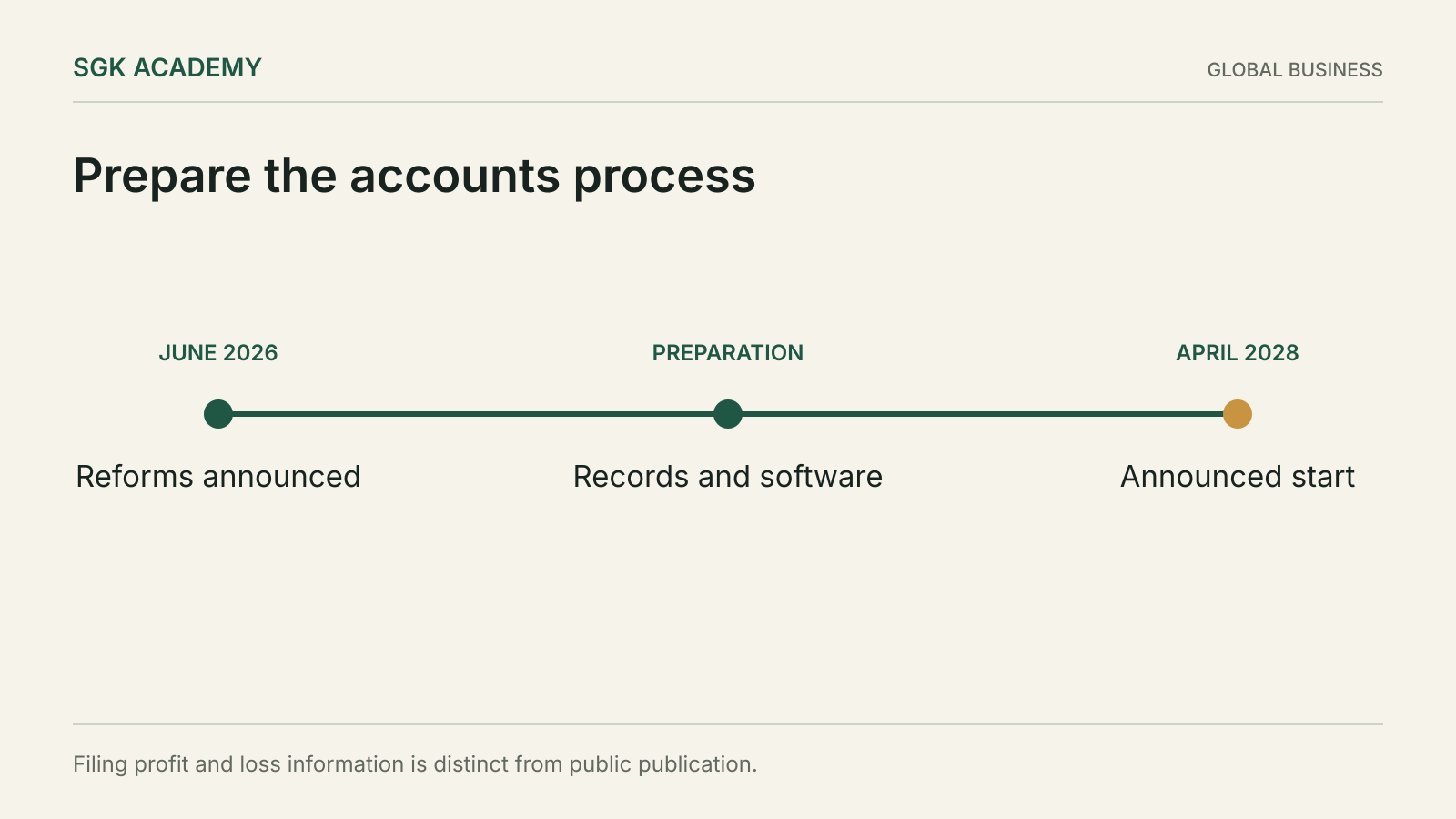
UK company accounts filing is set to change from April 2028 under the package announced on 9 June 2026. Companies House says annual accounts will need to be filed through commercial software, while small companies and micro-entities will file profit and loss accounts with an option to opt out of public publication. Filing and publishing are therefore separate decisions.
For a small company, the immediate task is preparation: understand the announced scope, check the accounting process and avoid making assumptions about details still to be confirmed. The changes are future requirements in this article’s June 2026 context.
Read the announced date carefully
The Companies House announcement of 9 June 2026 says the package will take effect from April 2028 rather than April 2027. It explains that companies have more time to prepare.
That is a change in the implementation timetable, not a statement that existing obligations can be ignored until 2028. Companies still need to meet the requirements that apply to their current filings.
Keep a note of the announcement and its date. If an adviser or software vendor uses an older April 2027 timetable, ask them to reconcile it with the June announcement.
Do not invent a more precise transition rule for a particular accounting period from a general start-month statement. Confirm the applicable detailed guidance as it becomes available and before making a filing decision.
Separate filing information from putting it on the public register
The announcement says small companies and micro-entities will be required to file profit and loss accounts, with an option to opt out of publishing that information on the public register.
This distinction matters for business owners worried about commercial disclosure. Choosing not to publish does not mean the information is not filed. Companies House says it, law enforcement and HMRC will still have access where a company opts out of publication.
The announcement also says that details of how smaller companies can opt out will be confirmed later. Do not describe a specific button, form or procedure as available before it has been established.
Record the company’s preference about publication, but keep implementation as an open item until the official process is clear. A preference and a completed filing instruction are different records.
Understand what software-only filing covers
Companies House says all UK-registered companies will need to file annual accounts in iXBRL format using commercial software from April 2028. The announcement covers companies filing themselves and those using accountants or agents.
It also says web and paper systems will close for accounts filings, while web filing remains available for non-accounts submissions such as confirmation statements and director updates.
That boundary prevents a common misunderstanding. The announcement is not that every Companies House interaction moves into accounting software. The accounts route changes; other filing services have their own arrangements.
For a director, the practical question is which system or provider will prepare and submit the accounts, who will review them and how successful receipt will be confirmed.
Start with the current accounting process
Map the path from transactions to filed accounts. Where are sales and purchases recorded? Who reconciles bank balances? Who prepares adjustments? Who reviews the final accounts? Who submits them?
A filing-software change can expose weaknesses earlier in that chain. If the books are incomplete, a new submission format will not make the accounts accurate.
Keep the map simple enough to use. A small company may have one bookkeeper and one accountant, while a founder handles source documents. The responsibilities still need to be explicit.
| Stage | Owner to identify | Evidence of completion |
|---|---|---|
| Source documents | Person collecting invoices and records | Complete period folder |
| Bookkeeping | Internal person or provider | Reconciled ledger |
| Accounts preparation | Qualified preparer as appropriate | Draft accounts and adjustments |
| Director review | Responsible director | Approved final version |
| Submission | Company or agent | Filing receipt and status |
| Retention | Named record owner | Accessible final documents |
The table is an operating model, not a replacement for the company’s legal responsibilities.
Ask software vendors about the exact filing need
A product may support bookkeeping without supporting the required accounts preparation and filing. Another may provide filing while relying on data prepared elsewhere.
Ask whether the software supports the company’s entity type, accounts requirements and intended agent arrangement. Confirm what is included in the price and what requires another product or professional service.
Do not assume that a current marketing statement guarantees future support for every aspect of the 2028 package. Ask how updates will be delivered and what commitments the vendor actually makes.
Also examine access and continuity. Who owns the account? Can the company obtain its records if it changes accountant? What happens if a subscription lapses? A filing dependency should not become an avoidable barrier to accessing the company’s own information.
Keep iXBRL in proportion
iXBRL is a way of combining readable accounts with structured tags. For most small-company directors, the important task is to select a capable process and review the underlying accounts, not to hand-author the technical format.
The preparation system should generate the required file and validate it appropriately. The person responsible should still check that the financial information and classifications are correct.
A technically accepted file can contain an accounting error. Conversely, correct accounts can fail a technical submission check. Treat those as different review stages.
Ask the provider how errors are reported and corrected. The company needs a clear route from a rejected submission back to the person who can resolve the problem, especially near a deadline.
Do not lose the other announced changes
The June package includes more than software. The announcement also describes removing the option to file abridged accounts, strengthening the eligibility statement for audit exemption, requiring component parts of accounts and reports to be filed together, and limiting how often an accounting reference period can be shortened.
The detailed effect on a company depends on its circumstances and the implementing guidance. A small company should ask its accountant which parts of the package change its current practice.
Do not assume that being small or dormant automatically answers every filing-format question. The software and advice should match the actual company and accounts.
Create a short list of applicable changes rather than copying the entire announcement into a task tracker. Mark uncertain items for confirmation and assign someone to resolve them.
Work through a company that uses an external accountant
Imagine a small consultancy whose director keeps invoices in cloud storage and sends a spreadsheet to an accountant once a year. The accountant prepares accounts and the director approves them by email.
The company should ask whether the accountant’s service will include the future software filing, whether the existing records are sufficient and how the director will receive the final filed copy and receipt.
It should also discuss the publication option separately. The accountant should not infer a preference simply because the director previously filed less information publicly.
If the consultancy changes accountant before 2028, it needs a usable handover: opening balances, supporting records, prior accounts, filing history and relevant decisions. The software transition is easier when those records are already under control.
This is an illustrative operating example, not a recommendation for a particular accounting system.
Build a preparation calendar with real decision points
A useful calendar starts with the current filing obligations, then adds a review of the announced changes, a software or provider decision, a data-quality check and a confirmation of the final implementation guidance.
Leave time for a trial of the process before a consequential deadline. That might involve checking an export, reviewing a sample accounts workflow or confirming that the director can access the required documents.
Do not create a calendar full of arbitrary compliance meetings. Each task should resolve a concrete dependency: missing records, uncertain scope, unsupported software or an unassigned filing responsibility.
Update the calendar when official guidance changes. The purpose is to remain ready for the applicable requirement, not to preserve a plan written before the details were settled.
Keep directors involved in the final result
Outsourcing preparation can be sensible, but the company should still understand what is being filed. The director’s review should address the actual accounts, not only whether a provider says the submission is ready.
Compare the final version with the approved draft and keep a record of material changes. Confirm that the intended publication choice is handled through the established process when that process is available.
After submission, retain the receipt and read back the recorded status. A sent file or an email from an agent is not always the same as accepted filing.
The practical outcome is a repeatable route from accurate records to reviewed accounts, successful submission and accessible evidence. The new format should fit into that route rather than become an isolated last-minute task.
Check the handover before changing providers
If the company plans to move to a different accountant or software package, obtain an inventory of the records that will transfer. Include the ledger, adjustments, supporting schedules, prior filed accounts and submission history.
Test that the exported information is readable and complete enough for the receiving provider. A PDF of the final accounts may be useful evidence but may not contain everything needed to prepare the next period.
Agree who handles the current filing while the transition is under way. Moving systems does not move the deadline, and an unclear handover can leave both providers assuming the other will submit. Record the responsibility and confirm it with the final filing evidence.
Keep the registered email address monitored during preparation. The June announcement says Companies House will contact companies through that address, so an old mailbox can cause the business to miss relevant implementation information even when its accounting records are otherwise in order.
Questions
Do the announced accounts reforms start in April 2027?
The 9 June 2026 announcement moves the package to April 2028. Check later detailed guidance for the treatment of the company’s specific filing.
Will small companies have to publish their profit and loss accounts?
The announcement says they must file them but can opt out of public publication. The detailed opt-out process was still to be confirmed in the June announcement.
Will Companies House web filing disappear entirely?
No. The announcement distinguishes accounts filing from non-accounts filings, for which web services remain available.
Does an accountant remove the need for director review?
No. Agree preparation and filing responsibilities, but retain a clear company review and evidence of the final submission.