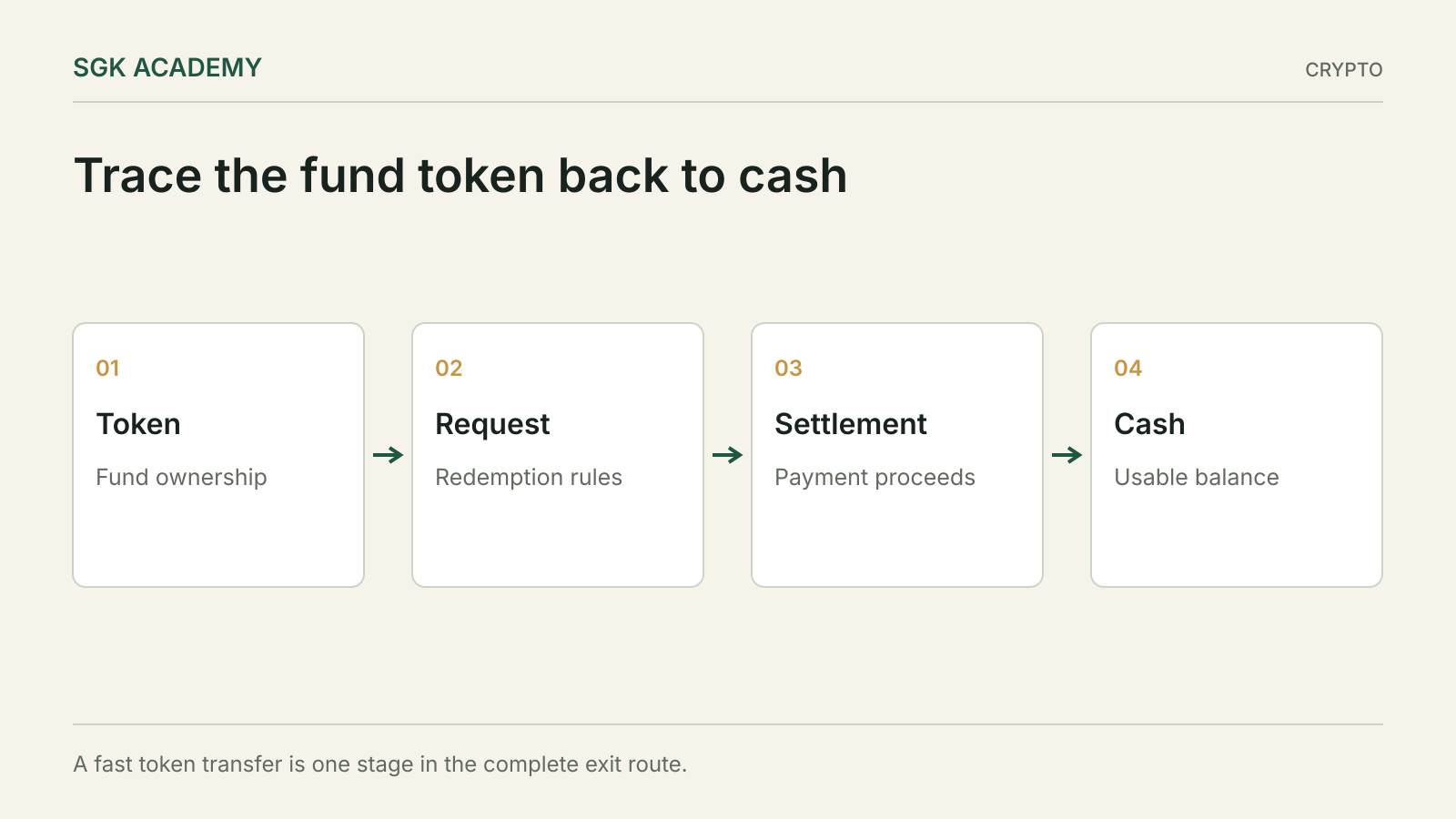
Tokenised money market funds put a digital representation of fund ownership on a distributed ledger. They do not remove the underlying fund, its assets or its redemption rules. Before treating a token as spendable cash, identify the legal claim, the authoritative ownership record and the route from the token back to money you can use.
The ECB’s April 2026 analysis is useful because it examines the actual structure behind the technology. Some processes can operate on-chain while others remain in conventional financial infrastructure. That split matters when an investor wants to transfer, redeem or use a token as collateral.
Identify the fund before the token
The ECB defines a tokenised money market fund as a money market fund whose shares are issued and recorded as digital tokens on a distributed ledger. The token represents a claim on the underlying fund.
Its April 2026 analysis explains that these funds invest in assets similar to those held by traditional money market funds. Tokenisation changes aspects of recording and transferring ownership; it does not turn every underlying instrument into a blockchain-native asset.
Begin with the fund’s legal name, domicile, manager, prospectus and investor eligibility. Then examine the token contract and the role it plays. A familiar ticker or blockchain address is not a complete product description.
Be careful with products that resemble a tokenised fund but are legally structured differently. The ECB’s analysis explicitly distinguishes its fund sample from some tokenised instruments with different asset constraints. Similar interface labels do not establish the same rights.
Ask which record establishes ownership
A blockchain transfer can be technically complete while the legal ownership process still depends on an off-chain register or reconciliation. The ECB found different arrangements among the funds it examined.
For some structures, the distributed ledger is the authoritative ownership record. For others, a conventional ledger remains primary. That distinction affects what a wallet balance proves.
Ask what happens if the token record and the fund administrator’s record differ. Which one prevails under the documents? Who corrects the discrepancy? How does the investor establish their entitlement during a dispute?
This is not an argument that an off-chain register is necessarily inferior. It is a reason to understand the arrangement rather than assume that the newest technical record automatically determines legal title.
Separate token transfer from cash redemption
A token may move between eligible wallets at a time when the underlying securities market or banking system is closed. That does not mean the fund can always liquidate assets and pay cash immediately.
Redemption can involve cutoffs, dealing days, identity checks, administrator processing and payment settlement. The final destination may be a bank account or another asset, depending on the product.
| Stage | What may happen | Question to ask |
|---|---|---|
| Token transfer | Ledger records a movement | Is the recipient eligible and is ownership final? |
| Redemption request | Investor asks the fund for payment | What cutoff and conditions apply? |
| Asset liquidity | Fund obtains the required cash | Which markets and counterparties are involved? |
| Payment settlement | Proceeds reach the investor | In what asset, currency and account? |
| Use of proceeds | Investor pays an obligation | Are the funds available by the needed time? |
The whole chain determines liquidity for the investor. Measuring only the speed of the token transfer leaves out the part that may matter most.
Read the assets and the dealing rules together
Money market funds generally seek exposure to short-term instruments, but short maturity does not mean every asset can be sold instantly at an unchanged price in every condition.
The ECB analysis discusses liquidity mismatches and operational fragilities as risks that tokenisation may amplify. Faster transferability of fund shares can coexist with slower or stressed liquidity in the underlying assets.
Read the portfolio constraints, liquidity management tools and redemption provisions in the actual fund documents. Determine whether the share value is intended to remain relatively stable or can fluctuate, and what the structure permits during stress.
Do not infer a bank-deposit guarantee from the words money market. The legal form, protection framework and risks need to be identified separately. A fund share and a deposit are different claims even when both are used for cash management.
Distinguish a fund token from a stablecoin
A tokenised fund share typically represents an interest in an investment pool. A stablecoin has its own issuer, reserve and redemption arrangement intended to support a reference value. The products can interact without becoming the same thing.
A fund may accept a stablecoin for subscriptions or redemptions. In that case, the investor needs to understand both the fund and the payment asset used to enter or leave it.
The ECB article includes a comparison of tokenised funds and stablecoins and notes their connections. The practical lesson is to trace the actual claim at each step rather than describing the whole chain as digital cash.
If redemption delivers a stablecoin, ask how that stablecoin becomes the currency needed for your obligation. Additional fees, eligibility, market liquidity and settlement steps may remain.
Work through a Friday liquidity example
Imagine a business holds €30,000 equivalent in a tokenised fund and expects to pay €10,000 to a supplier on Monday morning. The tokens can be transferred during the weekend, but the fund’s cash-redemption process follows a dealing schedule.
The business needs to establish the cutoff for the request, the expected payment date and the destination asset. A Friday-evening request may not produce usable bank money by Monday morning, depending on the product’s terms.
A secondary-market sale might be possible, but that introduces a different counterparty, price and liquidity question. It should not be assumed to provide the same amount as direct redemption.
The example is hypothetical. Its purpose is to show why an operational cash forecast must use the complete exit route. A wallet showing a large balance does not establish that a near-term bank payment can be made.
Examine collateral use as a separate exposure
A tokenised fund share may be accepted as collateral in another arrangement. That can create useful functionality, but it also introduces valuation, haircut, margin and liquidation questions.
Ask who values the collateral, how often the value is updated and what happens when the token cannot be transferred or redeemed. A collateral system may react faster than the fund’s cash process.
Using the token as collateral can also change the investor’s control over it. Read the rights granted to the counterparty and the conditions for return. Do not assume the asset remains freely available for ordinary spending.
The ability to reuse an asset in several systems is not the same as having several independent pools of liquidity. The same underlying value cannot meet incompatible obligations at the same moment.
Map the operational dependencies
List the fund manager, administrator, custodian, token platform, blockchain infrastructure and any payment asset or bridge involved. Not every product uses all of these, but every actual dependency should be visible.
Then ask what happens if each critical component is unavailable. Can ownership still be established? Can a transfer be processed another way? Who communicates with investors and corrects records?
Smart-contract controls, access restrictions and administrative powers also matter. Determine who can pause transfers, freeze a token or amend relevant system components, where those features exist.
A technical audit can provide evidence within its scope, but it does not replace the legal and operational documents. Likewise, a regulated fund structure does not prove that every connected application is equally robust.
Compare the tokenised and conventional routes
Use the same underlying purpose for the comparison. If the need is short-term investment exposure, compare costs, access, eligibility and operational burden. If the need is on-chain collateral, a conventional holding may not provide the same function.
Include custody and wallet-management work in the cost comparison. A tokenised route may create a need for key management, network fees and additional reconciliation.
Do not assume that a faster technical transfer means a cheaper or more useful complete service. Conversely, do not dismiss a tokenised structure merely because the assets remain off-chain. The value depends on which process is improved and for whom.
Write the claimed benefit in a testable sentence: for example, “eligible counterparties can transfer fund ownership outside the conventional dealing interface.” Then verify that the legal and operational documents support that statement.
Keep the exit route in the decision record
Before investing, record the legal claim, authoritative register, investor eligibility, dealing schedule, redemption asset and expected route to usable cash. Add costs and the main failure dependencies.
For a business, compare that route with the timing of its obligations. Keep immediately needed money in an arrangement that can meet the relevant deadline under realistic conditions.
Review the record when the fund changes its platform, accepted payment assets or transfer rules. A product can retain the same name while changing an operational dependency.
The useful question is not whether the token moves quickly. It is whether the investor understands what moves, what rights travel with it and how those rights become money when needed.
Reconcile the wallet with the accounting record
A business needs to record the fund holding, subscriptions, redemptions, distributions and associated charges in its accounting system. A wallet balance alone does not explain the cost basis or every off-chain event.
Check what statements the administrator provides and whether transaction identifiers can be connected with the blockchain record. If income changes the token balance or the value of each token, understand which method the product uses before building a reconciliation.
Ask for a sample statement before committing a material amount. A product may function technically while creating substantial manual bookkeeping. Include that effort in the comparison with a conventional fund account, especially if the holding will be used frequently.
Questions
Is a tokenised money market fund the same as a stablecoin?
No. A fund token represents an interest in a fund, while a stablecoin has its own issuer and redemption structure. A product can use one to interact with the other.
Does a blockchain transfer always complete legal ownership?
That depends on the fund’s authoritative record and documents. Some structures retain an off-chain primary register.
Does round-the-clock transferability mean immediate cash redemption?
No. Redemption may depend on dealing rules, underlying markets, banking hours and other conditions.
Can a tokenised fund replace all business cash?
Assess the actual liquidity route and the timing of obligations. A transferable investment claim is not automatically usable bank money.