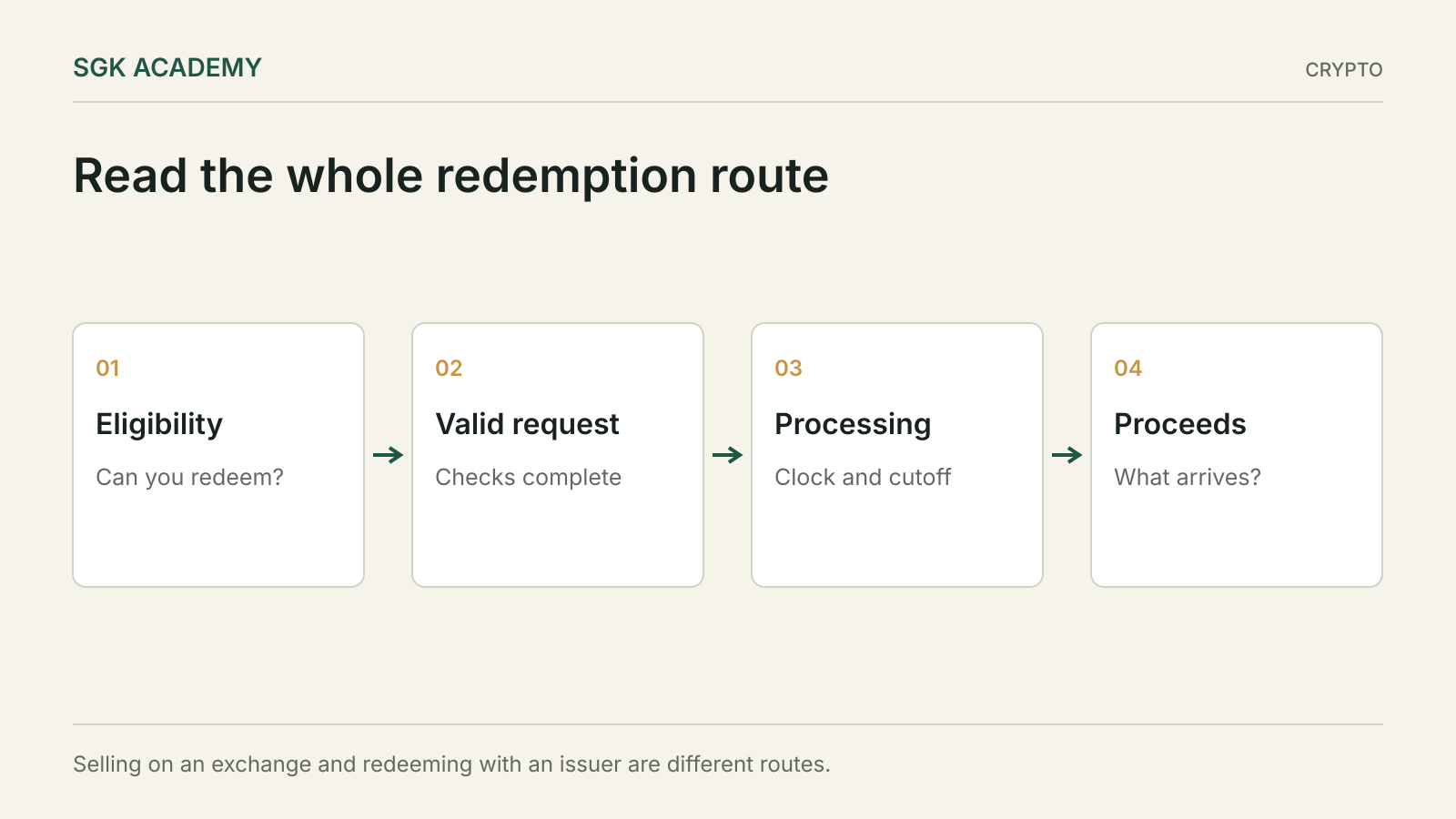
Stablecoin redemption is the process of exchanging a token through the issuer’s redemption arrangement. Selling the token on an exchange is a different route. A price close to its reference value does not establish that every holder can redeem directly, at any time, without checks, fees or settlement delays.
The UK’s June 2026 stablecoin rules provide a useful case study in why the details matter. They address backing, safeguarding, redemption and disclosure, but belong to a regime with a future commencement date. A holder assessing a token in July still needs to read the terms that actually apply to that token today.
Identify your route out before buying
There are several possible exit routes: direct redemption with the issuer, sale through an exchange or broker, transfer to a counterparty that accepts the token, or use through another financial product.
Each route has different dependencies. Direct redemption can require eligibility and onboarding. An exchange sale depends on the venue and market liquidity. A counterparty payment depends on acceptance and the agreed value.
Write down the route you would use for the amount and deadline that matter to you. “I can sell it somewhere” is not a complete cash plan.
If the intended destination is a bank account in a different currency, include conversion and payment settlement. The blockchain transaction is only one part of the exit.
Separate the reference value from an enforceable right
A token may be designed to track one unit of a currency. That design objective does not by itself explain who owes the holder money or under which conditions payment can be demanded.
Find the issuer, governing terms, eligible holder categories and redemption procedure. Determine whether your rights arise directly against the issuer or through an intermediary.
Read the product for the jurisdiction in which you use it. A global brand can have different entities, products or terms in different markets.
Do not infer a deposit-protection scheme from a stable price. The legal claim and applicable protection framework need to be identified explicitly.
What the UK announced in June
The FCA’s 30 June 2026 announcement describes final crypto rules and states that the new mandatory regime comes into force on 25 October 2027. Until then, the announcement says the FCA’s crypto oversight remains limited to financial promotions and anti-money-laundering controls.
The accompanying PS26/10 policy statement addresses non-systemic UK-issued qualifying stablecoins. Its scope should not be generalised to every token traded worldwide.
The policy covers issuance, backing assets, redemption, safeguarding and disclosures. It also explains refinements following consultation, including the treatment of identity checks before the redemption period begins.
For a July 2026 reader, these are published future rules to study. They are not evidence that a particular token already has every protection described in the new framework.
Find the event that starts the redemption clock
A promised redemption period is incomplete without a definition of its starting point. Does the clock start when you open a support ticket, submit a valid request, complete identity checks or deliver tokens to the designated address?
The FCA policy statement’s treatment of completed know-your-customer checks before the redemption period is a concrete example of why that question matters. An advertised processing target may exclude an earlier onboarding stage.
Ask what information must be supplied and what makes a request valid. Identify cutoffs, relevant working days and the point at which payment is considered completed.
| Exit detail | Question to ask | Why the answer matters |
|---|---|---|
| Eligibility | Can this holder redeem directly? | Market access may differ from issuer access |
| Onboarding | Which checks must be complete? | Preparation can precede the processing clock |
| Request | What makes it valid? | Missing information can delay acceptance |
| Timing | Which days and cutoffs apply? | A weekend transfer may not mean bank cash |
| Payment | Which asset and account receive proceeds? | Another conversion may remain |
| Cost | What fees or deductions apply? | Reference value and net proceeds differ |
Use the actual terms, not a general description of how stablecoins are supposed to work.
Read reserves as a liquidity arrangement
Reserve quality matters, but so does the ability to turn reserves into redemption payments when needed. The assets, custodians, banking relationships and legal arrangements all affect that process.
The FCA policy discusses backing-asset composition, segregation, safeguarding and reconciliation. Those are distinct elements: holding assets, protecting the pool, maintaining accurate records and meeting redemptions are related but separate tasks.
A reserve disclosure should be read for its date, scope and the information it actually establishes. It does not automatically show the exact experience of a small holder seeking cash through an intermediary.
Avoid treating a high-level reserve ratio as a complete liquidity model. A fully backed claim can still involve processing conditions, operational dependencies or delays.
Understand why market price can differ from redemption value
On an exchange, buyers and sellers trade at available prices. Their ability and willingness to use the issuer’s redemption route can influence the market, but not every participant has identical access or costs.
During uncertainty, a holder needing immediate liquidity may accept a discount rather than wait for a redemption process. Conversely, demand or market frictions can affect prices above the reference level.
This is a description of possible mechanics, not a forecast of a depeg or a claim about a named token. Evaluate the actual market depth and terms relevant to your transaction.
A displayed price also does not guarantee that a large order will execute entirely at that price. The spread, available depth and venue fees affect the net result.
Calculate the complete exit in a worked example
Suppose a business holds 20,000 units of a hypothetical dollar-referenced token and needs bank dollars. A market sale is available at $0.998 per token, with an illustrative 0.10% trading fee and a $15 withdrawal fee.
The gross sale proceeds are $19,960. The trading fee is $19.96, leaving $19,940.04 before withdrawal. After the $15 fee, the bank amount would be $19,925.04, ignoring any other charges or movement.
A direct issuer route might have different costs and timing, but it should not be assumed available without checking eligibility and terms. Compare the actual routes using the same amount and required arrival date.
The example’s price and fees are invented. It demonstrates why a token displayed near $1 can still produce a different bank receipt, even without a dramatic market event.
Include the intermediary in the risk assessment
If tokens sit on an exchange, you may first need the exchange to process a withdrawal before reaching the issuer or another market. The exchange’s account controls, operating status and contractual terms are part of your exit route.
A direct redemption right does not guarantee immediate access to tokens held through a disrupted intermediary. Likewise, a self-custodied token can still depend on issuer controls and supported networks.
Check whether the token on a particular network is the issuer’s supported form or a representation created through another arrangement. Bridges and wrappers can introduce additional claims and dependencies.
Our crypto custody guide explains how to trace the entity and asset chain. Apply the same method to the redemption route.
Test operations with a proportionate amount
Where appropriate and permitted, a small test can confirm that you understand the supported network, destination details and account process. It should use the intended route and a value proportionate to the purpose.
A successful small test is useful operational evidence, but it does not prove future availability or the ability to process a much larger amount under stress. Keep that limitation visible.
Record the steps, actual net proceeds and elapsed time. Distinguish blockchain confirmation from the point at which bank funds become usable.
Do not improvise around a failed test by sending assets to an address suggested in an unsolicited message. Use the issuer’s or provider’s official route and resolve the failure before increasing the amount.
Keep near-term obligations independent of an untested exit
A business that must pay salaries or taxes on a fixed date should know how the required currency will be available. A stablecoin holding can be part of an operating arrangement, but the complete route needs to fit the deadline.
Set limits based on the purpose of the holding and the consequences of delayed redemption. Avoid relying on a future regulatory regime to solve a current operational dependency.
Review terms, supported networks, banking routes and eligibility when they change. A route tested months ago can become different without the token’s name changing.
Before committing a material balance, be able to answer five questions: who owes the payment, whether you can request it, what starts the clock, what arrives at the end and what happens if an intermediary is unavailable.
Compare a normal day with a stressed day
Write two exit scenarios. In the ordinary case, the preferred venue, issuer route and bank account are available. In the stressed case, one important intermediary is unavailable or the market spread has widened.
Identify which alternative is genuinely independent. Two exchanges that rely on the same banking route may not provide the diversity you expect. A second wallet containing the same token does not remove an issuer-level dependency.
Estimate the effect on both amount and timing without pretending to predict a crisis. The purpose is to expose whether the holding is being used for a job that requires certainty the arrangement cannot provide.
For a business, record the person authorised to choose the alternative route and the evidence they need. An improvised sale under pressure can introduce avoidable network, counterparty or accounting errors even when the original liquidity problem is manageable.
Keep a copy of the terms used for the comparison. If the issuer later changes eligibility or processing conditions, that record helps distinguish a changed service from a mistaken assumption in the original cash plan.
Questions
Is selling a stablecoin on an exchange the same as redemption?
No. A market sale involves a buyer and market price; direct redemption follows the issuer’s terms and eligibility requirements.
Does a $1 reference value guarantee $1 in my bank account?
No. Fees, market price, eligibility, processing and conversion can affect the amount and timing.
Were the UK’s June 2026 rules already fully effective in July?
No. The FCA’s June announcement identifies 25 October 2027 as the new regime’s commencement date.
Why do identity checks matter to redemption timing?
They can be a prerequisite before a valid request or processing period begins. Read the exact definition in the applicable terms.