Project Agora explores a shared way to settle wholesale cross-border payments using tokenised central bank reserves and commercial bank deposits. Its May 2026 prototype demonstrated an all-or-nothing settlement design across currencies and jurisdictions. That is a result about experimental financial infrastructure, not an announcement that a new retail payment service is available to everyone.
For a business owner, the project is worth understanding because it exposes where cross-border payments become complicated. Moving a message, checking compliance, exchanging currencies and settling money are separate jobs. Improving one stage can be valuable without removing every cost or delay in the complete payment.
Start with the two sides of an exchange
Suppose one institution must deliver euros and receive another currency. If one side pays before the other completes its obligation, it can be exposed to the risk that the expected counterpayment does not arrive.
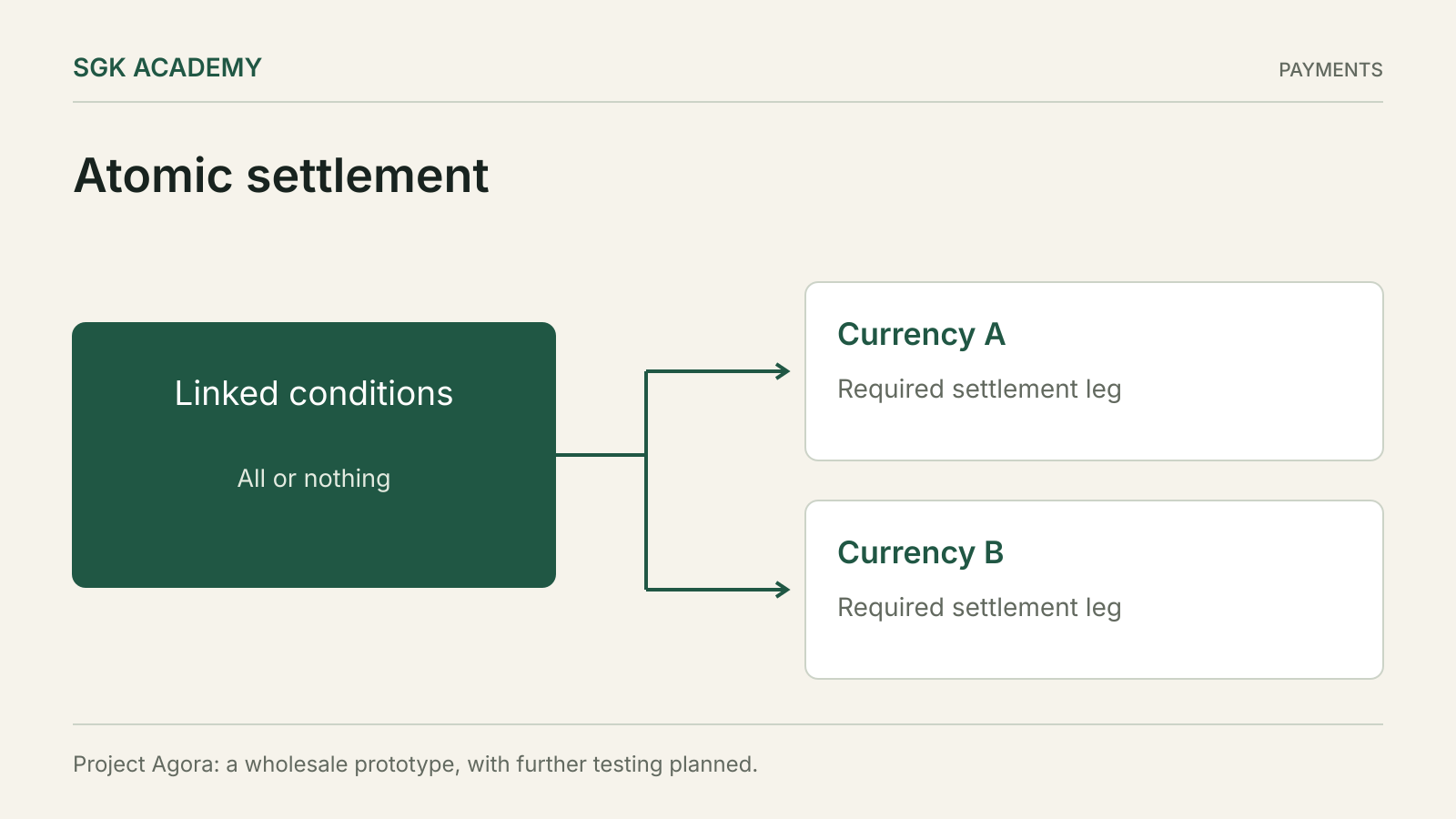
An atomic design aims to make the relevant linked settlement occur on an all-or-nothing basis. Either the required conditions are met and the linked movements complete, or they do not complete in that form.
This does not mean that every preliminary step happens instantly. Participants still need the necessary funds, valid instructions and satisfied conditions. Atomicity describes how the linked settlement is coordinated.
The distinction matters when reading a claim that a payment is faster. Ask which part became faster and whether the claim concerns messaging, execution, settlement or the final availability of funds to a customer.
What the May 2026 prototype established
The BIS and Institute of International Finance announced the findings on 27 May 2026. The collaboration involved seven central banks and more than forty private-sector financial institutions.
The announcement says the prototype demonstrated the possibility of atomic wholesale cross-border settlement using tokenised reserves and deposits. It also describes work on privacy, interoperability and legal finality across participating jurisdictions.
The project intends to advance testing, including real-value transactions involving certain currencies and participants. The BIS explicitly describes its Innovation Hub projects as experimental.
Those statements define the boundary of the result. A prototype can show feasibility and identify requirements. It does not by itself establish production reliability, universal access, final commercial pricing or coverage of every payment corridor.
Reserves and deposits are different claims
Central bank reserves are held within the central-bank monetary system by eligible institutions. Commercial bank deposits are liabilities of commercial banks to their customers or other relevant holders. They are not the same instrument.
Project Agora uses tokenised representations of these forms of money within its design. The BIS announcement states that the contemplated tokenisation does not change their legal character or associated obligations.
That is important for understanding the project. It is not simply replacing every existing claim with a new privately issued coin. The design seeks to coordinate forms of bank money while retaining relevant institutional roles.
For an ordinary business customer, access to the infrastructure would still be mediated through the applicable services and institutions. A technical description of tokenised reserves does not imply that a small company can open a reserve account.
Follow an illustrative transaction through the design
Imagine a wholesale transaction involving a euro payment and a corresponding payment in another currency. The participants first need to agree the transaction terms and ensure that the relevant balances and permissions are available.
The system can then check the conditions attached to the linked movements. An all-or-nothing settlement mechanism aims to prevent one required leg from completing independently while the other fails within that atomic operation.
After settlement, customer-facing systems still need to update records, provide confirmation and make the appropriate funds available under their service arrangements. Those surrounding processes affect the experience of the ultimate payer and recipient.
| Stage | Question being answered | What atomicity does not automatically supply |
|---|---|---|
| Transaction agreement | Who pays what, to whom? | A competitive exchange-rate quote |
| Validation | Are instructions and conditions acceptable? | Missing customer information |
| Funding | Are the necessary balances available? | Credit or liquidity for every participant |
| Linked settlement | Do the required legs complete together? | Universal system availability |
| Customer service | Can the recipient use the funds? | A particular retail price or support standard |
The table separates functions so that a benefit in one stage is not mistaken for a solution to every stage.
Liquidity still has to be available
Atomic settlement can change how risk is managed, but it does not create money for a participant that lacks the required funds. Funding and liquidity arrangements remain important.
If a transaction requires several conditions to be satisfied at once, an unavailable balance or unresolved condition may prevent completion. That can be preferable to an exposed partial settlement, but it is still an operational situation to manage.
Participants need rules for queued, rejected or expired instructions. They also need to understand how the system behaves during periods of stress or heavy demand.
For a business reading about the project, the practical question is whether a future provider can offer predictable completion for the intended corridor and transaction type. A technical possibility should be translated into a service commitment before it informs a cash plan.
Compliance work does not disappear with tokenisation
Customer identification, sanctions obligations and other controls depend on law and the roles of the institutions involved. Tokenising the money does not remove those obligations.
The BIS announcement describes potential future capabilities as regulatory and data-sharing frameworks evolve. That wording matters: a possible enhancement is not the same as a completed, universally available process.
A shared platform may make certain information or checks easier to coordinate, but participants still need appropriate access, privacy and responsibility arrangements. A system cannot simply expose every customer’s information to every participant in the name of efficiency.
When assessing a future service, ask which information the business must provide and how exceptions are handled. A payment can still be delayed because a legitimate compliance question requires resolution.
Legal finality and technical completion must align
A ledger can record a transaction, but legal finality concerns whether the transfer has the required effect under the applicable law. Cross-border systems must consider more than one legal framework.
The May announcement says legal analysis found settlement finality achievable across the seven participating jurisdictions. It also says further work is needed to define technical, operational and contractual requirements aligned with those frameworks.
Both parts belong in the explanation. Reporting only “finality achieved” would omit the remaining implementation work. Reporting only the uncertainty would omit the prototype’s substantive result.
For users of a future service, the relevant documents would need to explain when a payment is final, what happens during failure and which institution is responsible. Those are service and legal questions alongside the technology.
Privacy is an operating requirement
Institutions need enough information to perform their roles without unnecessary exposure of balances, customer details or commercial relationships. The prototype explored privacy at both balance and transaction levels.
That does not mean every participant sees nothing. Privacy design involves deciding who needs which information, under what authority and with what safeguards.
A business should ask how its data is used, retained and shared in the actual payment service. A project-level statement about privacy is not a substitute for the provider’s terms and operating design.
The same principle applies to auditability. A system can need a reliable record for reconciliation and oversight while limiting access to that record. Those objectives should be designed together.
Compare a future service with the route you use today
If an Agora-related service eventually becomes available to your business, compare the complete transaction. Use the same amount, currencies, destination and required arrival date.
Ask about the exchange-rate quote, explicit charges, intermediary deductions, rejection handling, refund or return procedures and the time when the recipient can use the funds. Do not compare a prototype’s settlement time with a bank’s full customer-service time.
Also assess integration effort. A faster underlying rail may still require changes to treasury systems, reconciliation and approval procedures. The benefit should be measured after those costs.
For small businesses, reliability and clear support may matter as much as a marginal reduction in settlement time. The relevant metric is whether the payment reaches the intended recipient predictably at an understood total cost.
Read the next announcement with specific questions
The next useful evidence would include the scope of real-value testing, participating currencies, operating requirements and results under realistic conditions. Later commercial services would need their own terms and performance evidence.
Keep experimental findings, production deployment and customer availability as separate milestones. A project can make progress without having reached the last stage.
Avoid using the announcement as a reason to buy a token or invest in a company with a loosely associated narrative. The BIS release concerns payment infrastructure research, not an investment recommendation.
The project gives readers a clearer vocabulary for evaluating payments: the claim being transferred, the conditions for settlement, the point of finality and the route to usable funds. Those questions are useful even when the current payment still travels through conventional infrastructure.
Keep payment status distinct from finality
A customer interface may display submitted, processing, completed or another status. The meaning of those labels belongs to the service contract and operating design. A successful API response may confirm receipt of an instruction without confirming final settlement.
For any future service built on the project, ask which event produces the status shown to the customer and how failures are reported. Reconciliation should use a transaction identifier that connects the instruction, settlement and customer-account entry.
That distinction can prevent duplicate payments. If a request times out, resubmitting it without checking the original status may create another instruction. Faster infrastructure still needs clear status handling and a supported way to investigate uncertain outcomes.
Questions
Is Project Agora a retail payment app?
No. The May 2026 announcement describes an experimental wholesale cross-border payment prototype and plans for further testing.
What does atomic settlement mean?
It means the relevant linked settlement is designed to complete on an all-or-nothing basis when the required conditions are satisfied.
Does tokenisation remove bank and compliance obligations?
No. The BIS states that the contemplated tokenisation does not change the legal character or obligations of reserves and deposits.
Does the prototype prove cross-border payments will be free?
No. It does not establish a universal retail price, commercial service or complete elimination of operating costs.